
[ad_1]
As the decorator of the Crystal Palace in 1851, Jones drew inspiration from the ornament of the Alhambra and placed particular emphasis on colour. As the critic Lothar Büchner observed that same year: “I had the impression that the raw material with which architecture works was completely dissolved by colour. The building is not decorated with colour, but constructed by colour.”
In the 1890s, exhibitions of Islamic art followed one another in Paris, culminating in the exhibition held at the Pavillon de Marsan in 1903.
In 1910, Matisse visited the major exhibition of “Mohammedan art” in Munich. Looking back on the experience in an interview with the art critic Jacques Guenne, he later recalled: “I felt within myself the passion for colour begin to grow.” That same year, while travelling in Germany, Le Corbusier attended the Secession exhibition in Berlin, where he noted that there were “two things” by Matisse (including Marguerite au chat noir) that appealed to him, “because of their beautiful colour, their synthesis.” During the winter of 1911 and the spring of 1912, the painter settled in Tangier, while the architect embarked on his journey to the Orient.
Colour had by then become an instrument of modern rationalism. In 1896, Frantz Jourdain invited the architects Henri Sauvage, François Garas, and Henri Provensal to exhibit at the Galerie Le Barc de Boutteville, known for its focus on Post-Impressionist and Nabi painting. The exhibition he organised, titled “Impression d’architectes”, presented no architectural projects as such, but rather spaces created through intense colour. Early rationalist architects, such as Auguste Perret, likewise played with the colour of construction materials while simplifying decorative motifs.
In 1903, Frantz Jourdain founded the Salon d’Automne, whose exhibitions accompanied the artistic ruptures then underway. Henri Matisse served on its governing committee, alongside several former students from Gustave Moreau’s studio at the École des Beaux-Arts. Charles Plumet was responsible for the overall scenography of the Salon.
When Julius Meier-Graefe published The Development of Modern Art in 1904, five years after opening his gallery, he titled the final chapter “The New Rationalism”, which he defined as a movement seeking to “modernise the old through the abstraction of ornament”. He then listed the most significant figures of the decorative arts, among them Plumet and the protagonists of L’Art dans Tout. Meier-Graefe also reproduced Matisse’s La Dame au chapeau vert, a work barely completed, shown at the 1905 Salon d’Automne at the centre of Plumet’s scenography—a Fauvist manifesto, a “pot of paint thrown in the public’s face”.
When Matisse painted Interior with Eggplants in 1911, the lattice of ornamental floral motifs and the matte tempera colours created the effect of wallpaper, of the “wall decoration” the painter himself sought. He travelled to Morocco, Spain, and Russia. He collected fabrics, fragments of tapestry, toile de Jouy, Persian carpets, Arab embroideries, African hangings, cushions, curtains, shawls, costumes, and screens. He referred to this collection as his “working library”.
Alongside paintings and sculptures, the Salon d’Automne also presented furniture, textiles, and wallpaper designed by French decorators. Charles Dufresne, André Groult, Jean-Louis Gampert, Louis Süe, André Mare, Paul Follot, and Édouard Bénédictus drew on the national tradition of the seventeenth and eighteenth centuries, borrowing its qualities of clarity and order as well as its recurring motifs—baskets of fruit and garlands of flowers. The path was thus opened for the naïve, brightly coloured floral designs of the Atelier Martine, founded in 1911 by Paul Poiret. It was in the couturier’s workshop, moreover, that Matisse designed an emperor’s coat, a stage costume commissioned by Serge Diaghilev. Floral motifs were everywhere, forms simplified, and colour took precedence. Decorators displayed “an attachment to pictoriality [that] asserts itself through the use of vivid, vehement colours… They are more concerned with impression than with form; they create what might be called an atmosphere for the interior.” (Léandre Vaillat, “L’art décoratif au SA”, 1911).
The Salon d’Automne affirmed the collaborative dimension that shaped the creation of modern interiors. In 1911, André Mare exhibited works by Raymond Duchamp-Villon, Jacques Villon, and Fernand Léger within his interior installations. The Maison cubiste, presented in 1912, invited visitors to step into a bourgeois salon. Against Gampert’s floral wallpapers hung the Cubist canvases of Léger and Jean Metzinger.
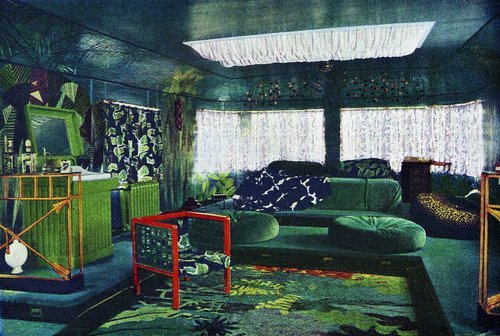
Intense colours—vivid orange, brilliant green, cobalt blue—covered the walls of these rational interiors. In 1910, Frantz Jourdain invited members of the Munich Werkbund to present their work at the Salon d’Automne. No décor: colour.
The German displays triggered a reaction among French decorators. More than anyone else at the time, Francis Jourdain pushed the idea of interior design to its most radical simplicity with his “interchangeable furniture”, a combinatory system of modular elements—economical pieces produced and distributed by the Ateliers modernes (1911).
[ad_2]
Source link
Other Articles

Anna Condo: between photography, visual art and AI
No Comment! Be the first one.