
[ad_1]
Four artists trace the visual lineage of Los Angeles graffiti, from Cholo writing and street photography to calligraphic abstraction, murals and contemporary West Coast culture.
Four visionary artists, one exhibition, and more than half a century of graffiti history. Los Angeles: A Visual Lineage at Woodbury House in London celebrated the vibrant legacy and far-reaching influence of LA’s graffiti scene. The show reveals how West Coast styles have shaped photography, paintings, murals, and streetwear, spotlighting their evolution and the intricate visual stories woven by each artist.
This exhibition showed how the ‘L.A. Lifestyle’ has changed over time, with each generation shaping styles in different media. It mixed LA street culture with cholo lettering, calligraphy, and other cultural influences. The featured artists were Charlie ‘Chaz’ Bojorquez, Estevan Oriol, Alex ‘DEFER’ Kizu, and Marquis ‘RETNA’ Lewis.
Chaz Bojorquez stands as a pioneer in the graffiti world and is often referred to as the ‘Godfather’ of the Cholo writing style. He began as a tagger in East Los Angeles, inspired by Chicano culture in the early 1940s, when writing on walls with paint was known as ‘placas,’ a practice used to claim territorial dominance.
“To me, ‘Cholo’ represented the idea of unity, identity, and respect to my community.”
Bojorquez’s early exposure to art came from Leo Politi, an Italian muralist who worked in Downtown Los Angeles and South Pasadena. At fourteen, Bojorquez took painting classes for two years. Upon graduating high school, he attended Chouinard Art School, now called CalArts, and studied Japanese calligraphy in Pasadena. He refined these skills and, in 1969, created the stenciled image Señor Suerte (Mr. Lucky), a skull with a New York-style fedora and fur coat at the Los Angeles River.
Bojorquez later travelled for three years, mastering writing styles in 35 countries, including commercial design, glyphs, tattoos, and typography. He studied newspapers to further understand writing. In 1980, convinced that graffiti belonged on canvas, he began creating a unique style of writing that embodied the cultural aspect of cholo phenomenon, as well as old English typography and Asian calligraphy.
At Woodbury House, his collection spans the 1990s through the 2020s. During this period, Bojorquez explored techniques to build multiple layers of writing styles that create visual illusions. While most paintings are black and white, some incorporate deep gold, blue, and green tones.
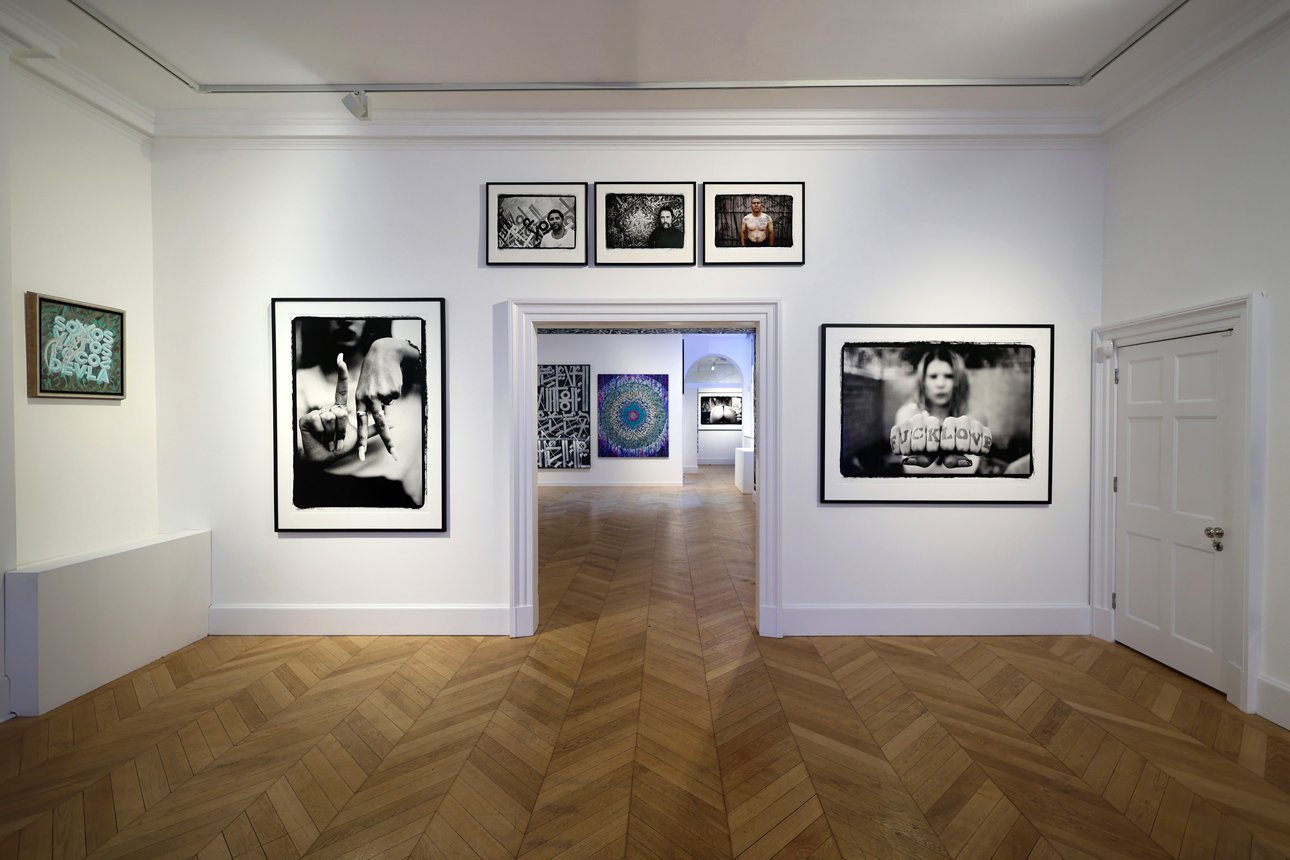
Bojorquez’s painting P./V. FOR LIFE features light blue and white acrylic lettering spelling out ‘Somos Vatos Locos DE V LA,’ set against a background of dark grey Zolatone paint and a vibrant green hue that emphasises dark strokes, complemented by a silver spray can on stencil paper.
LET THE CONVERSATION DESCRIBE THE COMPOSITION is a whimsical piece that shares stylistic similarities with P./V. FOR LIFE, but with gold lettering and feathering brush strokes that portray three birds circling the canvas. One bird stands out in dark blue, black, green, and gold.
Bojorquez now identifies as a cultural artist, and his work has appeared internationally at institutions such as the Smithsonian Institution, LACMA, MOCA, and the de Young Museum. He has contributed designs for brands like Nike, Converse, and Levi’s, and published books reflecting his work and life.
DEFER, Alex Kizu, is a graffiti writer who moved from street displays in Los Angeles to creating work on canvases and murals. He draws inspiration from his Japanese heritage and his upbringing in Boyle Heights, where he is recognised for freestyle calligraphy with abstract layering. DEFER has been part of the hip-hop and graffiti art movement in Los Angeles since the 1980s and is a founding member of the graffiti crews K2S, Kill to Succeed, STN, and KGB.
Over the years, he has collaborated with companies including Apple, Facebook, Beats by Dre, Jordan, and the L.A. Lakers. DEFER’s art is best described as fine art that fuses cultural and urban influences, featuring intricate lettering, bright colours, markers, spray paint, acrylic, and gouache.
This isn’t DEFER‘s first time at Woodbury House. In 2023, he had his UK debut with a solo exhibition in London, Spiritual Language. This year, he displayed works both ancient and futuristic, “hybrid calligraphic hieroglyphics.”
One piece, City of Champions on canvas, is painted in blue, green, and white acrylic, colours associated with Los Angeles city pride. The acronym LA is written in Gothic calligraphy with striking fine lines.
The City of Angeles, Soul Assassins features grunge fine lines and brush strokes in the background, creating a futuristic effect. His collaborative piece with photographer Estevan Oriol, LA Hands, 2011, was also included. It combined the evolution of their artistic work.
“I wanted to represent the vibrant and enigmatic subcultures of Los Angeles, in which Estevan Oriol has photographed throughout the decades.”
His collection captures the essence of a deep connection to Los Angeles roots, creating a unique style of artistic writing.
Estevan Oriol is an internationally recognised photographer, director, and urban lifestyle entrepreneur with over thirty years of experience. Before discovering his passion for photography, Oriol began his career in the late 1980s as a bouncer at hip-hop clubs in Hollywood. By 1992, he worked as a manager for the rap groups House of Pain and Cypress Hill.
At that time, his father, the world-renowned photographer Eriberto Oriol, noticed Oriol’s cultural influences and artistic side and gifted him a Minolta with a 50mm lens. While touring, Oriol took his Minolta and other film cameras and began documenting life on the road.
During downtime, he devoted time to capturing the neighbourhood identity of Los Angeles. That included Chicano culture, gang life, tattoo communities, and lowrider scenes, in which he was also part of his car club in East L.A.
In 1994, Oriol began working for magazines, including Big Time Magazine in 1998, a graffiti-focused publication. Perhaps one of his most prominent photographs is the LA Hands gesture modelled by a Latina, a universal symbol in Los Angeles that not only represents the city but also expresses street culture, especially in the Chicano community.
At the Woodbury House, Oriol shared works from 2005–2020, including portraits of gang members, lowriders, Downtown Los Angeles city landscape, a candid photograph of armed LAPD officers, Homeboy Stand-Off, including portraits of DEFER, Chaz Bojórquez, and RETNA.
“Being born and raised in one of the biggest and most influential cities in the world has been an incredible journey. I couldn’t have asked for a better way to be shaped.”
Since then, Oriol’s career has included photographing celebrities and contributing to music videos. He also published photography books, This Is Los Angeles Hb: This Is Los Angeles, L.A. Portraits: Volume 1 Hb: L.A. Portraits, L.A. Woman, and Back to Back: From Backyard to Boulevard, and even directed Cypress Hill: Insane in the Brain, Netflix documentary LA Originals, and If the Shoe Fits.
RETNA, Marquis Lewis, is a contemporary artist based in Los Angeles, known for his graffiti and street art. His career began in the 1990s, creating bold, unique typography and lettering, working with spray paint and brushwork, and script inspired by a mix of Blackletter, Egyptian hieroglyphics, Arabic, Hebrew calligraphy, and traditional street graffiti.
His artistic themes often refer to his multiculturalism, African-American, Spanish, Cherokee, and Pipil identity, as well as incorporates musical ambient soundscapes into his creative process. In fact, his artistic name, RETNA, was inspired by Wu-Tang Clan’s ‘Heaterz,’ and much of his fine art is elaborate line work, complex layering, and a wide range of colours.
His works have been exhibited globally and featured in prominent collections, including the Los Angeles County Museum of Art, LACMA, and the Museum of Contemporary Art, MOCA, Los Angeles.

Courtesy of Woodbury House
What does the idea of a “visual lineage” in Los Angeles mean to you personally?
Chaz Bojórquez: I believe that the most important artists are the ones who are ‘Influential’, artists who inspire and encourage other artists or movements through time. I was the first to use a plastic stencil to leave my tag in 1969, also using graffiti text as the subject of a painting. Many artists have followed my concepts of graffiti art and others followed them, together we’ve created a world movement. The L.A. graffiti style has had a long tradition of one letter type, all capital letters. The same formats or layouts and always in black paint, those traditions are still used and respected today. Everything I know comes from my experiences living in Los Angeles over seventy years.
See also


Courtesy of Woodbury House
How do you see your work in dialogue with the other artists in this exhibition?
Chaz Bojórquez: I’m a generation or more older than the other artists, so my vision and experience with Cholo style graffiti has changed the way I paint over the years. l now see graffiti paintings in different styles, like lines of Roll Calls or Mandala circles, these are compo positions I first painted 30-40 years ago, but we all ‘still’ in the same movement, the west coast movement never dies. All the artists in L.A. reference the ‘Lifestyle’ that was in Los Angeles before us and will continue after us. All our styles are fundamentally similar because we all come from the same ‘Graffiti Fathers’ but different Cholo ‘Mothers’.
Are there any UK-based artists or creative movements that you find interesting or inspiring?
Chaz Bojórquez: In the last few years, the world graffiti movement split up into two parts, one called ‘Calligraffiti’, which is letter-based artwork and writings. The other form is ‘Graffuturism’ using abstract forms and colors. Many of these movements came out of the London, inspired artists like Remi Rough and the American artist Augustine Kofie and the stencil work of Banksy have contributed a lot to Graffiti.
Can you tell me about the work you presented in Los Angeles: A Visual Lineage? What themes or ideas are you exploring in these pieces?

Courtesy of Woodbury House
Estevan Oriol: It starts with three portraits of the other three artist I’m in the show with, Chaz, Defer, and Retna. I felt that would be one way to show how I’m also tied to them for people who don’t know the full story. I’ve known all three of them since the 90’s and have shot and documented them multiple times throughout the years as well as Risky and Carlos Torres.
I printed three of my cLAssick iconic fotos large format, a set of street life and lowriding fotos, and I also brought some collabs I did with Defer, Risky, and Carlos Torres, painting on top of my silkscreen prints of the L.A. hand foto I did in 1994. The screenprints were printed by a good friend of all of ours named Richard Duardo R.I.P., from his company called Modern Multiples. I thought it was a good collection to show the city we live in and during the times some of the works and styles came from. Los Angeles has a strong history of graffiti and street-based visual culture, particularly within Chicano communities.
Estevan Oriol: My first exhibition in London was in old brick lane September of 2000, and I have been in a few exhibitions throughout the years since then the last one in February 2023 at the beyond the streets at Saatchi Gallery. That being said my work has been out here for years, but the experience with Woodbury House has been amazing.

Courtesy of Woodbury House
How did growing up in Los Angeles shape your approach to your work, whether through painting, photography, or other forms of visual expression?
DEFER: Growing up in Los Angeles greatly influenced my artistic practice. I remember seeing some great murals around where I was growing up as a youth in Boyle Heights by the LA Streetscapers and artists like Willie Herron and some of the Chicano Placasos that were really visible during some of LA’s historically turbulent times.
How has your artistic practice evolved over time? Have you noticed a shift in your visual language from when you first started to now?
DEFER: I feel that there has been a vast evolution in both my artistic practice and visual language. Initially I started doing art on the streets in the 80’s doing graffiti. Throughout the years – I also honed my skills using the brush and acrylic paints to create both large scale murals to works on canvas. I also explored the realms of abstraction and layering my works of art to create a dreamlike state.
This exhibition captured the spirit of Los Angeles culture, bringing together artists who shared a vision and showcasing art that reflected their style and love for the city. Although the exhibition ended on April 24, 2026, most works remain part of the collection, extending its presence at Woodbury House in London.
“If graffiti had a soul, what would it talk about?” – Chaz Bojorquez.
©2026 Woodbury House, Chaz Bojorquez, Estevan Oriol, DEFER, RETNA

Cristabell Fierros is a Los Angeles-based freelance journalist covering visual culture, community, arts, food, identity, and music. Born and raised in East Los Angeles, her work focuses on stories rooted in local culture and creative expression. She is an alumna of the University of the Arts London. Her writing has appeared in Artefact Magazine, The LA Local, Knock LA, and Music Is To Blame.
[ad_2]
Source link


No Comment! Be the first one.