
[ad_1]
Writing on the politics of jazz and the jazz of politics is not only an honor, it’s a duty. On some occasions, consciousness-raising, justice-seeking jazz is made purposely with force and ire, as is the case with the career of bassist-composer David Ambrosio, whose beyond-music résumé as an activist is arm’s length and continues into the present with his just-released Civil Disobedience, an album of anthemic songs speaking to the history of spirited civil rights activism.
On other occasions, the fight is waged in more subtle fashion, by jazz composers telling a civil rights tale with musical-theatrical works such as We Shall Someday, a story so directly related to the present that I can see it over my laptop, right now on CNN.
 Freedom Riders
The world premiere cast recording of the long-in-development, recently staged We Shall Someday musical — with book and lyrics by Harrison David Rivers and music and additional lyrics by Ted Shen — commemorates, nearly to the day, the May 1961 start of the Freedom Rides. These bus trips, taken by Black and white activists, challenged segregation in interstate bus travel and facilities through the South. The desegregation of those Southern bus terminals in November of that same year is directly related to the voter redistricting currently happening throughout the United States.
“Everything we are celebrating now in regard to those Freedom Rides, then, is in danger of being reversed,” says Shen, who, with Rivers and the cast of We Shall Someday, has been travelling with the last living Freedom Riders to make sure civil rights remain paramount in people’s minds as we head into the midterms. “We’re running our show to demonstrate hope and portray resilience.”
Rivers’s motto for their current trek across the States, and how the real and theatrical message of We Shall Someday must get pushed out to audiences by any means necessary? “Get back on the bus.”
While it would be enough, maybe, to tell JazzTimes readers that the score to We Shall Someday is richly jazz-infused with its righteous poetic, politicized texts scored to jazz’s rhythms and orchestrations, it’s important to note that its composer, Ted Shan, is a longtime jazz guitarist and bassist who has been down this road before with his soulful post-bop songs and score for his 2011 musical, A Second Chance.

“I didn’t intend to write a jazz musical or jazz opera” notes a soft-spoken Shen, who states that he is retired from playing jazz live (he’s also a retired investment banker). “My musical contribution has always, I felt, been in service of the narrative, its characters. I write in order to move a story forward. It just so happens that Harrison’s writing has a combination of rich characterizations and a propulsion that exists from his monologues’ format.”
The propulsiveness of jazz was a natural, Shen continues: There was always this left-handed bass line and the story was always moving forward. It’s not as if we had dialogue, then stopped to sing a song, then returned to more dialogue. The music is pushing through, continuously, seamlessly. The other thing is with the richness and complexity of Harrison’s characters and their monologues, pop music would not have worked, would not have served or brought out his stories or his people — not as the more complex harmonies of jazz could.”
Rivers, who recently wrote the libretto for the new opera My Name is Florence in dedication to pianist-composer Florence Price, said that the prompts given for each character’s monologues — be they ten, 20 or 30 minutes long — was geared toward momentum, literal and figurative.
“These characters each were going to change the world in some way,” says Rivers. “Being given lengths of 30 minutes for a dialogue, I could go wherever. Something intimate. The storytelling became circular. It just poured out. I didn’t have to think about text or rhythm or music.”
And to that end, the music and lyrics of We Shall Someday, and the manner in which the book writer-lyricist and the composer collaborate, is free-flowing and “organic,” in Rivers’ humble opinion. “The organic nature of how Ted composed all the music to whatever I gave him was conducive to jazz. The way that we move from human speech to human song feels like jazz. The emotion of jazz. The syncopation of jazz. All of that felt like synchronicity to me. Whenever I sent Ted text, whatever he sent me back, it all felt as if it was holding hands with each other.”
 Elevating the Vibration
New York–based composer, bassist, bandleader and educator (groups include 40Twenty, Grupo Los Santos and the David Ambrosio/Russ Meissner Sextet) doesn’t seem as if he’s holding anyone’s hands when he makes his particular brand of cutting, conscious jazz with his name above the fold.
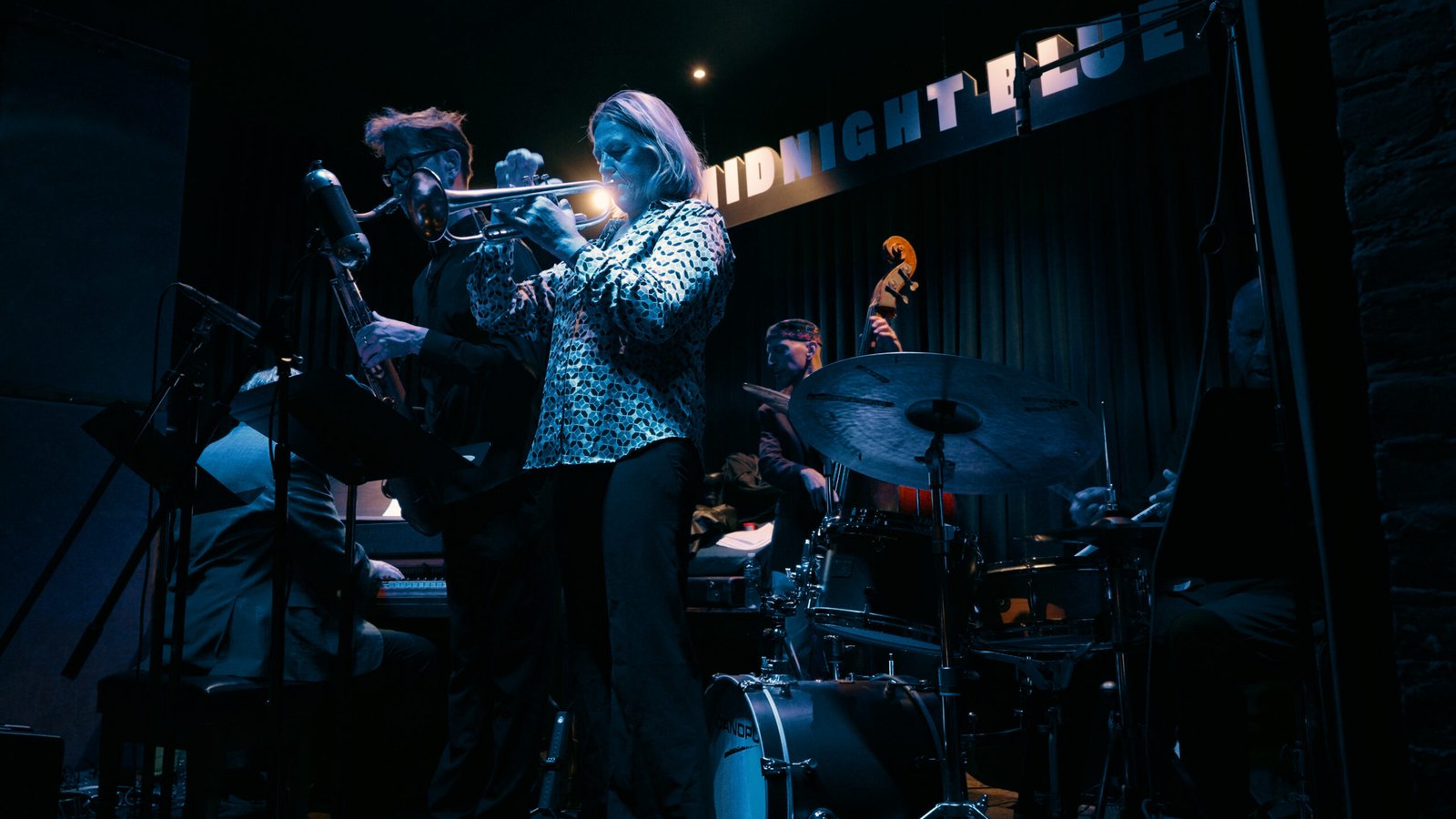
That is particularly true of the smoky-sounding Civil Disobedience, an album and a band, respectively produced and led by Ambrosio with saxophonist Donny McCaslin, trumpeter Ingrid Jensen, pianist Bruce Barth and, most poignantly, drummer Victor Lewis who has retired from playing since these sessions.
Culled from Blue Note–era material coinciding with the Civil Rights Movement and the grief and anger surrounding the assassination of Dr. Martin Luther King Jr., Ambrosio chose a disobedience-driven list of Black composers such as James Spaulding (the MLK tribute “A Time to Go”) and Harold Land (“Poor People’s March,” dedicated to the nonviolent protest of the Poor People’s Campaign of 1968) in which to weave his jazz-activist tapestry.
“When I first heard these compositions, they struck me as a listener because they have that energy and sound of Blue Note from the ’60s,” Ambrosio says, “but they were so unique, so modern, so fresh — compositionally reminiscent of music I was playing with my contemporaries here in Brooklyn.”
As an activist interested in progressive movements, he adds, “I could inherently feel the power and emotion in the songs. Once I looked deeper and saw the bigger context of ‘Poor People’s March’ and ‘A Time to Go,’ and how these pieces missed their moment in history by not being released at time they were written, I felt the calling as an activist and an artist to share this music… especially since American and the world are experiencing essentially many of the same issues now.”
Communal in a way that’s challenging for all, Ambrosio claims, “We are all activists in every moment of how we live our lives.” This includes the personnel of Civil Disobedience, musicians he’s worked with and been connected to for some time.

“The one exception was Victor Lewis, who I had not played with before this project,” notes Ambrosio. “I was always so inspired by him as not only a drummer but a composer and band leader. I sensed that he was the perfect person for this band, and that became apparent to me during the first discussion we had about it. He is part of the history that embodies this project.”
Ambrosio also speaks of the inspiration of King and his speeches, the likes of which “elevate my vibration in the hope that I can be even a small part of carrying these profound timeless messages for our society.”
As an activist, Ambrosio has a money-where-your-mouth-is list that requires its own résumé, including Food & Water Watch NYC volunteering and civil disobedience actions, urban farming and working to open debates to additionally balloted candidates.
“For the longest time I felt like I had two lives, my life as a musician and my work in the community and activism,” says the bassist. “Of course I could feel the connection between them, but it wasn’t until the creation of this project, through the discovery of this music, that I was really able to feel the union of these energies in my life. To be able to share the messages of past protests such as the Poor People’s Campaign and align them with life for all of us today, through the connective effect of music, is such a beautiful space in which to create community. It’s a joyful way to create awareness and have conversations about a movement that is still alive today and so needed. Peace, harmony, beauty, moral courage and love are at the core of any civil disobedience act, and jazz embodies these principles.” JT
[ad_2]
Source link

No Comment! Be the first one.