
[ad_1]

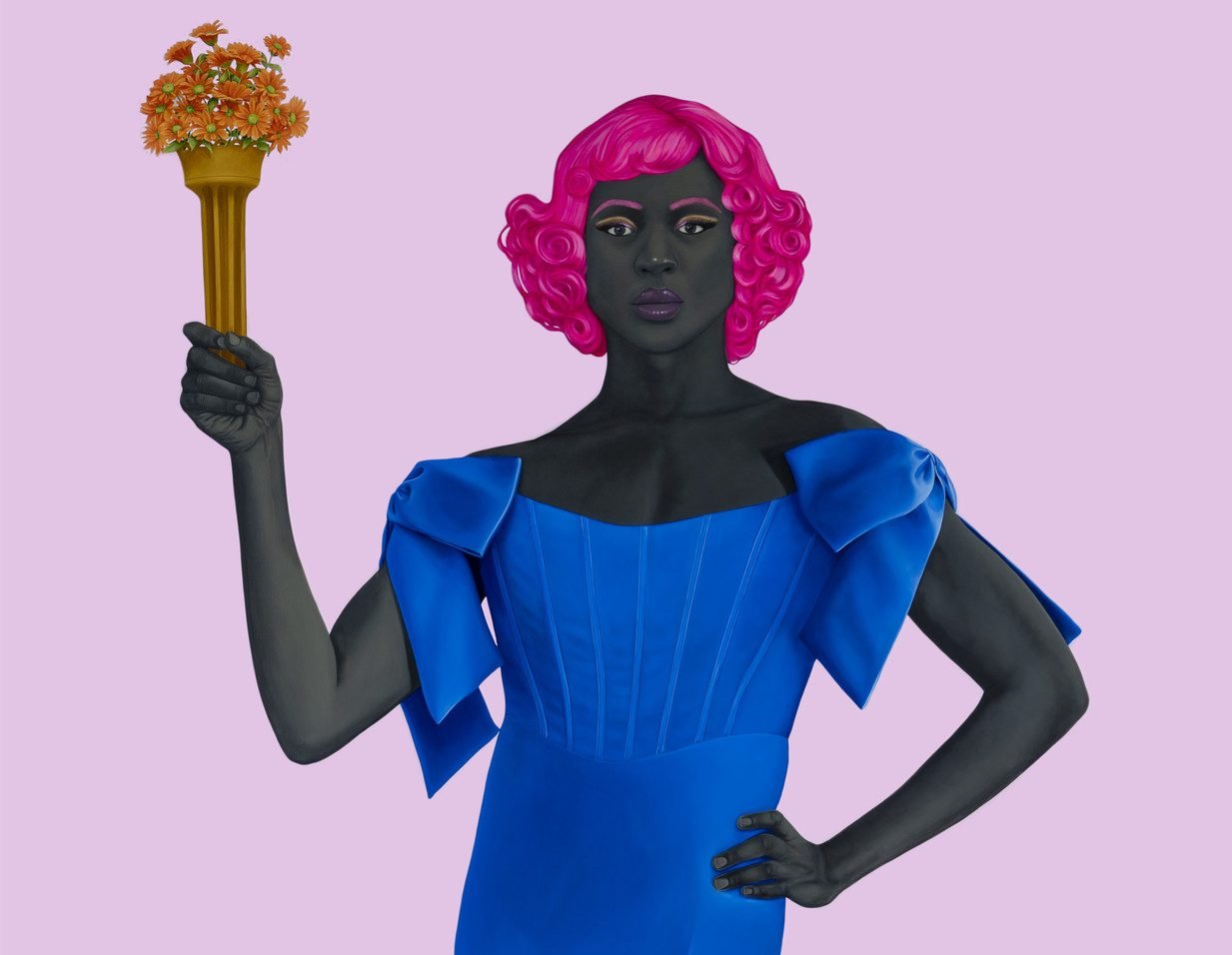
Artist Amy Sherald has announced her decision to cancel her upcoming exhibition at the Smithsonian National Portrait Gallery in Washington, D.C.—a presentation that would have marked the institution’s first extensive solo show by a Black artist. The move follows her discovery that the museum was considering removing or negatively contextualizing Trans Forming Liberty from her widely acclaimed major survey, “American Sublime,” which debuted at SFMOMA and is at the Whitney for another two weeks.
“As a painter, I believe in portraiture’s power to witness, to dignify, and to insist on presence—especially for those too often rendered invisible,” Sherald writes in the statement her studio shared with Observer. “We live in a society with a selective memory, one that frequently overlooks lives at its margins,” she continues, explaining that internal concerns had been raised about the inclusion of the painting, which features model Arewà Basit clad in a blue gown and holding a bouquet of orange daisies aloft. “While no single person is to blame, it’s clear that institutional fear—shaped by a broader climate of political hostility toward trans lives—played a role. This painting exists to hold space for someone whose humanity has been politicized and disregarded. I cannot in good conscience comply with a culture of censorship, especially when it targets vulnerable communities.”
Sherald’s withdrawal marks a turning point for artists confronting political interference, as mounting tensions continue to reshape Washington’s museums. At a moment when transgender people are being legislated against, silenced and endangered across the U.S., she made it clear that silence is not an option. “I stand by my work. I stand by my sitters. I stand by the truth that all people deserve to be seen—not only in life, but in art.”

Sherald’s rising profile and the core messages embedded in her practice—and in “American Sublime”—stand in stark contrast to the ideological shifts now reshaping the Smithsonian complex and other federally funded D.C. museums, particularly since the start of the Trump administration. Exhibitions are now subject to review by the White House, which has argued that the direction taken by these institutions in recent years undermines “the greatness of our nation or the millions of Americans who have contributed to its progress.” Those claims stem from Trump’s March 2025 executive order, Restoring Truth and Sanity to American History, a directive aimed at purging what he calls “improper ideology.” While the order explicitly targets the Smithsonian, its reach also extends to monuments and memorials under the jurisdiction of the Department of the Interior, according to the Congressional Research Service.
Although the Smithsonian is not technically a federal agency, it operates under the oversight of a Board of Regents, as mandated by Congress upon its founding in 1846. The current board includes the Vice President, the Chief Justice of the United States, six members of Congress and nine citizen regents. The institution also receives roughly two-thirds of its $1 billion annual budget from the federal government—funding that now serves as a lever for expanded political oversight.

On June 13, Kim Sajet—who had led the Smithsonian’s National Portrait Gallery since 2013—announced her resignation, days after former President Trump publicly claimed he had “fired” her over her support for DEI initiatives, describing her as “a highly partisan person, and a strong supporter of DEI, which is totally inappropriate for her position.” As one of his first executive actions upon taking office for a second term, Trump signed Executive Order 14151: Ending Radical and Wasteful Government DEI Programs and Preferencing on January 20. The order mandated that all federal agencies terminate activities related to diversity, equity, inclusion and accessibility, including the immediate closure of all DEI offices and the removal of DEI-related language from federal contracts and grants. Following Sajet’s departure, Kevin Gover, the Smithsonian’s Under Secretary for Museums and Culture, was named acting interim director of the National Portrait Gallery.


Meanwhile, more provocative responses to the administration’s machinations in the cultural sphere have not been in short supply. Earlier this week, artist provocateur Andres Serrano (best known for his “blasphemous” Piss Christ) unveiled a Trump-centered proposal for the U.S. Pavilion at the Venice Biennale. It expands on his ongoing project The Game: All Things Trump, a sprawling, multi-dimensional installation composed of more than a thousand Trump-related objects, products and memorabilia—most acquired from eBay at a cost of at least $200,000. The trove includes everything from merchandise tied to Trump’s hotels, casinos and branding ventures to an 11-foot neon EGO sign salvaged from the Trump Taj Mahal’s EGO Lounge and a banner-sized portrait Serrano shot of Trump in 2004. The title references Trump: The Game, a Monopoly-style board game released by Milton Bradley in 1989.
“I don’t think in terms of messages but rather ideas that I put out into the world. My proposal can be read in different ways, as it should be,” Serrano responded cryptically when Observer asked what the final message might be and how he expects an international audience to interpret the work. “Personally, I think it’s an idea whose time has come. At this moment in history, who better to represent America than the President himself?”
The U.S. Pavilion artist remains unannounced, even as the world’s most important biennial looms less than a year away. The delay has raised growing concerns not only about potential censorship or nationalist instrumentalization but also about the feasibility of realizing work at this scale on such a compressed timeline.


[ad_2]
Source link
Other Articles

No Comment! Be the first one.