
[ad_1]
CLEVELAND, Ohio — In the world of art, some acquisitions aren’t just about expanding a collection—they’re about rewriting the map of scholarship and cultural understanding.
That’s exactly what happened this week when the Cleveland Museum of Art and New York’s Metropolitan Museum of Art announced they had jointly acquired more than 200 exceptional Chinese color prints from the 18th century, known as Suzhou prints.
It’s exciting news for both institutions, each of which will receive over 100 works that instantly transform both into global destinations for the study of this remarkable art form.
These vibrant works hail from Suzhou, a city long celebrated for its elegance, artistry and innovation. They come from the legendary collection of Christer von der Burg, widely regarded as the most comprehensive private holding of Suzhou prints in the world.
With this acquisition, the CMA and The Met have placed themselves squarely in the top tier of institutions preserving and interpreting a rare and unique chapter in Chinese art history.
Suzhou prints represent the pinnacle of Chinese color woodblock printing. China invented woodblock printing as far back as the 700s and developed multicolor printing techniques centuries before they reached Japan or Europe.
By the 1700s, this mastery reached its height in Suzhou, where artisans blended fine art traditions with technical brilliance.
But despite their beauty and sophistication, very few of these prints survive in China today—they were often preserved in European collections or treasured in Japan.
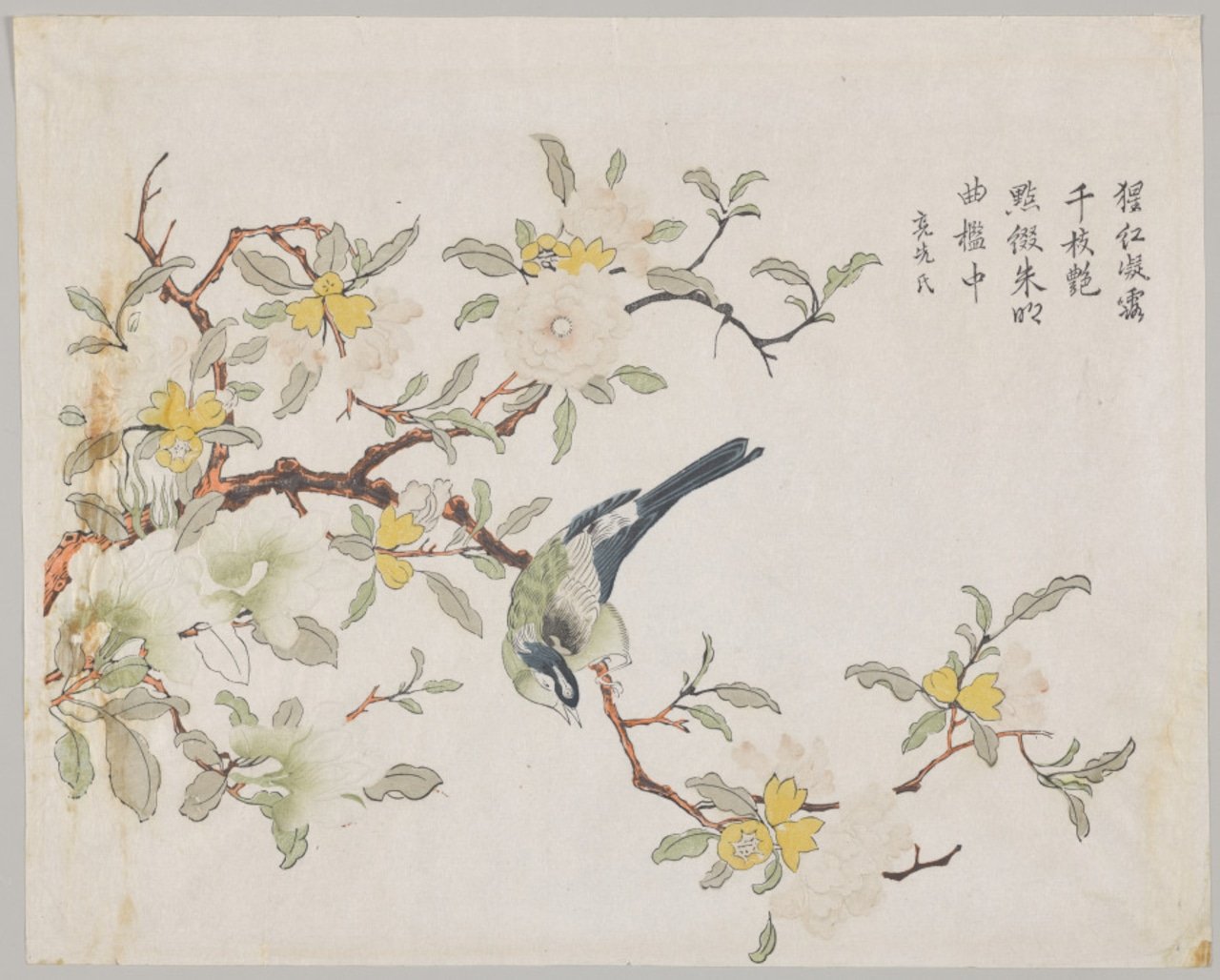
The subjects are as varied as they are striking: delicate birds and blossoms, sweeping architectural scenes, historic landmarks, elite women, gardens, games and even New Year’s prints.
Some were meticulously hand-colored, while others printed using sophisticated multiblock processes.
Many carry inscriptions—poems, artist signatures—linking them to the long and distinguished tradition of Chinese painting.
And then there’s the cross-cultural surprise: Suzhou prints frequently borrow from European visual techniques, especially linear perspective and shading.
While such influences had trickled into China’s imperial court centuries earlier, the rise of Suzhou prints in the 1730s and ’40s brought these techniques into the homes of the middle and upper classes.
The result? A distinctly Chinese art form that was also cosmopolitan—reflecting a global visual conversation centuries before the internet made such exchanges instantaneous.
This joint acquisition was handled with an eye toward balance and preservation. Curators from both museums worked side by side, ensuring that each collection now has representative works across all major subjects and styles, while keeping coherent series and sets intact.
“This acquisition is transformative for the Cleveland Museum of Art’s collection,” said Clarissa von Spee, the CMA’s curator of Chinese Art.
“These prints allow the museum to address China’s invention of printing—centuries before Gutenberg—and highlight the innovation of color printing with multiple blocks.”
The Met’s Joseph Scheier-Dolberg added that Suzhou prints are “some of the most vivid evidence we have of our interconnected past,” pointing to their popularity not just in China but also in Japan and Europe during the 18th century.
Visitors won’t have to wait long to see these works in person. The CMA will debut its selection in winter 2026 in the James and Hanna Bartlett Prints and Drawings Galleries, alongside other works on paper from the same period, putting Chinese innovation into broader historical context.
The Met will showcase highlights this fall as part of Chinese Painting and Calligraphy: Selections from the Collection (November 22, 2025–May 31, 2026).
In an era when museum collections are often built one piece at a time, it’s rare to see such a substantial, field-shaping acquisition—especially one that brings together two of the world’s most respected art institutions.
The CMA and The Met aren’t just adding to their holdings; they’re opening a new chapter in the story of global art history, one that invites us to see 18th-century China not as isolated, but as an integral part of a rich and ongoing cultural exchange.
If you purchase a product or register for an account through a link on our site, we may receive compensation. By using this site, you consent to our User Agreement and agree that your clicks, interactions, and personal information may be collected, recorded, and/or stored by us and social media and other third-party partners in accordance with our Privacy Policy.
[ad_2]
Source link
Other Articles

Dirimart opens largest commercial art space in Istanbul

No Comment! Be the first one.