
[ad_1]

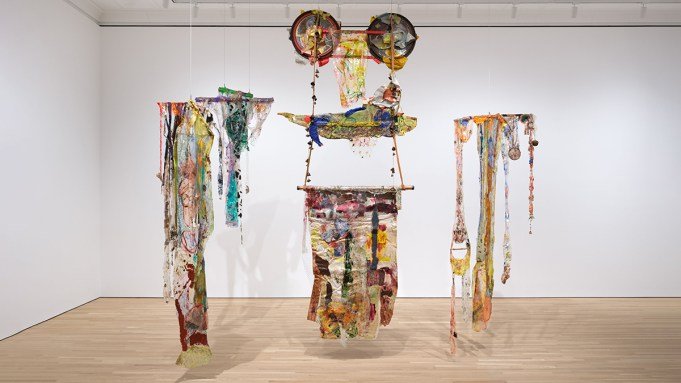
Courtesy of Ortuzar, New York
Art never takes a holiday, but the art world certainly does. Summer is traditionally a slow season, with collectors, dealers, and artists alike escaping to the Hamptons and other vacation enclaves. By Labor Day, they’re antsy for the fall lineup of exhibitions, typically among the most anticipated of the year.
This autumn promises to deliver, with must-see museum shows ranging from a rare stateside look at a pioneering French Impressionist to the first U.S. retrospective of an enormously influential Afro-Cuban artist. Mark your calendars now.
Above: Suzanne Jackson, Saudades, 2019–22
-
Seeing Silence: The Paintings of Helene Schjerfbeck

Image Credit: Finnish National Gallery/Yehia Eweis Metropolitan Museum of Art
December 5-April 5Little known in the U.S., the Finnish painter (1862–1946) could be this year’s big “rediscovery.” (Remember the Guggenheim’s eye-opening Hilma af Klint show in 2018-19?) In Schjerfbeck’s case, she was training in Paris by the time she was 18, lived her last decades reclusively in the Scandinavian countryside, and left behind a disarming oeuvre of modernist portraits and still lifes. Her early precise realism grew increasingly abstract over the years, though she never veered from representation. Like Mary Cassatt and Berthe Morisot, she excelled at painting women and children. And, in the tradition of some other greats—think Rembrandt, Frida Kahlo, Chuck Close—the visage she captured most compellingly and hauntingly was her own.
Above: Helene Schjerfbeck, Self-Portrait, 1912, oil on canvas
-
Wifredo Lam: When I Don’t Sleep, I Dream

Image Credit: Wifredo Lam Estate, ADAGP, Paris/ARS, New York
Museum of Modern Art
November 10-March 28The Afro-Cuban painter has become nearly synonymous with the tropics-inflected brand of Surrealism embraced by Caribbean and Latin American artists in the 20th century, yet this will be the first U.S. retrospective to cover his entire six-decade-long practice. The exhibition will trace Lam’s odyssey from the Cuban sugar-plantation town where he was born in 1902 to Spain, where he studied painting and fought the fascists, to Paris, where he befriended Picasso and André Breton, Surrealism’s chief theorist, and back to Cuba, where he sought to incorporate ideas about religion and colonialism into his work. With more than 150 pieces on view, it promises to be a major draw.
Above: Wifredo Lam, Les Invités, 1966, oil and charcoal on canvas
-
Suzanne Jackson: What Is Love

Image Credit: Courtesy of Ortuzar, New York San Francisco Museum of Modern Art
September 27-March 1Jackson has cut a wide swath through the arts in her 81 years, having at turns been a dancer, a gallerist, a poet, a costume designer, and a host of a weekly radio program about jazz. She has also long been a visual artist, and her colorfully dreamy “anti-canvases”—paintings made from thin, filmy layers of pigment supported by materials such as lace or netting and suspended from the ceiling—were highlights of the 2024 Whitney Biennial. Jackson is finally getting her first major museum retrospective, which will travel to the Walker Art Center in Minneapolis and the Museum of Fine Arts, Boston after its stint in San Francisco.
Above: Suzanne Jackson, deepest ocean, what we do not know, we might see?, 2021, acrylic wash, acrylic gel medium, acrylic detritus, crinoline, shredded mail, deer netting, textile pieces, wood, and D-rings, double-sided
-
Yoko Ono: Music of the Mind

Image Credit: Minoru Niizuma Museum of Contemporary Art Chicago
October 18-February 22It has been 10 years since MoMA’s well-received reevaluation of the multidisciplinary conceptual artist, noted iconoclast, and Beatle wife—and her reputation has only continued to grow. Now the MCA may be the sole U.S. venue for this retrospective, which earned glowing reviews when it originated at London’s Tate Modern. In addition to music, film, photography, performance, and installation, the show will offer visitors the chance to participate in some of the 92-year-old’s interactive works, such as Wish Tree (1996–present): You’ll be able to tie your own thoughts about peace to a living branch.
Above: Yoko Ono, Cut Piece, 1964/1965
-
Black Photojournalism

Image Credit: By Permission Carnegie Museum of Art
September 13-January 19In 2001, this Pittsburgh museum purchased the archive of Charles “Teenie” Harris, whose engaging photographs of the city’s Black community graced the pages of the Pittsburgh Courier from the 1930s into the ’70s. The cache of more than 70,000 negatives has formed the basis for several solo exhibitions as well as an ongoing oral-history project featuring Harris’s subjects. Now it has spurred the museum to examine the work of some of his peers. This show will pay tribute to more than 40 photographers who chronicled Black lives in the 20th century, from notable figures of the Civil Rights Movement to a bride bursting with joy.
Above: Ming Smith, America Seen Through Stars and Stripes, New York City, NY, ca. 1973, gelatin silver print
-
The Honest Eye: Camille Pissarro’s Impressionism

Image Credit: AKG-images/De Agostini Picture LIB./G. Dagli Orti Denver Art Museum
October 26-February 8Retrospectives of French Impressionists are about as crowd-pleasing as they get, and this fresh look at Pissarro—who hasn’t been granted a star turn in the U.S. in more than four decades—promises to deliver. Though an outsider in certain ways (Pissarro was born Jewish on the Caribbean island of St. Thomas), he was dubbed the first Impressionist by Cezanne. An anarchist, Pissarro stayed true to his vision, painting sun-dappled landscapes and farm laborers en plein air and foregoing the burgeoning bourgeoisie. The exhibition will feature over 80 paintings, some of which have never been seen stateside.
Above: Camille Pissarro, Hoarfrost at Ennery, 1873, oil on canvas
-
Sixties Surreal

Image Credit: Heard Museum, Phoenix; Gift of the artist. © Linda Lomahaftewa Whitney Museum of American Art
September 24-January 19André Breton penned his first “Surrealist Manifesto” in 1924, relying heavily on the theories of Freud and directing artists and writers to let “pure psychic automatism”—meaning the subconscious—fuel their creativity. Now, 101 years later, the Whitney is taking the opportunity to reconsider the movement’s reach into that most disruptive of decades: the 1960s. The survey will spotlight more than 100 artists, using the lens of Surrealism to examine the psychosexual and subversive art that emerged. Just as the original practitioners were coping with the fallout of World War I, their successors—including Diane Arbus, Yayoi Kusama, and Lee Bontecou—were responding to the societal upheavals of the Vietnam era. It’s a revisionist take that’s sure to have people talking.
Above: Linda Lomahaftewa, Untitled Woman’s Faces, 1960s. Oil on canvas, 36 × 48 in. (91.4 × 121.9 cm).
[ad_2]
Source link

No Comment! Be the first one.