
[ad_1]
What’s happening in the world of Charlotte arts? Get insights into theater, music, movies, art and museums in the Queen City with our weekly Inside Charlotte Arts newsletter. Catch it in your inbox every Thursday. Sign-up here.
Mixed media artist and UNC Charlotte ceramics professor Lydia Thompson likes to think of artwork as an ongoing conversation. It’s how she connects to the community, to students, to the past and even to a deeper understanding of herself.
That conversation expanded to Ghana this summer, thanks to a $6,600 travel grant from The Lighton International Artists Exchange Program.
The organization, based in Kansas City, Missouri, supports mid-career artists and arts professionals, with a mission of making “the world a smaller place by giving artists of different cultures the opportunity to work together, in the hope that lasting friendship and understanding will develop.”

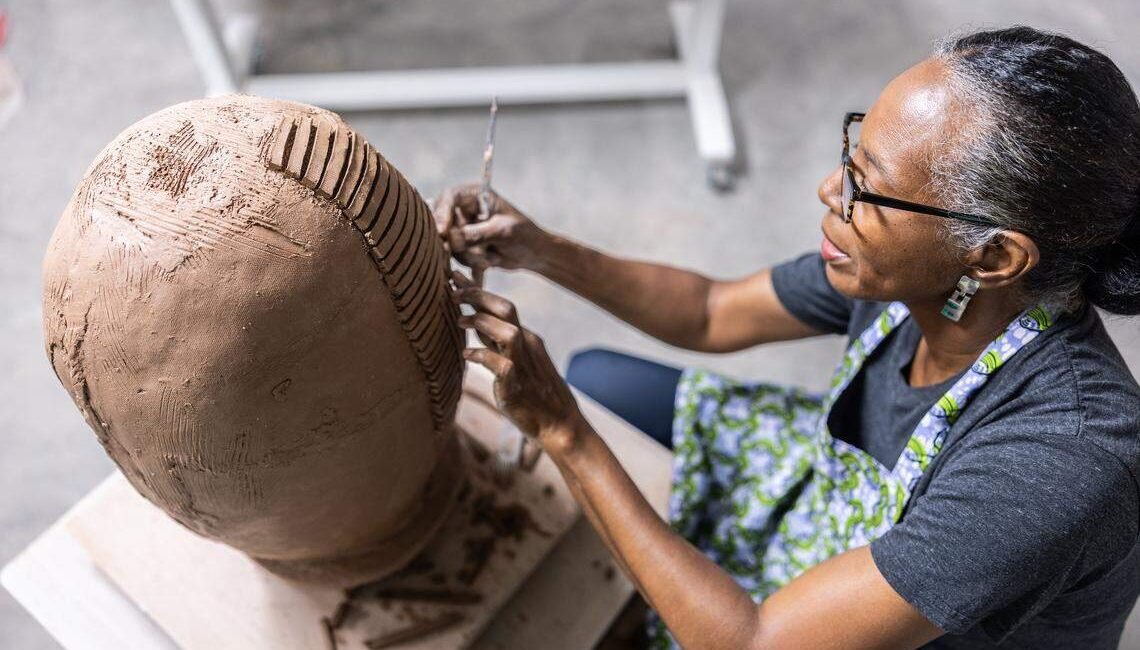
UNC Charlotte art professor Lydia Thompson works on an art project at her studio in Charlotte. She recently studied art and culture in Ghana with the help of an international travel grant.
Thompson, who specializes in ceramics, spent three weeks in Ghana studying traditional adobe architecture and indigenous pottery methods, meeting local artists, lecturing to students, and visiting cultural and historical landmarks.
The trip was full of discovery and inspiration. And it’s only one part of a very rich year of opportunities for Thompson.
This fall, she will be an artist-in-residence at Starworks, an arts and educational non-profit organization in Star, about a two-hour drive northeast from Charlotte.
Thompson also was recently named the 2025 North Carolina Fellow for Visual Arts by South Arts, a prestigious and competitive award program which recognizes one visual artist per state across nine Southeastern states.
Thompson spoke to The Charlotte Observer both before and after her trip to Ghana about what these opportunities and recognition mean to her.

Charlotte artist Lydia Thompson, left, spent a day working with batik artist “Auntie Matta,” seated, and her assistant, Elizabeth, on her recent trip to Ghana. Designs created by Thompson, in collaboration with the other women, hang behind them.
Finding inspiration in Ghana
Thompson spent nine months in Nigeria on a Fulbright-Hays grant 40 years ago as a graduate student. “I knew I wanted to go back to West Africa,” she said.
Thompson is on sabbatical from teaching at UNC Charlotte until January, and finally can delve more deeply into her research interests and studio work.
For years, she has juggled multiple responsibilities alongside her creative work: teaching, serving in leadership positions in higher education (most recently as chair of the Department of Art and Art History at UNC Charlotte), and raising her now-grown children.
The opportunity to travel to Ghana came at just the right time.
Much of her artwork is connected to the African-American experience, including the transatlantic slave trade. Thompson said there were multiple sites with emotional significance in Ghana that she longed to see.
She’s also interested in objects and their meaning, and incorporating them into her work.
She often recreates traditional architecture on a small scale through her artwork. “I’m attracted to ceramics because I can make more immediate forms,” said Thompson, whose artwork frequently reflects themes of migration, memory, displacement and loss.

Lydia Thompson will be an artist-in-residence at Starworks in Star this fall, where she will develop a body of work inspired by the adobe structures and traditional art forms she documented during her travels in Ghana.
In one village on her recent trip, for example, she spotted a deteriorating adobe house en route to another destination. On the ride back, she asked the driver to stop so she could take a look around.
They searched and searched to locate it.
With the help of one of the other passengers, a nurse who provides healthcare and immunizations to people in remote villages like this one, Thompson found out that the hut had been built by a father for his family. The roof had caved in and one of the walls needed to be repaired. It had been sitting like that for more than a year.
“They were just waiting to have enough money and enough resources to repair it, to build the wall back.”
Even though the house was in disrepair and so different from typical American abodes, Thompson saw something universal. She noticed someone had drawn the ABCs and numbers on an interior wall. It reminded her that the innocence of children extends across cultures.
During her time in Ghana, Thompson also visited rural villages and urban centers.
In Kumasi, the country’s second-largest city and a Sister City to Charlotte, she guest lectured at Kwame Nkrumah University of Science and Technology about her work, contemporary ceramics in the U.S. and UNC Charlotte’s department of Art and Art History.
Thompson said Nkrumah University has the top undergraduate ceramics program in Ghana, with about 300 majors. Her host, Samuel Nortey, professor of Art and ceramics coordinator at the school, whom she met through the National Council on Education for the Ceramic Arts, has also previously visited Charlotte as a guest lecturer.
As she traveled, Thompson had the chance to learn about several indigenous artistic traditions, passed down from generation to generation. At the Bonwire Kente Museum in the Ashanti region, she observed local men weaving kente cloth.
“It was pretty awesome. I mean just to see these ancient techniques still… going strong in this culture,” she said. “Not everything is automated. There’s still something to be said about working analog.”
Traditionally, women in Ghana make pottery and men work in textiles, but Thompson’s experiences didn’t always reflect that.
In the Vume region in Southeastern Ghana, Thompson worked with master potter Crispin Duah Atsu. “He didn’t go to school,” she said. “He just learned from… the other potters in the village. And that’s how it is over there.”

Charlotte artist Lydia Thompson with Ghanaian master potter Crispin Duah Atsu in his village in the Vume region.
Clay is never purchased, she said. The potters in the village she visited get their clay from a nearby stream. Local pottery is terracotta colored.
Any variations, Thompson said, come from natural dyes or residual smoke produced by the wood coal that’s used to fire the kilns. (She’ll be able to recreate some of these techniques this fall at Starworks, which has a wood burning kiln.)
Creative and spiritual highlights of the trip
Two experiences, in particular, stood out during her trip. To her surprise, neither was rooted in ceramics. She described one as creative, and the other as spiritual.
Thompson spent a day in a local village learning how to do batik, a traditional form of printing on fabric. She worked alongside batik artist Martha Rhule (who goes by the name “Auntie Matta”) and her assistant.
The two women are part of Global Mamas, a fair trade organization that enables Ghanaian women to practice their artisanal craft and earn a living wage from it.

Charlotte artist Lydia Thompson, right, with batik artist “Auntie Matta,” with whom she studied batik art and tye die techniques during her trip to Ghana.
Thompson said the materials and outdoor set up were basic, but they were able to create beautiful designs together.
For Thompson, having the chance to learn a new art form was exhilarating. “I had changed places and I wasn’t an instructor… or professor,” she said. “I was a student all over (again) and I loved that.”
Thompson said Auntie Matta spoke some English but they mostly communicated through objects in the studio.
“I think art is so universal that even though you don’t speak the same verbal language, you speak the same visual language,” Thompson said.
Another powerful experience was her visit to the Cape Coast Castle, a UNESCO World Heritage Site with a dark past. It’s where human beings were imprisoned in dungeons before being forcibly sent on transatlantic trade ships. The “Door of No Return,” the last door millions of enslaved people passed through before their terrible journey to the Americas, is also there.

Visiting the Cape Coast Castle, a site where enslaved people were imprisoned before the transatlantic journey to the Americas, was a poignant experience for artist Lydia Thompson on her recent trip to Ghana.
“These people, they were individuals… they were loved ones” who suffered without sunlight, without personal space, Thompson said.
“It’s an emotional experience for anybody… Black Americans, we probably feel it a little bit more. But anybody who’s a human being who is living in today’s world with some common sense would have to reflect on that situation too, you know, just the atrocity of what had happened.”
Thompson doesn’t know where her own ancestors came from, but she was deeply affected by the experience. The visit made her reflect on the origins of some of her past creative work, including a series called “House Beatings” in which small clay houses feature broken walls, indents and slashes.
Thompson’s website says these markings represent “the emotional abuse brought on by societal political power structures that starve communities of resources to support growth, wealth, and well-being.”
“I thought about that piece and I said ‘Oh my God, subconsciously this work is connected… this is what these pieces are about.’ ”
Even though it’s a sad reference, she said she foresees doing more work in that series now.
Looking forward to Starworks
At Starworks this fall, she will have the opportunity to redirect all of her reflections, sketches, photographs and conversations with Ghanaian artisans into the studio. She describes Starworks’ facility as “a hidden gem.” It’s located near Seagrove, an area renowned for its wild clay and as a haven for generations of potters. The area mimics other cultures, such as African countries, Japan and China, where ceramic traditions are passed down through families.
At Starworks, Thompson plans to experiment with some of the techniques she learned in Ghana.
“Sometimes your well runs dry…” Thompson said. “Sometimes you question yourself, ‘Am I just making the same stuff because I can make it, because I know how to make it?’ And I think what happens for me sometimes is once I figured it out and I start making it, I say, ‘Okay, this is coming too easy. You need a little bit of a struggle, a challenge here.’ … You always want to be searching and finding the new challenge.”

UNC Charlotte ceramics professor Lydia Thompson was recently named the 2025 North Carolina Fellow for Visual Arts by South Arts. That prestigious program recognizes one visual artist per state across nine Southeastern states.
On Winning the South Arts Prize
As she delves into new artwork, Thompson’s current creations are also being recognized by South Arts, a non-profit regional arts organization based in Georgia.
As the 2025 North Carolina Fellow for Visual Arts, she received a $5,000 award and her work will be featured in a touring exhibit that launches at KMAC Contemporary Art Museum in Louisville, Kentucky, on Aug. 30.
The exhibit also includes artwork from the 2025 state visual arts fellows from Alabama, Florida, Georgia, Kentucky, Louisiana, Mississippi, South Carolina and Tennessee.
In addition, Thompson will be considered alongside the other state fellows for the Southern Prize, which will be announced at the opening of the touring exhibit. The winner receives $25,000 and a finalist receives $10,000.
Thompson is grateful for the recognition and that someone else sees her current work as relevant.
“They might not understand it but they’re making a connection to the work,” she said. “It’s kind of like, ‘yeah you get me …you get this stuff, you know, you’re feeling something. You’re feeling a vibe from the work’… I want people to look at this stuff and I want us to have a conversation about it.”

“I think art is so universal that even though you don’t speak the same verbal language (as people in other countries), you speak the same visual language,” Lydia Thompson said.
More Arts Coverage
Want to see more stories like this? Sign up here for our free, award-winning “Inside Charlotte Arts” newsletter: charlotteobserver.com/newsletters. And you can join our Facebook group, “Inside Charlotte Arts,” by going here: facebook.com/groups/insidecharlottearts.
[ad_2]
Source link


No Comment! Be the first one.