
[ad_1]
This September, during the New York Fashion Week S/S 2026 season, Marimekko is once again staging “joy” as performance. The Finnish design house has partnered with US–based artist Laila Gohar to launch a playful bedroom-themed capsule collection. Inspired by Gohar’s maxim: “if it’s ironed, you can wear it out,” the capsule reimagines Marimekko’s iconic archive stripes by artist Maija Isola into pajama sets, bedding, ceramics, and home items designed to move freely between private and public life. Earlier last month, at Le Bon Marché in Paris, Marimekko opened a pop-up where Gohar and Marimekko created a giant bed inviting visitors to lounge. In a world filled with stress, it was a welcomed reprieve.
Inspired by Laila Gohar’s maxim: “if it’s ironed, you can wear it out,” the capsule reimagines Marimekko’s iconic archive stripes by artist Maija Isola into pajama sets, bedding, ceramics, and home items designed to move freely between private and public life.
Courtesy of Marimekko
This latest collaboration underscores why Marimekko remains a cultural touchstone. Since its founding in 1951, the Helsinki-based company has been a force of Finnish modernism, bringing bold prints into everyday life around the world. Its floral and stripe prints have transcended fashion, and have become ubiquitous with Finland, ultimately becoming key symbols of the country’s creative identity. Its archive of more than 3,500 prints is a national treasure. Jackie Kennedy wore Marimekko dresses on the campaign trail; Georgia O’Keeffe collected its textiles; Japan has long embraced the brand as a philosophy of living. The house’s enduring success lies in a cautious balance of timeless design and reinvention.
Vogue, November 15, 1965 – Model in a bed of yellow flowers in a rowboat on a riverbank near Helsinki, Finland, wearing a fish scale patterned black and white bikini with a high top and a side-slashed bottom, with matching cotton back-zipped boots, by Marimekko. (Gordon Parks/Conde Nast via Getty Images)
Conde Nast via Getty Images
Today, under Creative Director Rebekka Bay, Marimekko is returning to its roots as prints-driven house while recalibrating for a digital age. Bay, who has led design at COS, Gap, Everlane, and Uniqlo, brings a global perspective as well as a Nordic clarity to Marimekko’s next chapter.
I sat down with Bay to discuss how she approaches Marimekko’s legacy, how she balances high tech and human touch in design, and what joy means to her today.
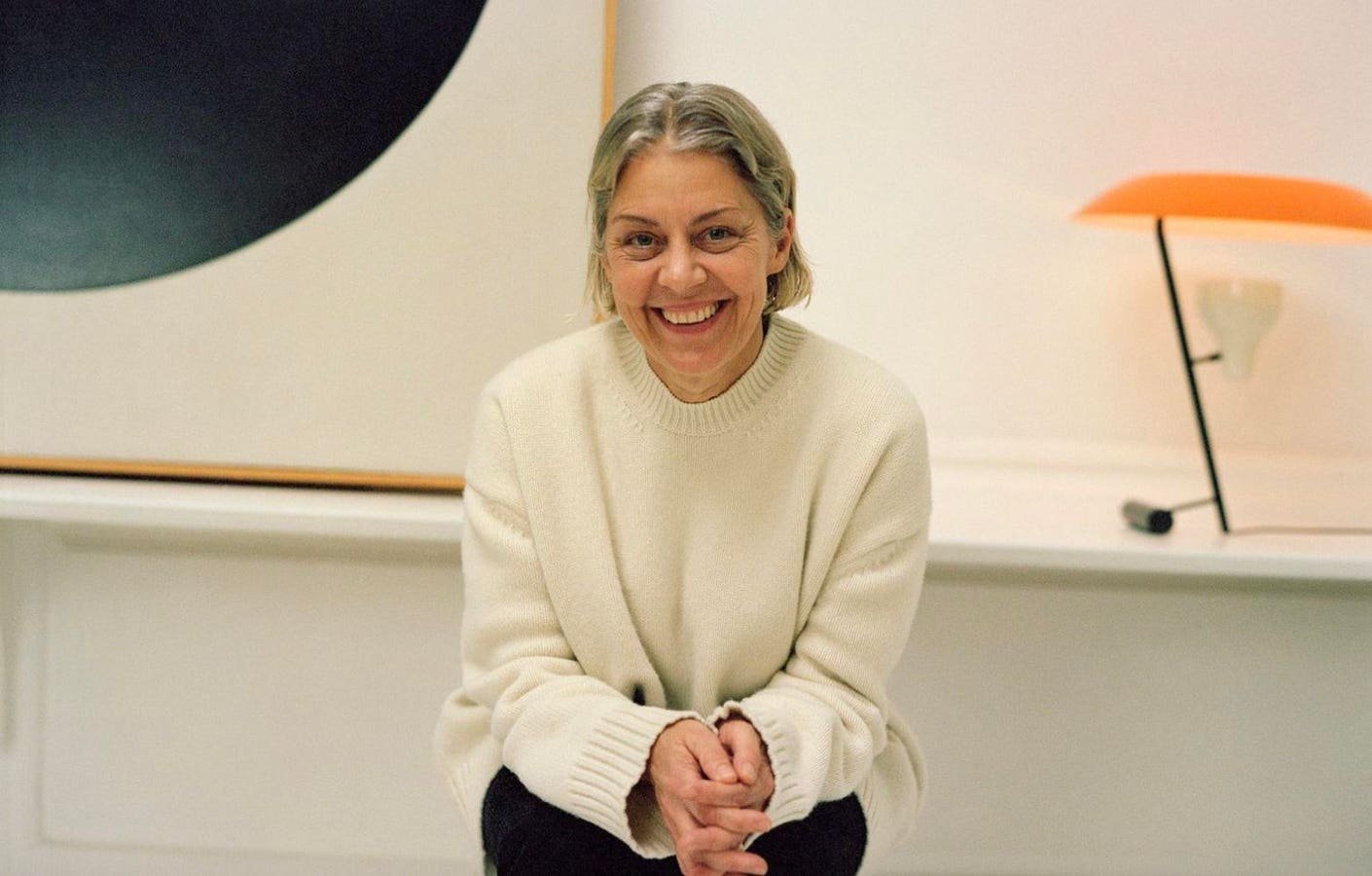
Rebekka Bay, Creative Director of Marimekko
Courtesy of Marimekko
Q: You’ve had quite the transatlantic journey, I imagine stepping into a brand as iconic and visually loud as Marimekko must’ve felt like switching fashion languages entirely. How did you begin to translate its legacy into your own creative vocabulary?
Rebekka Bay: In a way, coming to Marimekko felt very natural. There was a connection right from the start that stemmed from knowing and admiring the brand for my entire life growing up in Denmark and being a member of the board of Marimekko before joining as the Creative Director.
For me, Marimekko’s essence is about creating art that is applied to a different kind of canvas – a dress. As Creative Director, I have leaned into that aspect of Marimekko’s heritage, and our team has really celebrated the art of printmaking. Fittingly, this season in Copenhagen, we are highlighting that through our show titled Art of pattern. The show reimagines our iconic approach to prints, this time through people, patterns and color. Our runway presentation has been inspired by the overlapping colors in Marimekko prints, overlapping lines, and it forms an ever-changing, human-made pattern, set to a soundscape recorded at the Marimekko’s textile printing factory and mixed by artist YSI. So, in essence, our show blurs the line between fabric and form, print and performance.
Vogue, November 15, 1965 – Model on the bulwark of a rowboat filled with yellow flowers on a riverbank near Helsinki, Finland, wearing a sleeveless short cotton smock dress printed in yellow and blue waves and black-lacquered wood clogs laced to the knees with blue and yellow straps; by Marimekko. (Gordon Parks/Conde Nast via Getty Images)
Conde Nast via Getty Images
From the start, I was also drawn to Marimekko silhouettes – ever since the 1950s, Marimekko silhouettes have been architectural, timeless and functional. Our ethos is to design dresses that allow you to walk your own path in life, dresses you can run and dance in, dresses with pockets, dresses that never obstruct you. Marimekko pieces are for everyone – they are artworks that you can wear in your everyday life.
Marimekko is synonymous with joy, but joy today feels more complicated than ever. What does “joy” mean to you today, and how do you design for it without veering into too much nostalgia?
Rebekka Bay: I am happy to hear that you think Marimekko being synonymous with joy since that is our mission – to bring color and joy into lives and homes everywhere and encourage people to be happy as they are.
One of my favorite quotes from Marimekko’s founder Armi Ratia is that Marimekko could have been anything – modern jazz, an ice-cream parlor or a flower shop, as long as it brought joy to people. We really lean into that idea when creating, for example, event concepts where we can allow people to experience Marimekko in an entirely new, but joyful way. For example, during Milan Design Week in April, we created a giant bed in the foyer of Teatro Litto together with New York -based artist Laila Gohar to celebrate the softer things in life and taking time to relax and unwind in the middle of the hustle and bustle of a busy week with a book, a magazine or earplugs. I could see how much joy that notion of relaxation brought to our visitors.
Marimekko Ready-to-Wear Collection
Courtesy of Marimekko
Q: Design today often feels like it’s caught in a constant tug-of-war: heritage versus trends, seasonless versus seasonal, etc. How do you hold space for all of that push and pull while still making something that feels coherent, and most importantly, wearable?
Rebekka Bay: I would like to refer to another favorite quote of mine from Armi Ratia. She once said that “Marimekko is not about trendy fashion, with a few minor exceptions. We make lasting and timeless products. Timelessness may, however, occasionally come into fashion by chance, like now.”
That timelessness remains a guiding principle in our design ethos, and helps us focus on creating timeless, functional and high-quality products that give people long-lasting joy, and they want to pass on to the next generation. Of course, we pay attention to the shifts that are happening in design and culture around us, but the emphasis on timelessness really does help to focus.
Q: You helped build Uniqlo’s Global Innovation Center, where modularity is built into the design process. Did you bring any of that tech-minded approach into a brand like Marimekko?
Rebekka Bay: It is fitting that you mention modularity because modular thinking is part of our timeless design. Our goal is to create items that help our customers build a capsule wardrobe consisting of timeless pieces they do not want to throw away. I see each season adding building blocks with everything working together to make a timeless wardrobe. To support this, we have, for example, created three archetype silhouettes that are available in new prints and colors in each collection: A-Line, Straight, and Fit & Flare. The idea is that these archetype silhouettes do not have an expiration date, and they help our customers find the right silhouette and size each season.
Marimekko Ready-to-Wear Collection
Courtesy of Marimekko
Q: How do you create something enduring in a culture that’s obsessed with the next viral thing?
Rebekka Bay: Marimekko is a lifestyle more than just a fashion or a design brand – and it has been like that ever since we were founded. We are very fortunate to have that over 70-year heritage because I am generally seeing a newfound appreciation for heritage, craft and high artistic integrity – people want to surround a product with real storytelling and meaningful experience. That is why we have initiatives such as the Marimekko Artist Series, which is a platform that invites emerging and established artists to collaborate with us on limited-edition capsule collections that push the boundaries of printmaking while also democratizing art by making it more accessible.
Marimekko prints are pieces of great art, and I have always admired the prints the same way I do other pieces of great design such as architecture or furniture. I really love immersing myself in our archive of over 3,500 prints while working with our design team and artists to create new pieces of art and see where we can take the art and science of printmaking next. There is such a vast variety in Marimekko prints!
Q: The brand has global cult status, but hasn’t quite cracked the American market. Why do you think that is? And do you think the American consumer today is finally ready for Marimekko, or perhaps, has the brand become more ready for them?
Rebekka Bay: We have always had a community of friends of Marimekko in the US and we are actively fostering and building that community further. This began all the way back in the 1960s when notable figures such as Jackie Kennedy and Georgia O’Keefe became fans of the brand. Especially in New York, where our flagship is located, we notice the vibrant enthusiasm that people have for our brand whenever we arrange events in our stores or in other locations. I feel like Marimekko is becoming a more and more recognized brand in the US, which we are excited about.
Q: There’s a certain Nordic philosophy in Marimekko, however, in an era where “inclusive” can mean everything and nothing, how do you keep that philosophy grounded?
I feel that Nordic design has always been grounded in functionalism, which is something that guides my work as well. Our pieces serve a function and are meant to be part of everyday life while also being beautiful pieces of art. Equality and authenticity have been important values for Marimekko since the early days, so it is part of our DNA to also have these values in our design.
Marimekko Ready-to-Wear Collection
Courtesy of Marimekko
Q: Do you worry about AI’s impact on creativity?
Rebekka Bay: I am very interested in the ways AI can help boost the wider digitalization of Marimekko’s value chain and ensure that our customers get inspiring, frictionless and tailored omnichannel experiences wherever they meet us. But for design, we value the human handprint in our work – even in our printing factory in Helsinki, while the machines are printing the products, our employees are dispensing the paint on our print screens, monitoring the process and inspecting the fabric by eye.
For our prints, many of our artists paint or draw by hand, others work digitally, use photographs, dried plants or paper cuttings. But no matter the method, the human touch is always visible in a Marimekko print in perfectly imperfect ways.
[ad_2]
Source link
Other Articles

Explore 200 years of American landscape art in Hagerstown

No Comment! Be the first one.