
[ad_1]
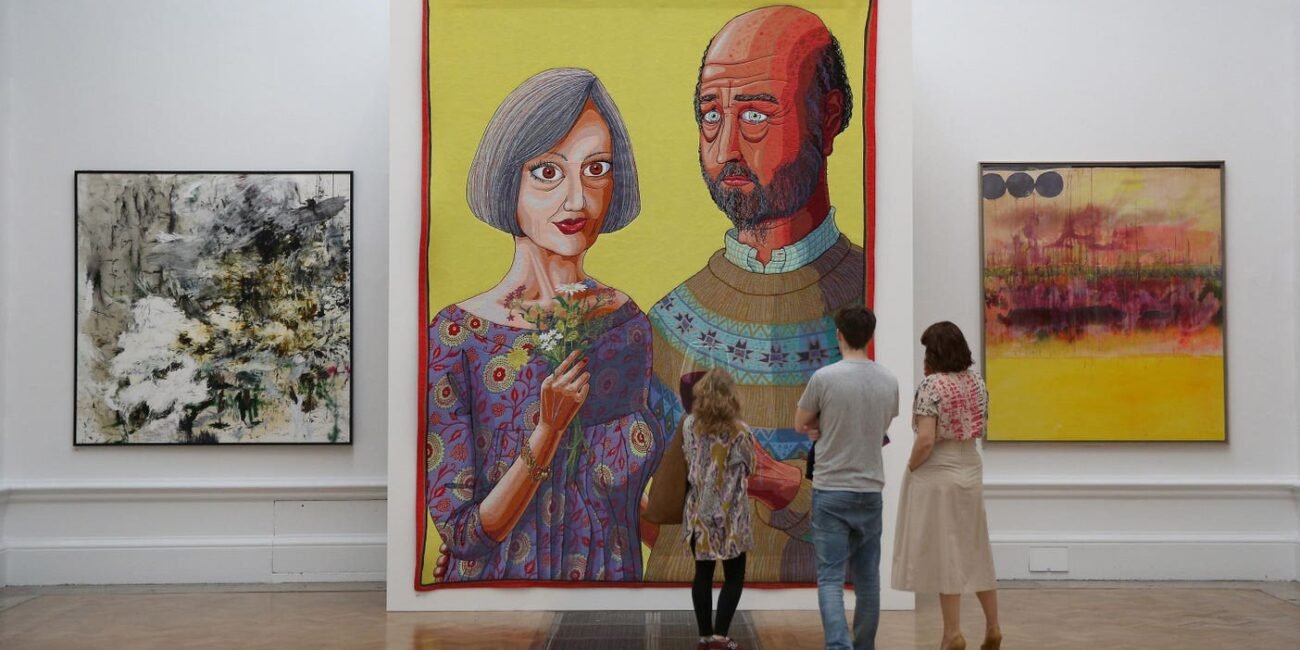
LONDON, ENGLAND – JUNE 03: Visitors look at a tapestry by artist Grayson Perry called ‘Julie and Rob’ in the Summer Exhibition at The Royal Academy on June 3, 2015 in London, England. The RA Summer exhibition is the world’s largest open submission contemporary art show with 1200 entries selected to be shown. It opens on June 8 and runs until August 16, 2015. (Photo by Peter Macdiarmid/Getty Images)
Getty Images
Good things happen when we look at art. It’s a primal response: your brain’s limbic system, which controls your emotions, is activated, releasing neurochemicals like dopamine that create feelings of pleasure.
In its most quotidian form, our positive response to art is why we don’t live in blank white boxes, why we visit galleries or buy posters to hang on walls. And beyond a short-term dopamine boost, art therapy and engagement with the arts has been shown to reduce symptoms of depression and anxiety, help people heal from trauma, and enhance social cohesion, among other benefits. Yet this all focuses on the cognitive, and as important as mental wellbeing is, what if art can also improve our physical wellbeing?
A Life Hack For Healing
“Our lifestyle obviously affects us,” says Rui Reis, a personal trainer and injury rehabilitation specialist, who holds an MA in Sports Science and has spent a decade studying biomechanics and neuroscience. Most of us spend the working day hunched over our laptops, in the glare of the blue light; it’s easy to become stiff, tired, and achy.
This unhealthy lifestyle may be behind our wellness obsession, which has seen global wellness tourism surge to a $1 trillion mark, with the Global Wellness Institute forecasting the industry to hit $9 trillion by 2028. But instead of chasing the latest fads, what our bodies might need dates back to the Stone Age, when our ancestors first began daubing cave walls with ash and ochre.
Personal trainer and injury rehab specialist, Rui Reis, at work with a client
Rui Reis
Reis explains that stress keep our bodies in fight-or-flight mode. “If you are stressed, that means you have higher cortisol (the stress hormone) in your system. This results in less blood flow, so your cognitive performance decreases. One way to combat that is to exercise.” But here’s the real revelation: “It might surprise you to know that looking at art also returns balance to our nervous systems.”
Because we feel good when we are looking at or making art, we’re able to relax out of fight-or-flight efficiently. This is not the same as getting quick hits of dopamine through alcohol or eating chocolate; these may feel good in the moment, but inevitably accumulate long-term harms. “The state you want to be in when you’re doing injury rehab,” Reis continues, “is the same state you’re in when you look at art.”
Art can be found all around the city of London, allowing us to calm our nervous systems if we slow down and pay attention to it.
Rui Reis
The Power Of Art
We often force our brains to override signals as we rush about our busy lives – we’re all guilty of not prioritizing what our body wants, whether that’s staying up late to finish one last task or running for our commuter train on a dodgy ankle. The brain tries to protect us by limiting our access to pain… though eventually, this’ll catch up with us. “If you have a crick in your shoulder, that’s not a serious injury,” says Reis, “but other parts of your body still need to compensate for the vulnerability of that area. Long-term, this creates weak neuro pathways.”
By harnessing the power of art, we can return our beleaguered bodies to a state of harmony, setting them up for success in the healing process. “The environment of injury rehab is important too,” Reis adds, “you can nudge your body towards recovery in many small ways, whether via the lighting or the music that may be playing in the treatment room.”
Rui Reis taking in the beauty and art of nature
Rui Reis
Of course, the pressure you put your body under in training still matters – but the stress you’re experiencing will affect how hard you’re able to push. If the workout takes place in the right environment and your stress levels are where they should be, then your body can perform better. This means art can serve as a tool, helping you reach goals faster by preparing you for a great workout.
We might not have gyms that hang Picassos next to treadmills yet, but if you’re feeling particularly run-down this winter, try swinging by a gallery. Whether you go in for photography or painting makes no difference, but your system will thank you for providing a natural tool that’ll help it rebalance.
Rui Reis is a personal trainer for injuries who works in London and can be found via his private practice at Oitoo.
[ad_2]
Source link


No Comment! Be the first one.