
[ad_1]
On another view, art can be more revelatory. It shows the nature of something, not just the thing in nature. The purpose of sacred art, like Scripture, is to reveal God’s Word, not resemble it. This type of art can provide us with meaning. It is not meant solely for looking but for reading, like words on a page. Just as we read poetry or literature for meaning, we can also read an artwork for the same purpose, regardless of what it depicts or how it looks.
One work that I think captures this well in Menton is Anna Vinzi’s “Croce e Delizia,” a quasi-cruciform assemblage of pale brown paper and fabrics, highlighted by strong pink slashes and accented with splashes of blue. She told me that she created this piece from ephemera that she had collected. The organization, colors and patterns come to her as she is making it, without any forethought. When reading this artwork for meaning, we can reflect on how the crosses in our own lives are like the material of Vinzi’s “Croce”: our pain is momentary, our frustrations fleeting and our struggles last only for a brief time from an eternal perspective. Furthermore, our suffering might appear quite random in our experience, like the arrangement of these scraps. Yet, in that mess, there are slashes of humanity and splashes of the divine. Even in those crosses, even death, there is a sort of “miracle” where the divine is through it, in it and with it all.
Traditional and representational artworks can also be read in a revelatory way. It might even be more challenging to do so because we often stop our engagement at recognition rather than engage with it in a more sustained reflection. In Daphné du Barry’s maquette of her “Madonna del Pollino,” Mary lifts Christ up and his arms extend in a cruciform shape. This position seems unnatural; the Madonna’s hands are holding the child from his waist, yet his arms react as if he is suspended by his ribs, where his arms could rest easily on his mother’s hands. Yet this small detail perhaps reveals that Christ, even as a child, voluntarily raises his arms as if already crucified and is not compelled to do so by a parent. This work reveals something about Christ in addition to resembling Him.
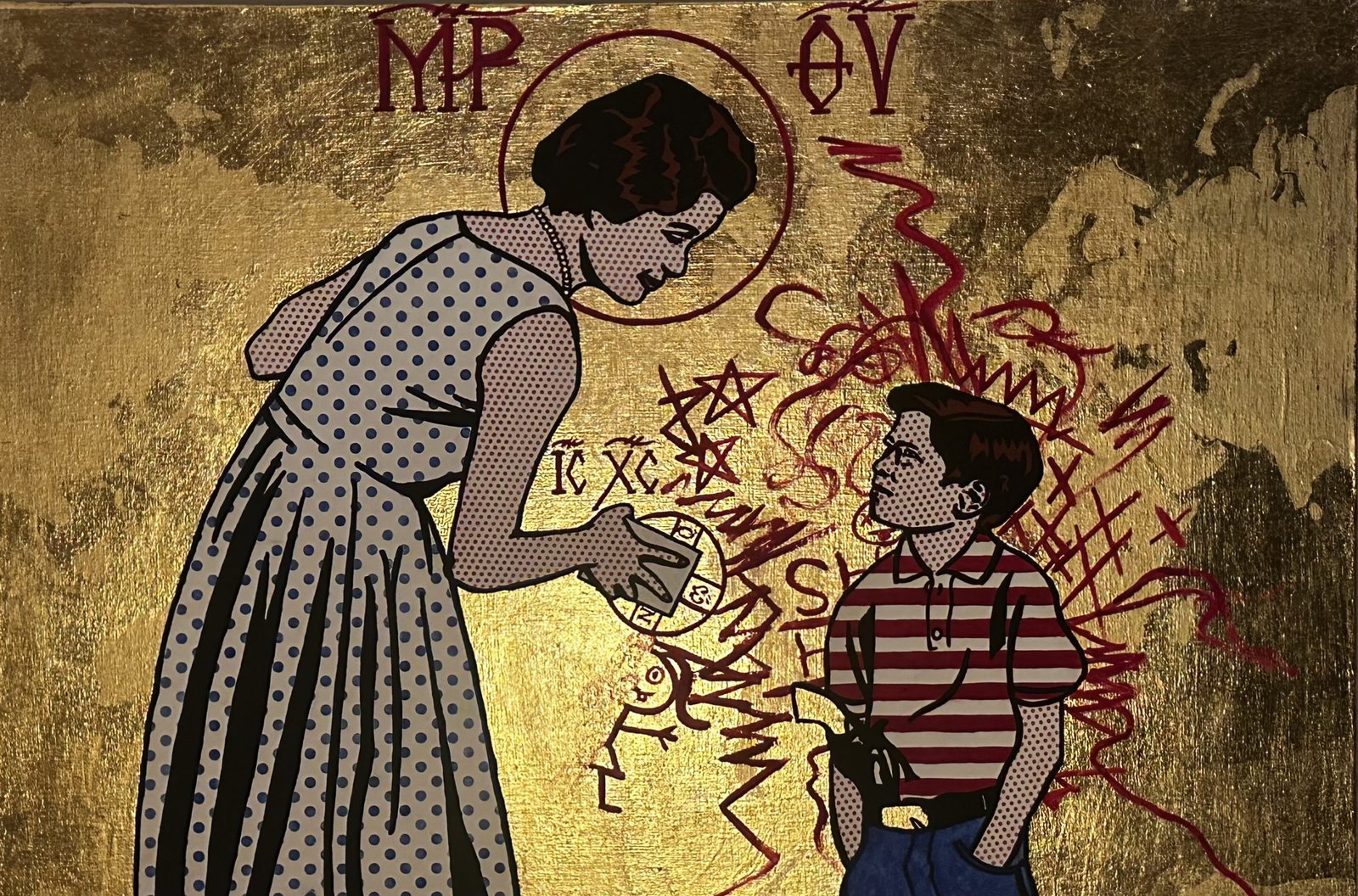
My own contributions to the Biennale, I hope, also add to this conversation about recognition and revelation. In “The Holy Family,” Joseph holds up a Brillo Box haloed like the Christ child in a traditional icon while Mary stands with him above a mountain of glimmering pots and pans. The work invites us to see Christ in consumerism and as a mass-produced product. He is the one who “shines” and cleanses the dirty and stained; he is not a prize for the perfect. “Madonna and Child (‘Laudato No’)” is a meditation on Pope Francis’ ecological encyclical, “Laudato Si’,” suggesting that even though we act irresponsibly in our world and cause disaster, Christ, through Mary, comes to clean up our mess. Like the Vinzi and du Barry pieces, these works are not sacred solely because of their appearance, but because they invite a conversation that deepens our awareness of God through the forms and symbols of our own time.
[ad_2]
Source link


No Comment! Be the first one.