
[ad_1]
Ever since my colleague saw the new The Frame Pro TV from Samsung back at CES in January, I’ve been waiting to get my hands on the newest (and potentially best) art TV on the market. At long last, that has finally happened, and I’ve been testing the Frame TV Pro to see if it lives up to its name.
I consider myself an enthusiast of all things home theater, one with a surround sound system and an expansive media library in my cozy apartment. But I also spend a ton of time at home as a hybrid employee who works remotely. So if there’s anyone who is going to enjoy a better mix of style and substance in the art TV market, it should be me, right? That’s why I spent the past month putting Samsung’s The Frame TV Pro to the test to see if it’s impressive enough to earn a spot in my home theater as one of the best TVs around.

Samsung’s new and even-higher-end art TV improves one of CNN Underscored’s All-Star products with better picture quality, a design that does a better job mimicking a picture frame and a new Wireless One Connect Box to fully realize the promise of a wall-mounted TV that doubles as a piece of home decor.

The biggest selling point of Samsung’s The Frame TV series is that when you’re not actually watching something, the TV can double as a digital picture frame, hence the name. Previous versions of the television, as well as competitors in the space like TCL and Hisense, have done solid jobs at mimicking the look of a Van Gogh or Vermeer painting, but none have done that good a job. At least, not good enough that they truly live up to the promise of an art TV. They’re more pieces of home decor that double as a way to watch TV shows, versus something that excels in both categories. The saying “a jack of all trades is a master of none” comes to mind.
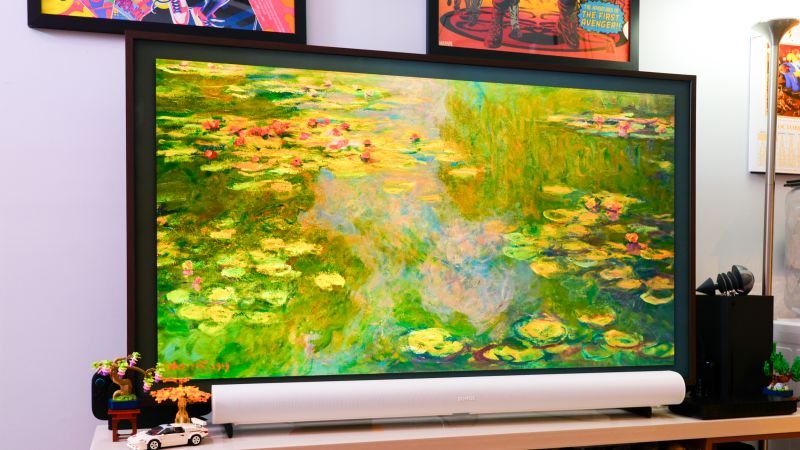
The Frame TV Pro takes a step forward with the best screen you can currently buy on an art TV. That’s not even a subjective statement. Nowhere else on the market can you find a television of this variety that rocks a panel as good as Samsung’s 4K Neo QLED technology, nor will you find one with a native 120Hz refresh rate that can boost up to 144Hz with the brand’s Motion Xcelerator Turbo+ variable view rate feature — a major perk for gamers and sports fans craving extra-smooth motion. Samsung is also on its fourth generation of matte finish for the screens, which does such a phenomenal job at cutting back on glare from the sun. It also means that artworks end up looking more like paintings than images rendered with a screen. The technique isn’t flawless, but it does a far better job at mimicking the look of an actual framed photo than the competition.
On the more subjective side of the TV experience, all of that technology comes together to offer a lovely viewing experience that has far fewer compromises than other art TVs on the market. The HDR10+ certification means that, on paper, it should have bold colors and dark black hues. In person, it absolutely delivers on that expectation with impressive picture quality that offers sharp contrast between colorful scenes and darker backdrops. During my time with the home theater upgrade, I watched everything from the second season of “Peacemaker” to some of my favorite animated series like “Mobile Suit Gundam Unicorn,” not to mention the 2025 World Series and the first few hockey games of the New York Rangers season. In everything from gritty live action television shows and vibrant animation series to fast-paced sports, The Frame TV Pro continued to earn its spot in my home.
One of the first things I always do when trying out a new TV is to pull up a clip from a movie or series that has a bright light on a dark background. Whether it’s a title card on a movie, the opening crawl of text from any of the “Star Wars” films, a scene with a flickering flame lighting a dark room or something else, I am always trying to see how a TV handles banding. A screen that does a poor job with banding will show visible stripes radiating from the source of light as those gradient tones fill the darker space. The Frame TV Pro did a splendid job at keeping banding to a minimum, largely due to its full-array local dimming.

Samsung has been in the art TV game for years now. It has spent that time not just pioneering the idea of a television that can double as a digital painting, but iterating to improve the experience. In the newest and most capable version of The Frame series, the Pro edition improves even more than previous editions with those glorious screen enhancements that allow pieces of art to look even more like the real things. On top of some new display technology, there are some other adjustments that allow the Samsung The Frame TV Pro to make such a good impression.
One of the most obvious improvements is just how thin The Frame TV Pro is. The thinner design not only means it won’t be such an eyesore, but also that it will do a better job at blending in when mounted onto your wall. If you plan to disguise the television amongst other framed works of art or treat it as a centerpiece in your room, the new Slim Fit wall mount and the home theater display’s slimmer appearance combine to offer a better art TV.
Packed within that slimmer appearance are the same customizable bezels that allowed you to camouflage previous releases in The Frame TV series. Motion and brightness sensors allow that shiny 4K Neo QLED technology to adapt the television’s display to your environment. The motion detection can be configured to turn your display on when someone walks into a room, while the brightness-sensing tech means it’ll fine-tune the visuals to look the best for how much sun is blanketing a room. The new glare-free coating applied to the screen completes the experience, delivering a matte texture that really does a phenomenal job at ensuring digital works of art can fool you into looking like actual paintings.
Hardware improvements aside, Samsung has also leveled up its digital art game. This isn’t exclusive to The Frame TV Pro, but Samsung has been spending the past years growing its library of digital paintings. There are hundreds upon hundreds of different artworks to choose as your television’s wallpaper, as well as the ability to set custom playlists that circle through selected pieces or chose from one of Samsung’s curated galleries that offer paintings themed around specific holidays and events. The Pro version of the TV may not be the only way to enjoy these features, but it’s certainly the best experience from Samsung so far for showcasing these incremental improvements.

If the new display and improved Art Mode experience on The Frame TV Pro weren’t enough to sway you, Samsung has one final card up its sleeve. What really ties the home theater upgrade together is its new Wireless One Connect box, which fully delivers on the promise of a piece of digital art you can hang on your wall. Normally, you’d have to run a cable from the TV down to a connection box that has to remain within a few feet of the mounting point on your wall. This typically means you need to place the TV right above a television console or other piece of furniture that can hide connected devices. But now, you can install this on a gallery wall without anything underneath.
The wireless connection is so good, in fact, that you wouldn’t even know it was wireless. And to make sure that I wasn’t being wowed by the technology, I put it to the test with someone who doesn’t review technology for a living: my wife, Taylor. She’s a massive video game fan, and someone who would notice any issues in picture quality and frame rate when diving into a round of Battlefield 6. I set up The Frame TV Pro in my family room without disclosing the Wireless One Connect box’s existence. The verdict? She, like myself, was impressed by the performance to the point where she couldn’t tell that it wasn’t connected by a cable in the traditional way. It’s rare to see the implementation of newer technology like this work so well, but credit where credit is due: Samsung nailed it.

Over the years, I have used just about every smart television platform on the market. That includes built-in operating systems from Samsung, LG and Hisense as well as dedicated streaming media player interfaces from Roku, Amazon and Apple, the last of which I personally rely on in my own home theater. I know what to expect from a smart TV these days. Samsung’s latest implementation still managed to throw me for a loop with an inconsistent experience.
My typical interactions with the Samsung The Frame TV Pro — things like watching movies, switching over to gaming consoles and using my preferred streaming media player — were all a mixed bag. Samsung’s operating system was easy enough to maneuver after I went through the guided setup. But after completing an otherwise straightforward process, I was greeted by an incredibly cluttered landing page. It’s packed with onboard apps for popular streaming services, which all worked just fine in my testing. But sometimes they worked a little too well.
Several apps, on reoccurring occasions, would begin autoplaying after I woke up the television from sleep. Sometimes those apps would be for services I had never even configured, like those within Samsung’s Live TV Recommendations, which immediately began blasting audio for a cartoon that I wasn’t interested in watching — let alone hearing— and live news broadcasts. That experience in particular was inconsistent at best and annoying at worst. Though to Samsung’s credit, the television maker does do a notable job of making sure you can switch over to whichever devices you actually intend to use. For me, that means ditching Samsung’s OS in favor of an Apple TV box, as well as any number of gaming consoles. It avoids my grievances with the cluttered user interface altogether and lets me skip right to enjoying the best parts of the television.
On the flip side of the actual television-watching experience, there’s the Art Mode interface. Configuring the settings that turn the display into a piece of home decor was simple enough during the initial setup process, but from there, the same inconsistencies as with watching TV crept in. My largest frustration was with the wait time on actually using the Art Mode feature. Turning off the TV and in turn activating art wallpaper would sometimes pull up a photo instantly, while other times it would spend several seconds transitioning over to its framed painting wallpaper.
I am sure there is some reasoning for why and when Samsung needs to validate the artwork before displaying it, but having to wait so long is such an annoyance — especially when you’re switching over from a homepage filled with literal ads and other content you didn’t choose to see. It also further highlights the issues with Samsung’s operating system. I expected the company’s NQ4 AI Gen3 processor to do a better job at handling these kinds of performance issues, but when there’s so much bulk on the page, it makes sense why there would be loading times.

As I mentioned above, Samsung certainly delivers on variety of art to choose from for turning The Frame TV Pro into a digital photo frame. The only issue with that is all the customization features are locked behind a paywall. After already spending so much on a television, to then have to pay extra in order to unlock all of the functionality it offers (a gallery of paintings and other artworks) is a bit of a tough sell.
I completely understand that this is just the way art licensing works, but it’s one thing that spoils an otherwise amazing experience with the television. The fee is only $5 per month, which isn’t a deal breaker, but considering you’ll likely have this TV for years and years to come, the thought of an ongoing paid subscription poses another chance for you to stop and ask yourself if an art TV really is right for you.
|
Samsung The Frame TV Pro |
Samsung The Frame TV |
Hisense CanvasTV |
TCL NxtVision Art TV |
|
|---|---|---|---|---|
| Size options |
65 in., 75 in. and 85 in. |
32 in., 43 in., 50 in., 55 in., 65 in., 75 in. and 85 in. |
55 in., 65 in., 75 in. and 85 in. |
55 in., 65 in., 75 in. and 85 in. |
| Smart TV OS |
Tizen OS |
Tizen OS |
Google TV |
Google TV |
| Panel type |
Neo QLED Mini-LED |
QLED |
QLED |
QLED Pro |
| Matte finish |
Yes |
Yes |
Yes |
Yes |
| HDR |
HDR 10+ |
Quantum HDR |
HDR10+ |
HDR Ultra |
| Connections |
HDMI 2.0 (5) |
HDMI 2.0 (2) |
HDMI 2.1 (2), HDMI 2.0 (2) |
HDMI 2.0 (4) |
| MSRP (65-in. model) |
$2,100 |
$1,200 |
$1,300 |
$1,300 |

After spending a month with Samsung’s The Frame TV Pro in my family room, it feels like the final form of the art TV. It finally breaks the limitations that have kept previous models from earning spots as real home theater centerpieces, thanks to a screen that actually looks good enough for movie nights at home as well as a thinner design that does a better job at actually looking like a framed painting.
The best way to highlight how much I like The Frame TV Pro is by comparing it to the other art TVs on the market. Previous models from Samsung and current editions from competitors have all been a compromise — you’re sacrificing the screen’s quality in order to have a television that doesn’t look like a black rectangle. As much as I’ve wanted to ditch the black mirror from my family room, these picture-frame-style televisions just haven’t included screens or features that can match a normal TV. Now, The Frame TV Pro finally answers the call with specs you’d find on something that is actually worthy of taking center stage in a home theater.
However, as much as I have enjoyed using Samsung’s newest frame-style TV, I can’t recommend buying this at full price. That’s my final caveat for the television. If you’re already used to Samsung’s TV OS or plan to use another streaming media player, I can easily recommend it on sale. If you also don’t mind paying for a subscription to access the high-quality art galleries that Samsung has curated, The Frame TV Pro is worth scoping out with a discount (like the one available as of this writing) from the usual $2,098 price tag that’s paired with the 65-inch model. The deals expert in me is always going to say to try and score this around its all-time low price — whatever that may be in the future — but anything below $1,800 feels like a solid value to me.
The deals team at CNN Underscored offers a unique perspective in the service journalism field by covering every stage in a product’s life cycle. That means our senior deals editor, Rikka Altland, follows a product from the moment it’s announced through testing it herself and then circling back once it begins going on sale.
Our goal here is to save you money, and by considering the entire journey of a product, we can offer better thoughts on if it’s worth your cash. Altland has been doing just that for nearly a decade, and that kind of experience extends to the rest of our deals team. Being an advocate for buyers to make sure we’re only recommending the best prices on the best products is what we’re all about, and that focus comes across in our work.
[ad_2]
Source link
Other Articles

Designs for $200m Las Vegas Museum of Art revealed – The Art Newspaper
Sotheby’s and Christie’s hail recovery in global art market

No Comment! Be the first one.