
[ad_1]
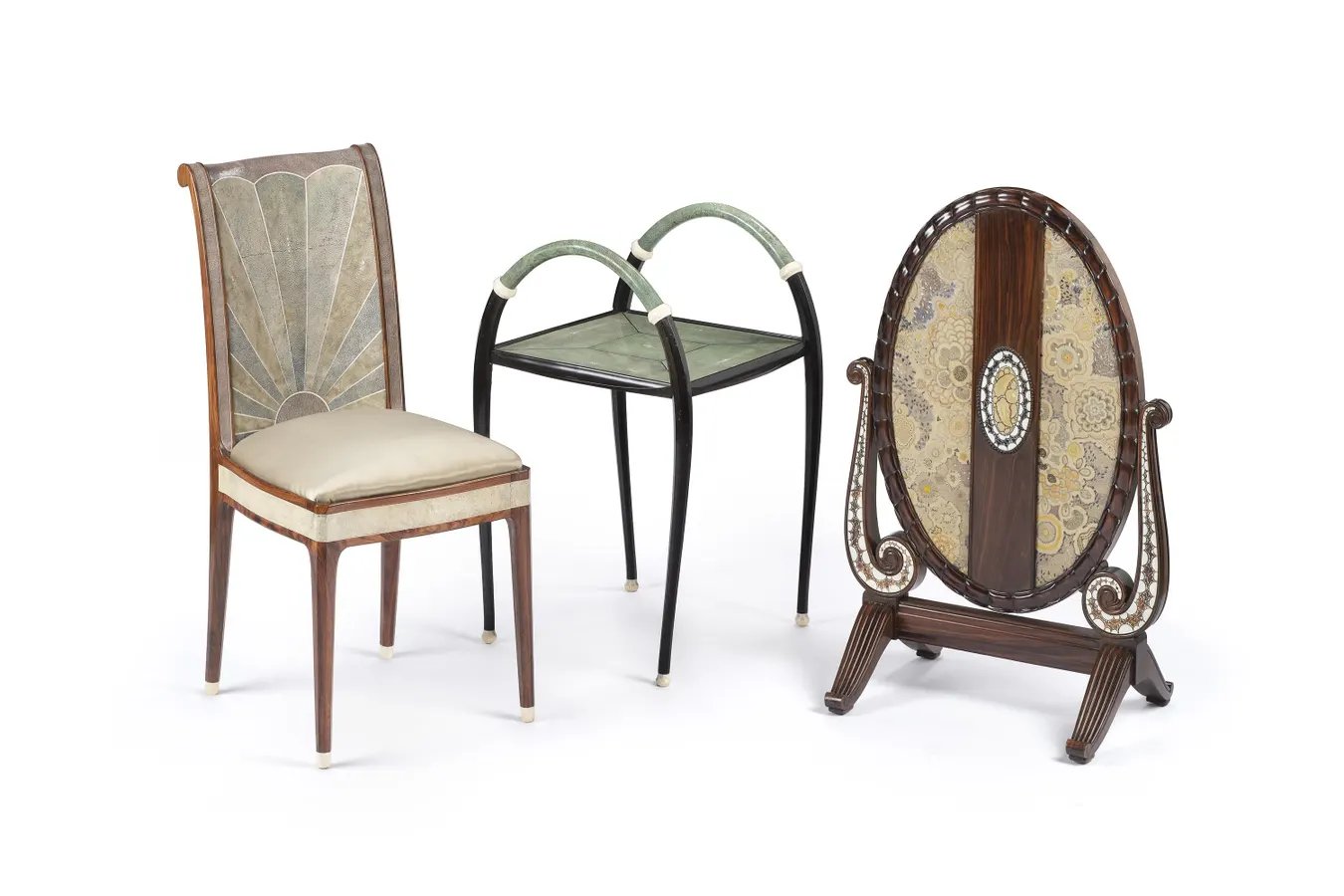
Clément Rousseau (1872-1950), chair, Paris, 1921, rosewood, stingray, ivory, silk, newspaper table, Paris, circa 1921, ebony, shagreen, ivory, Van den Aker, fire screen, Paris, circa 1923, Macassar ebony, engraved and patinated ivory, embroidered silk
Photo Christophe Dellière. Courtesy of Les Arts Décoratifs
At the Musée des Arts Décoratifs in Paris, the exhibition “1925–2025: 100 Years of Art Deco” marks a century since the 1925 International Exhibition of Modern Decorative and Industrial Arts propelled a distinctly modern French esthetic onto the global stage. On view until April 26, 2026, the ambitious survey brings together a wide variety of works—furniture, jewelry, fashion, drawings, glass, metalwork and textiles—drawn largely from the museum’s own exceptional holdings, enriched by major loans. Rather than presenting Art Deco as a stylistic rupture, the exhibition reframes it as the culmination of reflections that began in the 1910s, when designers such as René Lalique, Jean Dunand and Émile Decoeur gradually distilled ornament into geometric clarity, while elevating materials—shagreen, lacquer, exotic woods, jade and ivory—to protagonists in their own right.
Through iconic pieces by figures including Jacques-Émile Ruhlmann, Eileen Gray and Sonia Delaunay, the show reveals a movement at once sumptuous and rigorously structured, shaped by Cubism and global influences, and disseminated worldwide through the Orient Express, ocean liners, international commissions and the cosmopolitan networks of luxury. It also underscores the museum’s own pivotal role in championing, collecting and later reviving Art Deco, from early 20th-century salons to the rediscovery of the style in the 1960s and ’70s. In this conversation, Assistant Curator of Modern and Contemporary Collections, Lisa Jousset-Avi, unpacks the origins, defining characteristics and enduring global resonance of a movement that continues to inform contemporary design.
What are the origins of Art Deco? How did this movement first begin and why did it flourish in the 1920s?
Contrary to popular belief, Art Deco is not a sudden break with Art Nouveau, but rather an esthetic reflection that began in the 1910s, with designers such as René Lalique, Émile Decoeur and Jean Dunand playing an active role in this evolution. This transition involved increasingly synthesized decorations and a rationalization of object forms, with a growing interest in clean lines, but without neglecting decoration through patterns or materials. These ideas reached their peak in the 1920s and in 1925 at the International Exhibition in Paris, before spreading throughout the world, with each country appropriating this esthetic.
Cartier, Maurice Couët (1885‑1963), pendulum clock, 1927 (mount), China, 18th century (jade), carved white jade, onyx, diamonds, emeralds, coral, mother-of-pearl, gold, enamel
Photo Christophe Dellière. Courtesy of Les Arts Décoratifs
How would you describe the Art Deco style? What are its main characteristics in terms of inspirations, motifs, materials, techniques and crafts?
Art Deco brings together a variety of esthetics and sources of inspiration. It draws on the past, such as the Louis-Philippe style or Roman antiquity, which inspired Armand-Albert Rateau’s bronze furniture and Madeleine Vionnet’s dresses, as well as on other cultures, from the Orient to the Far East. There is a persistence of motifs such as water jets, found in wallpaper and monumental decorations, stylized baskets of flowers or roses on Paul Follot’s chairs or Jean Luce’s glassware. Animals also feature prominently, with vases populated by deer or gazelles for Jean Mayodon, and parrot-shaped jewelry at Cartier. The abstract, Cubist and Fauvist movements also contributed to the geometric and colorful vocabulary, from Camille Fauré’s vases to Sonia Delaunay’s textiles. Art Deco is also an art of materials, with a veritable science of combining precious or innovative materials and techniques that are often sufficient for ornamentation. This is the case with the amboine wood inlays highlighted with ivory on Émile-Jacques Ruhlmann’s furniture, embossed leather and shagreen by Clément Mère, jade by Puiforcat, lacquer by Eileen Gray and even eggshell by Dunand.
Art Deco has had a global impact. How did the style travel beyond France to influence design cultures in places like the United States, Latin America, Africa and Asia?
The resounding success of the 1925 Exhibition was one of the first catalysts for the impact and spread of Art Deco around the world. The United States delegation called on French designers such as Edgar Brandt and Paul Iribe for cinema, while Japan placed orders with Henri Rapin. The great ocean liners, Normandie and Ile de France, were new ambassadors for French luxury—from the French way of life to interior design—to the point where transport was forgotten. The multiple influences fed off each other, and each nation embodied the main principles of Art Deco, drawing on its own cultural history, as in the case of Brazil and Sweden.
The Musée des Arts Décoratifs has shaped the history of Art Deco, from hosting the salons of the Société des Artistes Décorateurs in the early 20th century to the revival exhibitions of the 1960s and ’70s, driven by Yves Saint Laurent and Jacques Grange. What has been the museum’s role in the recognition of Art Deco and how does this institutional history shape the way you present Art Deco?
The Union Centrale des Arts Décoratifs, with its links to the Société des Artistes Décorateurs and various industrialists and designers, was initially involved in Art Deco in its contemporary form, participating in trade fairs and exhibitions to promote the decorative arts through the museum’s showcase. Donations and acquisitions formed the large collection of objects and furniture from the 1910s onwards. Financial constraints forced the museum to make specific choices during the 1925 Exhibition, mainly focusing on furniture and silverware. Following the split of the Union des Artistes Modernes in 1929, the museum became involved in debates on art and industry. It was later, in the 1960s, under the impetus of curator Yvonne Brunhammer, that historiography and acquisitions on the subject resumed, retrospectively, through donations and bequests showing the link between creators, companies and the museum institution.
Maxime d’Angeac, sequel to the new Orient Express, 2021-2025, 1:1 scale model, detail of the embroidery on wood by Jean-Brieuc Chevalier
Photo Alixe Ley. Courtesy of Orient Express
Contemporary designers frequently return to Art Deco motifs in fashion, interiors and architecture. How do you explain the enduring appeal of Art Deco, what aspects of the movement do you think resonate most strongly with today’s creatives and how has it influenced design around the world today?
Contemporary designers and creators draw on the Art Deco imagery mentioned earlier. These references can be simply evocative of ideas associated with luxury and the Roaring Twenties, or more subtle, through the use of techniques such as straw marquetry, dark woods and enveloping ensembles. Designers use clean lines, emphasized by subtle contrasts, festive, saturated colors, low-waisted dresses and jewelry adorned with colored stones. We want the public to have the keys to recognize these principles in the renewed visions of Art Deco.
[ad_2]
Source link
Other Articles

No Comment! Be the first one.