
[ad_1]
Last week, I noticed an undeniable difference in how campus made me feel. Maybe it was the soft pink petals scattered across the pathways or the few hours of sunlight remaining after my 5:00 p.m. class, but likely, it was because of the sheer number of people enjoying the lush natural spaces that have unveiled themselves as spring unfolds.
I am greatly affected by the environment that surrounds me, and while the UBC campus is truly beautiful during every season of the year, my heart can’t help but ache when remembering the cold, leafless trees and gray sky I will be returning to come September — only getting a glimpse of colour as the school year comes to an end. I am far from the only student who experiences this ache, and as the world becomes increasingly darker, some are looking for new ways to introduce light, colour, and community back into our everyday spaces. Hannah Ramos, a self-taught textile and free-form crochet artist and the recipient of the UBC Inspire Art Grant, has taken on this mission with her project, the Woven Grove.
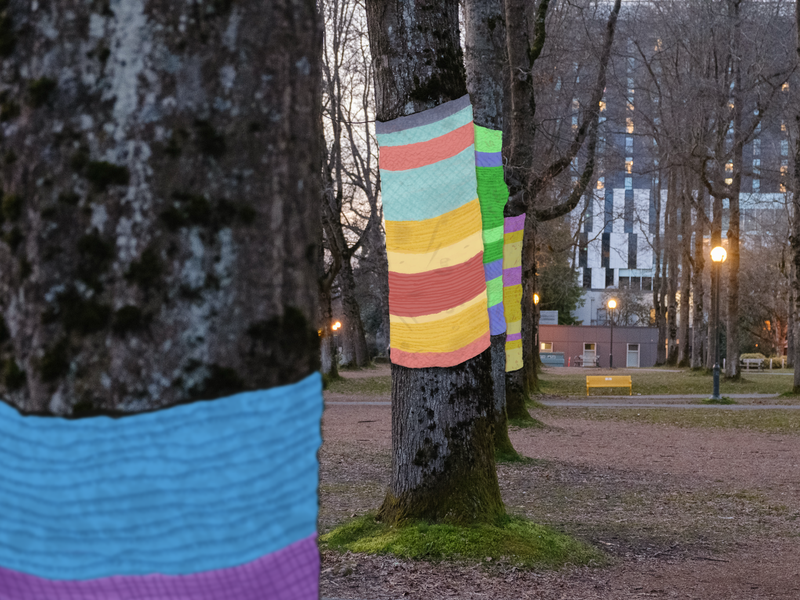
A community-led yarn installation, the Woven Grove will be installed in early September of 2026, infusing vibrant hues into our natural environment through the technique of yarn bombing — a unique form of street art where public objects, structures or natural spaces are covered in knitted or crocheted yarn. Artists yarn bomb public spaces for a number of reasons, whether it be for raising awareness or making a political statement. In Hanna’s case, it is used to create an immersive art experience that helps forge deeper community bonds, both in the creation and installation phases of the piece.
Deciding what space to use for the project was not a small task, and Ramos explained in an interview with The Ubyssey that she prioritized finding a space where people gather both often and in large quantities to “maximize the amount of crochet happiness” possible. The Bosque, located between the Life Building and the Irving K. Barber Learning Center, emerged as the ideal location, situated close to the bus loop and many central buildings on campus. The space, scattered with trees and marked by the footprints of students sprinting to class, bridges urban space and natural environment, creating the perfect intersection for the Woven Grove.
Ramos’s goals for the installation go beyond creating a beautiful space to welcome students back to classes in the fall. The heart of the Woven Grove is community, and Ramos hopes to build the project alongside students at UBC and other community members. In a post announcing the project on Instagram Ramos explained that to contribute to the project, participants are encouraged to make knitted or crocheted squares. These squares can be dropped off at The Centre for Interactive Research on Sustainability (CIRS) bin, a hub for sustainability work on campus, or at workshops and sessions hosted by Ramos. Through her collaborative and community-based approach, she hopes the project will bring people together, stitching together both community and a beautiful piece of art.
Ramos is also an upcycler and has been working with second-hand and used materials since she began her practice. Ensuring the health of the environment is one of the project’s primary concerns, and on the Woven Grove website, the health of the trees has been described as a top priority. In our discussion, Ramos assured me that all installation methods are reviewed through the campus permitted process, and that she and the other artists will work with a professional arborist throughout the entire installation process. Additionally, all the materials used will be biodegradable, ensuring the piece remains sustainable and environmentally conscious for the entire duration of its installation.
To kick off the project, Ramos hosted a Crochet & Community evening on Feb. 25 in collaboration with UBC Sprouts and hosted at the Sprouts Cafe, a non-profit student-run organization that aims to make food accessible to all on campus. The event featured a crochet tutorial led by Ramos and welcomed participants of any experience level, from absolute beginner to crochet veteran. Ramos was enthusiastic about the event after the fact — she said it was wonderful to see a group come together to create in this manner, especially considering how many participants were beginners.
Crochet, like many artistic practices, can be quite a solitary activity. It requires hours of dedication and a commitment to the craft even as things inevitably go wrong or fall apart entirely. Knowing the difficulties of beginning to crochet herself, Ramos encouraged participants to work together — the theme of the evening, she said, was to “lean on each other to learn”.
Ramos is continuing this mission with weekly Woven Grove community crochet sessions in collaboration with the UBC Knitting Club. The sessions are, once again, open to everyone, regardless of skill or access to resources. All materials are provided to participants, from hooks to yarn to emotional support. According to the event’s description the sessions are an opportunity to “slow down, learn something new, and feel connected,” and after attending the session on March 20, I can confidently say they achieved that goal.
Walking into the small but full room of textile artists, I immediately felt welcomed by the Woven Grove community. Ramos eagerly set me up with my first project — creating a five-link chain of yarn. Having had a number of crochet artists in and around my life for several years, I was familiar with some of the concepts. However, after trying and trying again — and again — to make the seemingly simple five-link chain, I quickly understood the frustration Ramos had described to me a few days prior.
Ramos encouraged me, as well as other beginner crochet artists in attendance, to push forward. She sat patiently, walking me through every loop and every mistake. After about 30 minutes I successfully completed my first single crochet,which Ramos excitedly displayed to the group. Despite my initial embarrassment, a wonderful feeling of pride eventually settled in, and although I wasn’t able to contribute a square to Hannah’s project, the sense of community and collaboration gave me enough confidence to want to return and try again.
Walking through the Bosque following the workshop, I couldn’t help but feel excitement as to the possibilities of the space. Maybe it wasn’t the pink pedals or sunlight after all, but simply the thought that through the transformation of our everyday environments a new perspective can be unlocked — allowing us to see the beautiful and creative potential that surrounds and lives within us all.
[ad_2]
Source link

No Comment! Be the first one.