
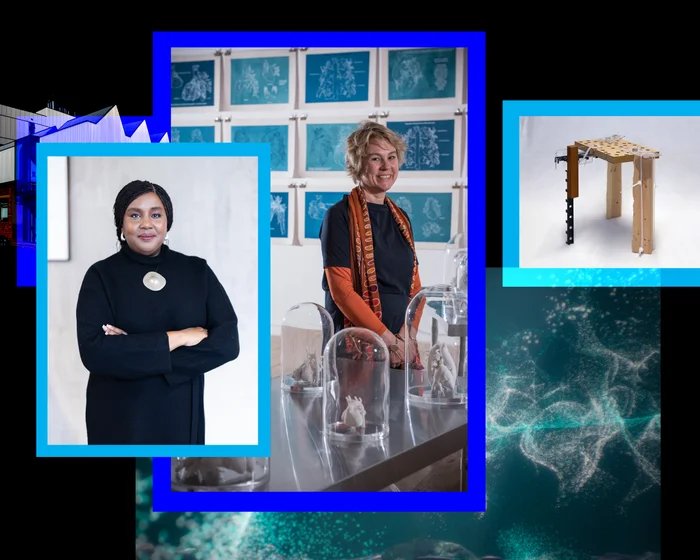
With a background in film and animation and a keen eye on the explosion in immersive media, Polina Ami Kosele joined the Royal College of Art (RCA) with a desire to “shape the bigger picture” by moving into creative direction.
Shortly before graduating in 2024 she started working as a designer at Frameless, London’s largest permanent immersive art experience, and less than a year later she became a junior art director at the company.
It is, she says simply, a dream role – and one she was prepared for not just by the state-of-the-art technical skills she learned on the RCA’s Digital Direction MA, but by the way it shaped her approach to her work, developed her confidence in collaborative environments, and helped her build the stamina needed for a demanding creative role in a commercial setting.
“I became much more intentional, in a reflective way – asking the tougher questions and really interrogating why, who, or what something is for,” Kosele says.
“Being given the freedom to explore ideas but having to take ownership of your choices made me more comfortable with being uncertain, or facing challenges and needing to troubleshoot. I realised that these things can help you evolve, and result in even better ideas.”
At Frameless, which has a partnership with the RCA to provide a platform for graduates to showcase digital artworks, she mainly works on the creation of immersive experiences for private client events, a busy and challenging role. “I think the MA programme prepared me for that professional step of thriving under creative pressure and offering solutions that evoke emotion,” she says.
It’s not only those at the start of their working lives who find the RCA experience transformative. Sofie Layton already had a successful 30-year artistic career behind her – “quite a meaty background”, as she puts it – when she joined the Master of Research MRes programme and found an environment of intellectual richness, rigour and challenge that proved instrumental in the evolution of her work.
Here, and continuing into a PhD, Layton started working with anatomical scans to explore the grief and loss associated with miscarriage, pregnancy, stillbirth and child loss, which necessitated a deep examination of the challenges of working with medical data: considering how to promote change by shining new light on topics that have historically been taboo, while maintaining “care” for both data and patient narratives that could potentially be traumatising.
“Intellectually, I was prompted to really think through things in a very different way,” Layton says. “And I think it’s an extraordinary gift to have the opportunity to be challenged in a way that doesn’t shut down thinking, but opens it up.”
Being afforded the time to truly explore ideas was also invaluable. “As an artist you’re maybe given funding to work on a particular project, but you don’t necessarily have the time to really develop that work,” she says.
For Professor Zey Suka-Bill, the college’s Pro Vice-Chancellor, Education & Student Success, this is what creative education at the RCA is all about. “It creates space for exploration, for ideas that take time to mature, and for forms of knowledge that emerge through practice rather than through predefined answers,” she says. “That doesn’t mean we don’t care about rigour or accountability – we do. But we also recognise that some of the most valuable impacts of creative education are longitudinal. They unfold across careers, across sectors, and across lives.”
When she meets alumni, the impact of their time at the RCA is clear: “They’ve learned how to ask better questions, they’ve developed the confidence to say: ‘I don’t know yet, but here’s how I’ll find out.’ Those are exactly the capabilities of creative education that are needed to shape the world.”
This space for exploration articulated by Professor Suka-Bill is an approach that resonated with Barcelona-based architect Pol Mensa Biosca. He was drawn to the RCA’s one-year Design Practice MArch programme by the freedom it offered not just in what students could research, but their end result. “It felt like some universities were more uptight in terms of what the expected outcome is,” he says.
While the sustainable design course was kept grounded with elements on skills such as carbon measuring and the workings of policy design, he found experimenting with research methods such as speculative design and critical fabulation have changed his thinking.
“I come from a very technical background,” Mensa Biosca says. “Here in Spain, architecture is not an arts degree. So I would always do everything from the bottom up. But on this part of the programme you were asked to imagine a future that would, in some sense, feel better – and then, from that position, track back to how you would achieve that.”
Today, instead of approaching a project in terms of what’s possible within its constraints, he might start by working out what they’re based on, to see if there are solutions that weren’t being considered.
Now back in Spain, he is exploring incorporating design-led research with his architecture practice, and credits his year at the RCA with helping him think more freely and optimistically about what that could look like. “I feel less constrained,” he says.
For Layton, the impact is already clear: after finishing her Arts and Humanities Research Council-funded PhD last year, she was offered a postdoctoral research associate position at the Visual and Material Lab, part of the Wellcome Discovery Research Platform for Medical Humanities at Durham University. She is now continuing her research practice and exploration into how artists can work in collaboration with patient groups and clinical and support staff, along with academic specialists, to generate new insights into health conditions.
That wouldn’t have happened without the development the RCA made possible, she says, pointing out the access it provided to supervisors, technicians, fellow students and visiting speakers – as well as novel materials and innovative technologies.
“You’re exposed to so many different ways of thinking,” Layton says. “It was an incredibly rich space in which to develop new work. For me, it was a stepping stone into accessing the academic landscape in quite a different way. And as an artist, I am hopefully helping to push the boundaries within that landscape.”
Other Articles
No Comment! Be the first one.