

Wayne Hyde works on the initial model of a monument of the musical duo The Everly Brothers. Mirror photo by Patrick Waksmunski
BEDFORD — The middle child of three boys, artist and renowned sculptor Wayne Hyde grew up on his parents dairy farm near Manns Choice, Bedford County, where the brothers hunted, fished or played in the woods when not busy with school or farm work.
They were “three ordinary country boys,” Hyde said, but with their mom being a skilled seamstress and their
dad drawing and making figurines from clay, it’s not hard to see where Hyde got his talent.
“My brothers both became skilled craftsmen and I must have inherited the same family artistic gene,” Hyde said.
“As long as I remember, I was drawing, painting or trying to create figures.”
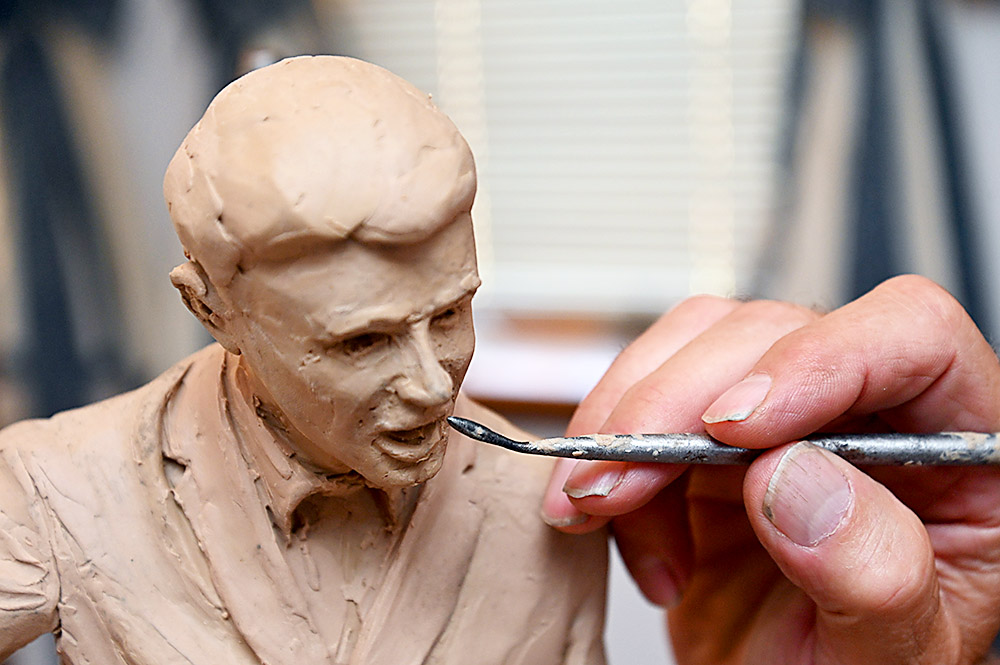
The Everly Brothers monument is designated for installation in a special themed music park in Knoxville. Wayne Hyde is creating the initial model for the legendary musical duo popular between 1951-73.
Mirror photo by Patrick Waksmunski
While Hyde makes his home in Bedford County, his life-sized and larger bronze sculptures can be found not only in downtown Bedford, but also in towns dotted across the U.S., including Maryville and Knoxville, Tennessee; Chester, New Jersey, and Clinton, Missouri.
Across the pond, Buckingham Palace is home to a smaller gallery piece. “The Charge” was commissioned in 2009 by the Royal Canadian Mounted Police, depicting a Mountie on horseback in a full speed charge. The first piece was given to Queen Elizabeth and it is that piece that can be viewed in Buckingham Palace. Additional pieces of “The Charge” have been given as gifts to visiting heads of state.
Much of Hyde’s work is in the form of memorials honoring soldiers — from the Civil War, Vietnam War and World War II — along with firefighters and police. His work can’t be pigeonholed though, as he is currently working on a monument of the musical group The Everly Brothers and he also has wildlife pieces depicting elk and wolves among others.
He’s known for his attention to detail, historical accuracy and the way he seems to imbue his creations with soul, making them come alive to the viewer.
Getting to the point today where he is confident in his abilities “took some doing,” he admits.
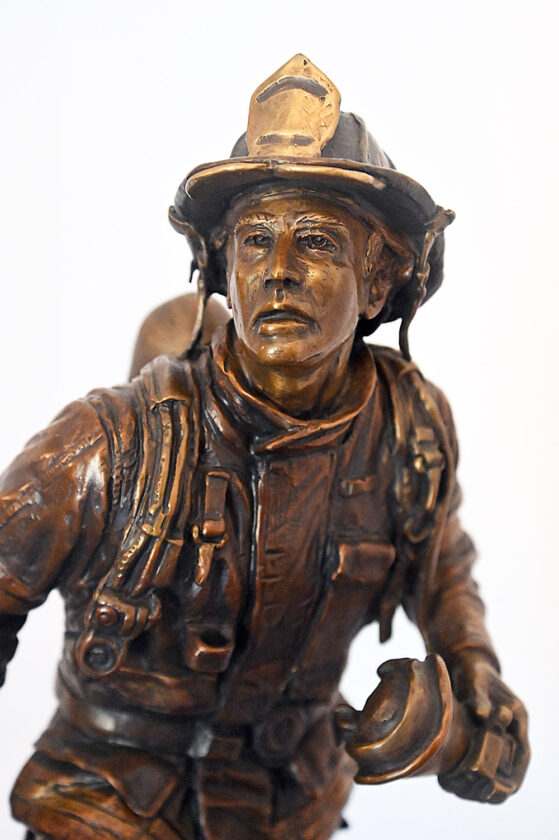
A firefighter is portrayed in “When Seconds Count” by Wayne Hyde. Mirror photo by Patrick Waksmunski
“Basically, I am self-taught as an artist,” Hyde said with a smile. “I am at a good place with my art. God gave me a measure of talent, but I always felt it was my responsibility to continue to improve. It has been a long tough road but I feel extremely fortunate to have my work so well accepted and for my strong following in the bronze art world. I am confident enough in my ability that at this point I want to relax and simply do the type of work I want to do and that I find personally satisfying and inspiring.”
Passion traced to childhood
Hyde’s work is a passion that can be traced to his formative years, when he would use leftover pie dough to make various creations. He would also cut boxes apart and use tape to create 3D objects.
“When I was about 10 years old, a neighbor lady taking ceramic classes would bring me clay that I used to make some of my early work. When I was finished she would take them back to class and have them fired. These became my first permanent creations,” Hyde said.
While life on a farm brings its own kind of inspiration, Hyde said his family received a subscription to National Geographic magazine and that became his window to the world.
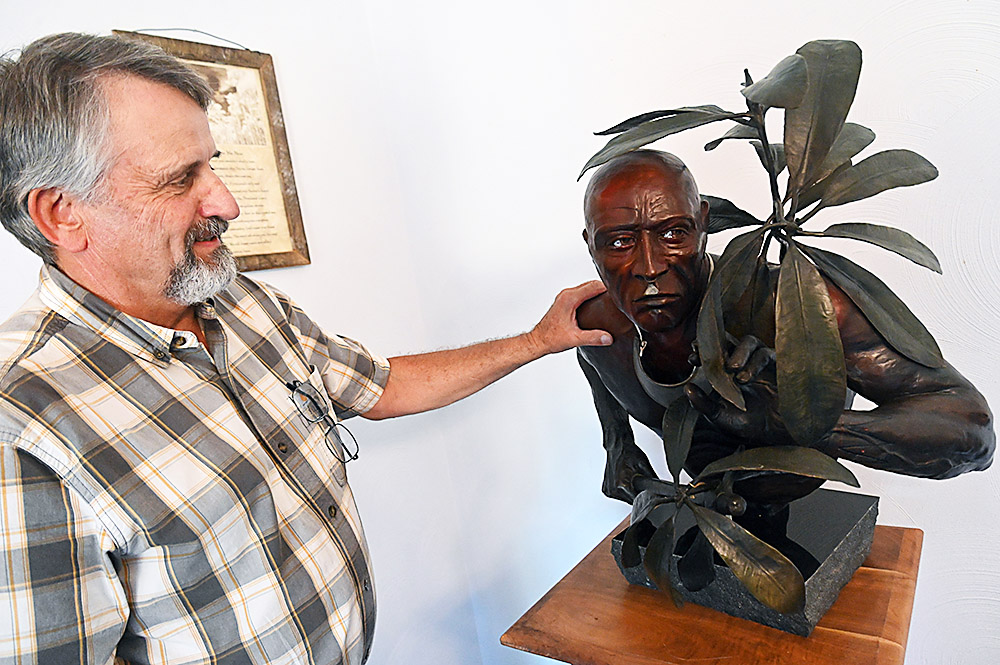
Wayne Hyde’s sculpture, “Eyes of the Forest,” portrays an Eastern Woodland warrior prepared for battle. Mirror photo by Patrick Waksmunski
“I learned about different cultures, exotic wildlife and a lot about history,” he said .
Throughout high school, Hyde focused on art and after graduation, attended the Art Institute of Pittsburgh.
“I wanted to take fine arts but I was advised to take commercial art instead,” he said, adding “I was told getting a job in the fine art field was extremely difficult.”
What he didn’t realize at the time was that someone who is truly an artist and is passionate about their art is actually in business for themselves.
“Their art is their personal product, produced by their vision and skill, the value of which is determined by the market,” he said. “There is no ‘job’ in the normal sense. I spent over two years completing commercial art training and learned a great deal about perspective, scale, colors, etc. and how it applied to my personal interest, but my goal remained to become an artist in the fine arts.”
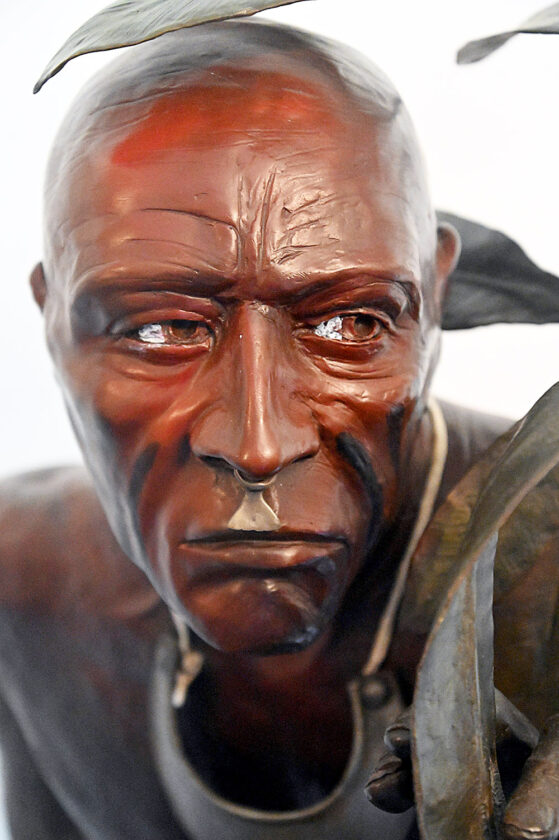
A closeup of Wayne Hyde’s sculpture, “Eyes of the Forest.”
Mirror photo by Patrick Waksmunski
At the end of the course, several companies visited the school to view the students’ work, Hyde said, noting that representatives from Hallmark liked his work as they were marketing a line of small seasonal figurines.
The job meant that he would have to relocate to Ohio and live in the city.
“I had just spent several years living in Pittsburgh and I knew two things — I wanted art to be an important part of my life and I didn’t want to live in a city,” he said.
Instead, he returned to Bedford County and the family farm where he continued to hone his craft. Using a synthetic clay cured in a conventional oven allowed him to produce and sell artwork directly to customers, making some money while improving his skills and the quality of his work.
In 1990, at the age of 31, Hyde married and moved to Carlsbad, New Mexico, where his wife had a job.
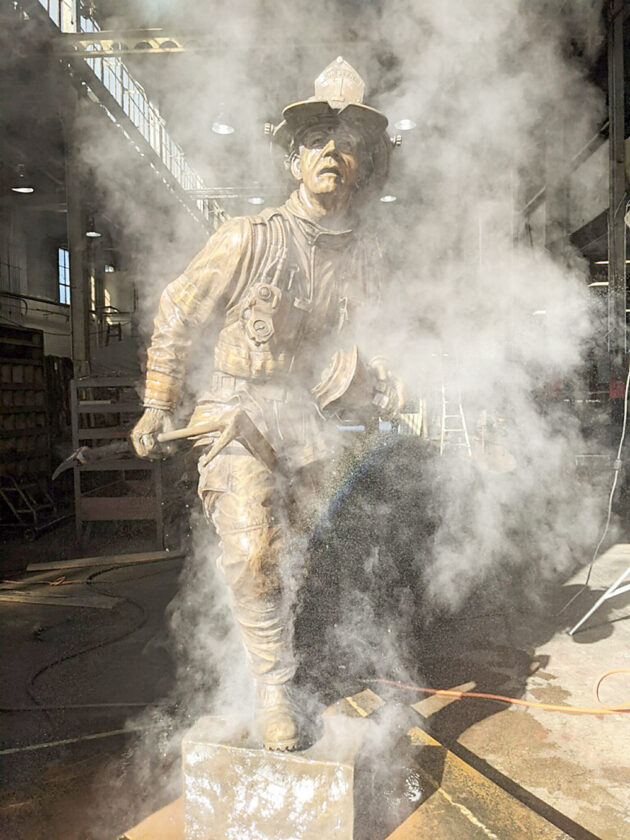
Wayne Hyde’s sculpture, “When Seconds Count,” is seen shortly after it was removed from a mold.
Courtesy photo
It was a good time to be an artist, as New Mexico was attracting people searching for a relaxed lifestyle. Hyde was able to sell his art work, sculptures and paintings — though he still had to supplement his income with other work — and he continued to fine tune his techniques.
He ended up working as a firefighter after meeting a local biologist and wildfire firefighters who were building wildlife projects.
He also continued to be involved in the arts community, where he met Curtis Fort, a real cowboy turned successful bronze artist specializing in western art.
That meeting was the first step in what would become Hyde’s favored line of work.
“I was attracted to bronze because it is a permanent form of art and even if damaged, can be repaired,” he said.
Fort connected Hyde with a bronze casting foundry, which worked solely with bronze artists, and helped him understand that the process of creating bronze sculptures is “extremely involved.”
Ever learning, Hyde continued to work on his techniques and his reputation as an artist grew.
There may be no definitive moment when an artist knows they “made it,” but when Hyde received an invitation to display a piece of his work at the “Art on the Pecos” art show, which featured highly respected artists, and his work was also included in the Rocky Mountain Elk Foundation’s annual auction, which attracts a number of wealthy bidders, Hyde and his art began attracting attention.
Monumental work
By late 1996, Hyde returned to Pennsylvania, helped on his parents farm and got a job locally working for the Pennsylvania Department of Conservation and Natural Resources. He had returned home as a proven artist whose artistic skills were honed and he was now positioned for the next step in his career — to create bronze sculptures and specifically create monuments.
He contacted the Joseph Bronze Foundry in Joseph, Oregon, seeking monument work. As luck would have it, there was a customer seeking an artist and Hyde’s name was added to the list for consideration.
After a review of the various artists’ work, Hyde was chosen and the Civil War monument he designed was placed at the Missouri State Capitol. Since then, Hyde has completed 12 monuments.
The making of a large piece, life size or greater, is a huge project and is done in multiple steps, Hyde explained. It can take one to two years to complete and easily cost into the hundreds of thousands of dollars, he said.
“Monuments are normally ordered by civic groups or organizations with a planned installation in a specifically dedicated area. In these cases they normally give the artist the general purpose for the monument but leave the actual design up to the artist,” he said.
His job is then to visualize how to represent the intended purpose of the monument.
“I want to create something that makes a connection between the viewer and the person, persons or event being memorialized,” he said. “As an artist, if I have to explain my art I have failed to communicate the proper thoughts and feelings. Art needs to capture emotion or it has no purpose.”
Giving a “for instance,” Hyde said he received a request from the Chester Fire Company in New Jersey to design a memorial honoring volunteer firefighters.
“My first step was to visualize a situation that would capture the viewer’s attention and present the firefighter in his finest hour,” he said.
He then created a rather involved storyline about a volunteer firefighter on his way home from work, tired and dirty. He gave his characters names and personalities in an effort to create the heart of the monument.
The story, Hyde said, begins as the firefighter arrives home.
“No sooner did both of his feet hit the ground when his beeper went off,” Hyde said of his imagined firefighter. “Jumping back in his truck, he decides to head directly to the fire location. A few minutes later he skids to a stop just as a elderly neighbor lady waves at him frantically. ‘Save Jenny, Save Jenny.’”
“For an instant he sees little Jenny’s face in an upstairs window, then she disappears. He hears the siren of the fire truck coming closer, help is on the way. Should he wait? No! He thinks, ‘Seconds can save a life,’ as he runs up the steps,” Hyde said.
“The image of that firefighter running up the stairs was burned into my mind as I visualized the final design,” Hyde said.
With an idea in place, he researched the clothing and equipment that would be included.
“I wanted the final piece to be accurate, proportional and historically correct in every detail. I also worked hard to make the stationary object project motion to the viewer. … I want the viewer to live in the moment displayed,” he said.
Armed with all the pertinent information, Hyde created a small-scale model of the design, which allows the client to give input before the full-scale model is created.
“Once the prototype is approved, work on the final piece begins,” Hyde said, noting the entire process from conception to installation can take one to two years or longer, depending upon the complexity and size.
Accuracy important
The sculpture in Chester Township, New Jersey, memorializes Larry Maysey, an Air Force paramedic, who posthumously received the Air Force Cross for his work during a Black Ops maneuver during the Vietnam War.
Maysey had helped two wounded soldiers safely on board a helicopter when a rocket propelled grenade struck the aircraft, which exploded and burst into flames. The pilot and one other man survived and were later rescued but Maysey and all others aboard were killed.
In an attempt to recover their bodies, a small detachment of Marines was sent in but were quickly engaged in a firefight with the Viet Cong and were ordered to abort their mission without recovery.
None of this made the national news because it was all considered a Black Ops operation, Hyde said, but as the years passed and the story unfolded, the citizens of Maysey’s hometown of Chester Township wanted to honor him. Hyde was selected for the job of designing and creating a memorial in Maysey’s honor. It was dedicated in 2005.
With a lump in his throat, Hyde recounted the day of the unveiling when he was approached by an unknown individual who said, “I want to thank you for doing what I was unable to do. You brought Larry home.”
“That was the greatest compliment of my life,” Hyde said, adding that he later found out the stranger was one of the Marines sent in to recover the bodies.
Ongoing work
Wayne is currently working on the initial model of the Everly Brothers monument designated for installation in a special themed music park in Knoxville, Tennessee. He also is planning to do smaller desktop pieces of wildlife, which have always been his love, and is intending to display his work in more art shows and exhibits.
Examples of Wayne’s work can be viewed locally in Bedford at The Veterans Grove, on the corner of Penn and Juliana streets, and in Everett at the corner of Main and Hopewell Streets. Wayne’s work also is on display for viewing and for sale in the Lord Nelson’s Gallery in Gettysburg.
To learn more, visit waynehydebronze.com
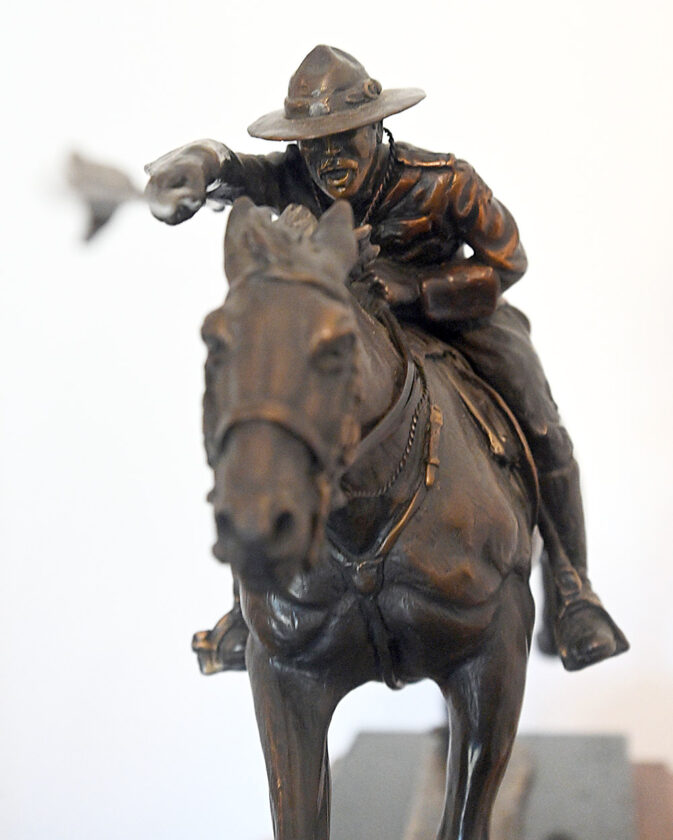
“The Charge” commissioned in 2009 by the Royal Canadian Mounted Police, depicts a Mountie on horseback with spear in a full speed charge. The first piece was given to Queen Elizabeth, which is now on display in Buckingham Palace.
Mirror photo by Patrick Waksmunski
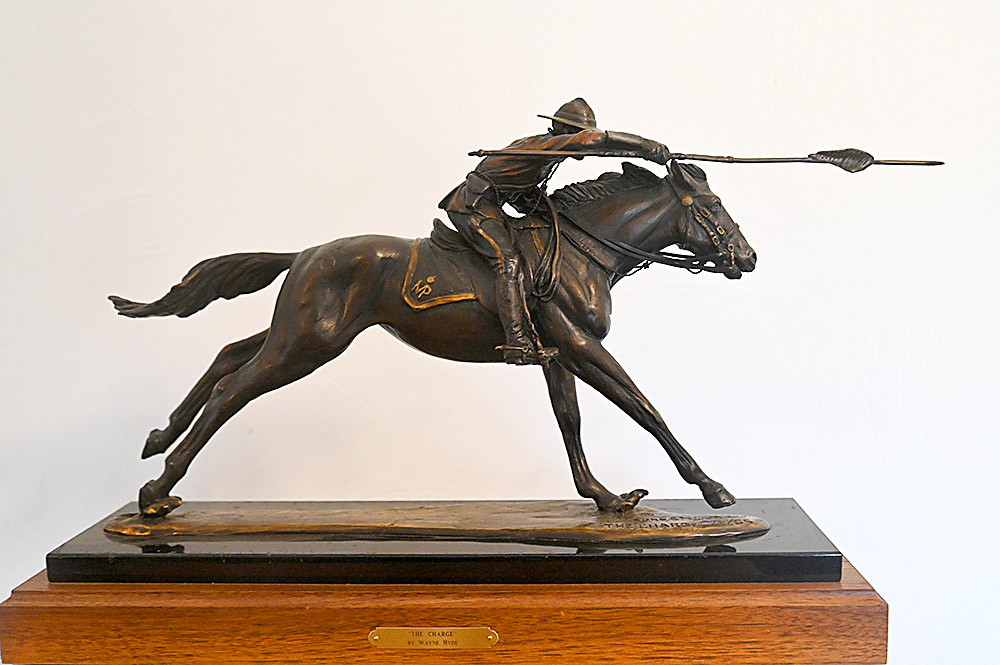
“The Charge” commissioned in 2009 by the Royal Canadian Mounted Police, depicts a Mountie on horseback with spear in a full speed charge. The first piece was given to Queen Elizabeth which is now on display in Buckingham Palace.
Mirror photo by Patrick Waksmunski
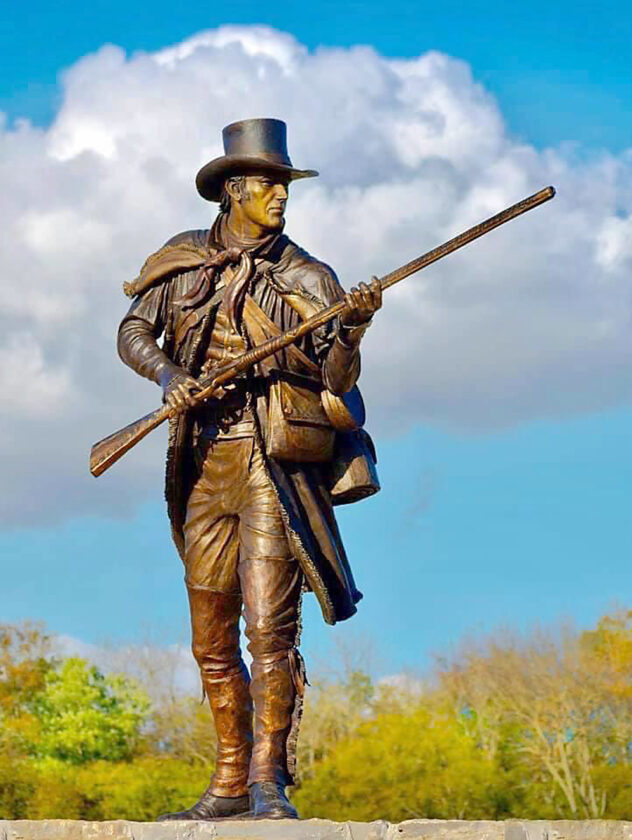
Wayne Hyde’s “The Tennessee Volunteer.”
Courtesy photo
Other Articles

Art comes to downtown Parkersburg | News, Sports, Jobs
Fun Palace event returning to the Falmouth Art Gallery
No Comment! Be the first one.