
The mind behind the glow blends an architect’s discipline with a glassblower’s nerve. Add a technologist’s curiosity and you have Arbel’s signature.
Clemens Poloczek
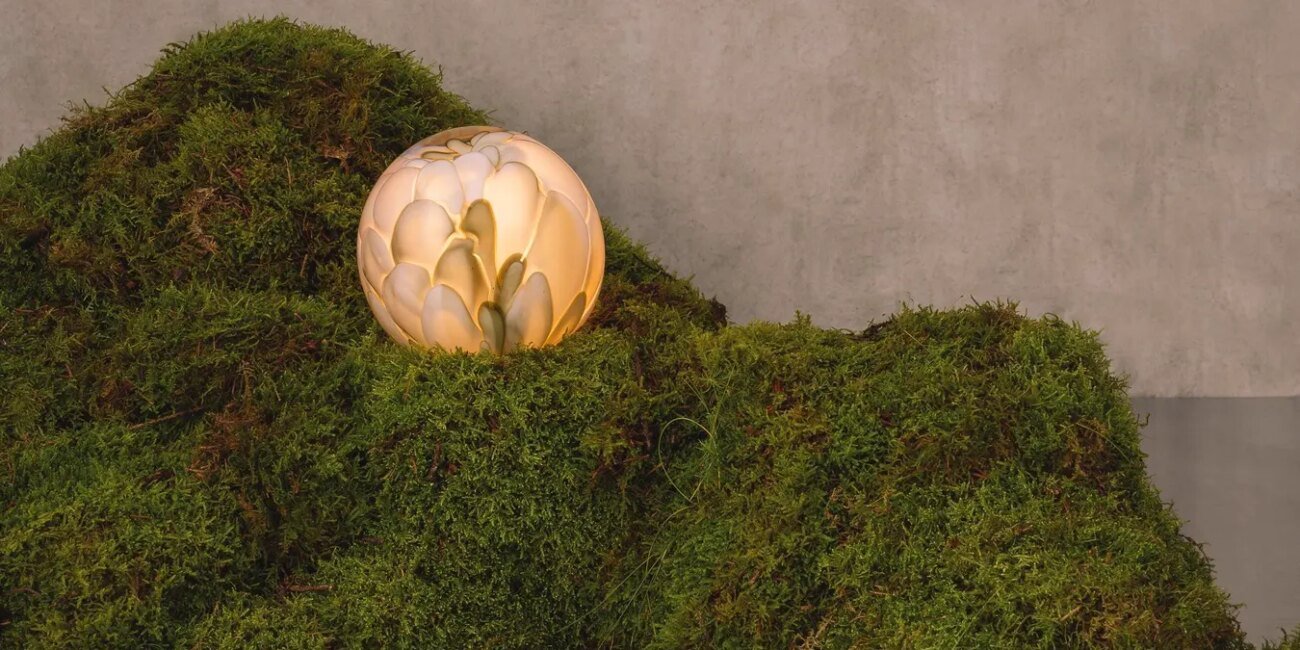
Paris calls itself the City of Light. Omer Arbel’s counterproposal? Make it liquid. Unveiled last week at Paris Art Week, Bocci’s 118p—a cordless sequel to his 118 series—distills two decades of material research into a palm-sized glow. The sphere resembles a small planet lit from within, its skin etched with fine striations—subtle “stretch marks” left by a reusable steel cage during the blow. Arbel, co-founder and creative director of Bocci, treats glass as a kind of memory device: heat, gravity, and air do the authorship. The result is a pocket of atmosphere you can carry from room to room—and a crisp expression of Arbel’s enduring obsession with light as a medium to be shaped.
Omer Arbel, co-founder and creative director of Bocci, treats glass like a memory device and light like a material.
Fahim Kassam
Canadian designer Omer Arbel occupies a singular position—neither purely artist nor strictly designer, but something more elusive: a material philosopher whose numbered experiments have redefined luxury lighting’s conceptual boundaries. He traces that fixation to years spent in “dusty, sunny cities”—Jerusalem, Barcelona, and Mexico City—where he learned to think of light as liquid. “The particulate in the air catches light at the micro scale,” he tells Forbes. “Rooms and buildings become containers for it, and objects are the particulate, catching that light and letting it be felt.” That image—a room filling with luminous volume—has animated his output since he co-founded Bocci in Vancouver in 2005 and, in parallel, established Omer Arbel Office (OAO), a laboratory-style practice spanning architecture, design, and art.
If Bocci’s early work was anchored in sculptural, hardwired installations (the now-classic 14 Series dates to 2005), 118p embodies a newer freedom. Improvements in batteries and LEDs mean the glow can travel, from dining table to garden, and from gallery to bedside. The lamp launched during Paris Art Week 2025 as a cordless sphere in four finishes—clear ($1,000), or bronze, grey, and green ($1,250)—its light intentionally soft, closer to candle than spotlight.
Grouped on mounds of white and oxblood blooms, multiple 118p spheres demonstrate Arbel’s thesis: treat light as a material and glass as a memory device.
Clemens Poloczek
The magic, though, is in the making. Each 118p begins as molten glass blown into a reusable steel cage. As air is introduced, the glass swells to occupy the cage’s voids. Gravity draws it downward; heat keeps it supple. When the glass is released and “reamed off,” the lattice of the cage lingers as a pattern within the glass matrix. Arbel calls these markings “stretch marks”—in other words, the object’s memory of its own formation. “With 118, we discovered that glass keeps organizational patterns long after they’re set,” he explains. “The cage guides the shape, but the material’s response—its flow, stretch, and texture—defines the final object. The portable 118p captures that entire process in a single sphere.”
Arbel speaks of function and expression as if they’re the same task, and in his studio they essentially are. “Internally, we don’t draw boundaries between architecture and design,” he explains. “We work on ideas without scale, budget, or schedule. Once or twice a year we review what we’ve made and decide what each piece wants to become. Some become products, others remain research, still others turn into methods for buildings.” That fluidity informs a career that ranges from experimental houses (like House 23.2 and House 75.9, where fabric-formed “lily-pad” concrete columns grow from the landscape) to museum-shown installations at the Victoria and Albert Museum, the Barbican and the Montreal Museum of Fine Arts.
A view of its debut at the 2016 London Design Festival: Bocci’s 44 commands the Barbican foyer, where over 300 coral-like aluminum forms conduct low-voltage current so bulbs appear to hover, weightless and cable-free.
Omer Arbel
His deviation from a conventional architectural path revealed itself in retrospect as deliciously deliberate. “I still make buildings and enjoy it in rare, special cases,” he shares. “But I was dissatisfied with the power dynamic baked into standard procurement. It discourages risk, exploration, the irrational. If we can move the architect’s role toward something more like an artist’s commission—count me in.” That stance helps explain why Bocci’s objects feel less like sellable products and more like impactful episodes in an ongoing material narrative.
The 118p is as another episode, and a portable one at that. Arbel likes to describe single objects as “containers for light”; groups of them, gathered in a room, become “particulate thickening the atmosphere,” a field that holds and modulates illumination. In practice, that means the lamp isn’t trying to dominate a space so much as lightly season it with an intimate glow. On a mantel among flowers, it looks like a lantern from a dream; carried onto a terrace, it turns night air a few degrees warmer.
A single 118p turns a café two-top into a stage set, its rechargeable core slipping easily between interior and terrace like a pocket lantern after dusk.
Karla Vinter-Koch
If the series has a signature image, it’s that surface: the feathered, directional striations left by the cage, each sphere an unrepeatable record of its making. Arbel is adamant that this is not haphazard decoration but an ethical position that has something to say about authorship and craft. The lamp wears its manufacture on its skin as a small truth telling. That commitment to process over polish has been present since the early numbered works and continues to govern the studio’s choices to this day. “At root I think I’m a sculptor,” he admits. “A lot of things end up in the work; it’s best not to over-explain and let it happen.”
For Arbel, Paris Art Week was a conversation on the subject, rather than a pure commercial initiative. The new lamp locates Bocci’s research in a context where art audiences are primed to see and feel process, not just buy outcomes. It also reframes portability as an intellectual issue, not a lifestyle feature: light that moves, that finds different volumes to fill, that remembers how it was made.
What’s next? He resists the crystal ball. “I try not to look ahead too much,” he says. “There’s so much change around us. We have many ongoing projects, each with their own forking paths and sometimes more exciting questions. It feels like the work has its own trajectory and momentum—and I’m just along for the ride.” That humility understates what’s obvious in Paris: with 118p, Arbel proves he isn’t chasing novelty, but instead, refining a worldview where materials are wholehearted collaborators, light is a tangible substance, and design is just another way of catching it. The lamp may be small, but it’s built to hold a little piece of the atmosphere—and to carry it with you.


No Comment! Be the first one.