
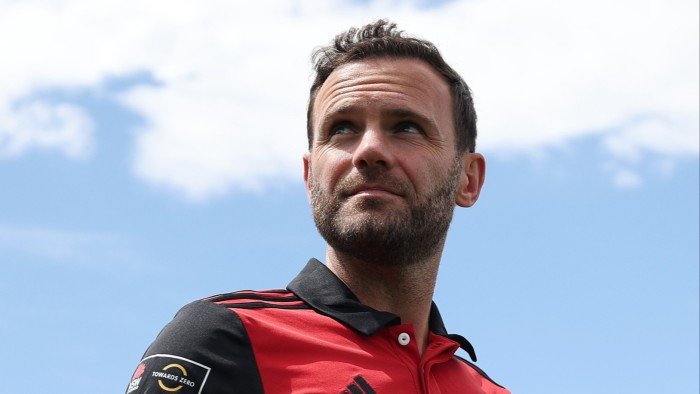
Some years ago, Hans Ulrich Obrist, the influential artistic director of London’s Serpentine Gallery, discovered that he had a surprising follower on Instagram. Spanish footballer Juan Mata, then at Manchester United, kept liking his posts. Obrist messaged Mata, who explained that he was trying to learn about art.
They met for coffee in Manchester. Mata recalls Obrist asking: “Why don’t we try to create something that has not been done before?” So, Mata says, “We came up with the idea of trying to connect football players, present and past, with artists.” Together with writer and filmmaker Josh Willdigg they have curated the exhibition Football City, Art United, which features new artworks created by 11 pairs of footballers and artists. The show opens on July 4 at Aviva Studios as part of Manchester International Festival, and will later tour in China and Canada.
Sports art has never acquired much status, despite the start it received from Greek sculptors. Football, the world’s most popular sport, has been particularly neglected. The European hierarchy used to be: the posher the sport, the more respected the art. So Degas and Manet depicted horseracing and its society crowds, while Max Liebermann and Sir John Lavery painted rich people playing tennis. Most artists scorned traditionally working-class football, with a few honourable exceptions: Frenchman Nicolas De Staël painted his “Footballers Collection” after watching France-Sweden in Paris in 1952, Manchester’s LS Lowry depicted matchstick fans in “Going to the Match” (1953), Andy Warhol portrayed German great Franz Beckenbauer and Joan Miró produced the official poster of the 1982 World Cup in Spain. But last century, there wasn’t much else. In art’s high-low divide, football was considered a profane subject.
Those divides never interested Obrist. Having grown up in Switzerland in a family that didn’t go to museums, he says, “I think it’s important that we create contact zones in society; that people can encounter art in a more unexpected way. I believe in this transformative power of art.” He once curated an exhibition of art and video games, “because a third of the world population engages in video games”. He helped connect the filmmakers Douglas Gordon and Philippe Parreno with the French footballer Zinedine Zidane for Zidane: A 21st Century Portrait (2006), in which 17 cameras followed the player during a game.

Mata was Obrist’s ideal co-curator. As a young player in Real Madrid’s academy, he had encountered Picasso’s “shocking” “Guernica” in the city’s Reina Sofía museum. All his playing career — in Manchester, Istanbul, Japan and now Australia — Mata has frequented galleries and museums, generally left in peace by other visitors. “I like every type of art,” he says. “I also love music, cinema, writing. It’s more a way of disconnecting from football, and a way of learning.”
His work with Obrist began at the Manchester International Festival in 2023, when Mata collaborated with Tino Sehgal on a performance piece that drew on the choreography of football. The show’s title was The trequartista — the Italian term for a team’s playmaker, or creator, who executes unexpected, creative passes and dribbles. Mata, who grew up admiring trequartistas such as Zidane and Ronaldinho, says, “Some footballers I consider to be artists, in a way.”
Obrist muses: “Great art and great mathematics, as [the mathematician] Gregory Chaitin once told me, has to do with the unknown. Maybe the unpredictability of some of these great footballers connects as well to this unknown.”
Mata thinks the artistry of the trequartista types is being stifled. Nowadays, he says, “football is a much more coached sport. Football and art are both industries, in terms of financial means and productivity.” He senses that in both fields, “prices, the market, and the activity are becoming more relevant sometimes than innate talent”. To him, football and art are forms of self-expression. Footballers “communicate with ourselves and our teammates and with the world through the game and the ball,” just as artists do through their mediums.
Artists and footballers responded enthusiastically to their exhibition idea. “We could have invited 50 artists,” marvels Obrist. “There are many artists who work with football.” Visitors will enter the exhibition through a tunnel created by Dutch ex-footballer turned “photographic artist” Edgar Davids, in collaboration with American sculptor Paul Pfeiffer. The tunnel invites visitors to “step into the thoughts, feelings and rituals players experience as they move through the sacred space between the dressing room and the pitch,” explains the press release.


The exhibition’s local hero is former Manchester United player turned actor and all-purpose artist, Eric Cantona. Raised in Marseille watching his father, an amateur artist, paint in his studio in the evenings, Cantona always considered football a branch of art. Mata sees him as “the epitome of the footballer-artist”. For this exhibition, Cantona collaborated with British conceptual artist Ryan Gander on a multi-faceted work, “Privileges of Hindsight”, exploring how fame affects footballers. A spotlight will randomly pick out and follow a visitor to the exhibition, treating them as a celebrity; “Le temps passe”, a song written by Cantona, will play at intervals.
The artist Jill Mulleady drew on her youthful experience of meeting Diego Maradona. Obrist enthuses, “She almost resurrects Maradona through a hologram!” English painter Rose Wylie collaborated with England footballer Lotte Wubben-Moy, who loves drawing and provided images for Wylie to reimagine. Mexican sculptor and fashion designer Bárbara Sánchez-Kane collaborated with cult Mexican keeper Jorge Campos.
Parreno (maker of the Zidane film), artist-director Marco Perego and football manager Carlo Ancelotti have pioneered a video game project that invites footballers to sketch floor plans of the homes, neighbourhoods and other spaces where they grew up, starting with Ancelotti’s own “personal geography”.
Italian architect Stefano Boeri, Mexican artist Eduardo Terrazas and legendary Italian footballer Sandro Mazzola have created a space where visitors can physically recreate Mazzola’s goals and moves. Terrazas, 89, was making sports art before it was cool: he co-designed the logo and promotional posters for Mexico’s 1968 Olympics. Obrist says, “Terrazas now has ideas for next year’s World Cup in Mexico, US and Canada.” In an almost virgin field, there’s scope for much more football art.
July 4–August 24, factoryinternational.org
Find out about our latest stories first — follow FT Weekend on Instagram, Bluesky and X, and sign up to receive the FT Weekend newsletter every Saturday morning
Other Articles

No Comment! Be the first one.