
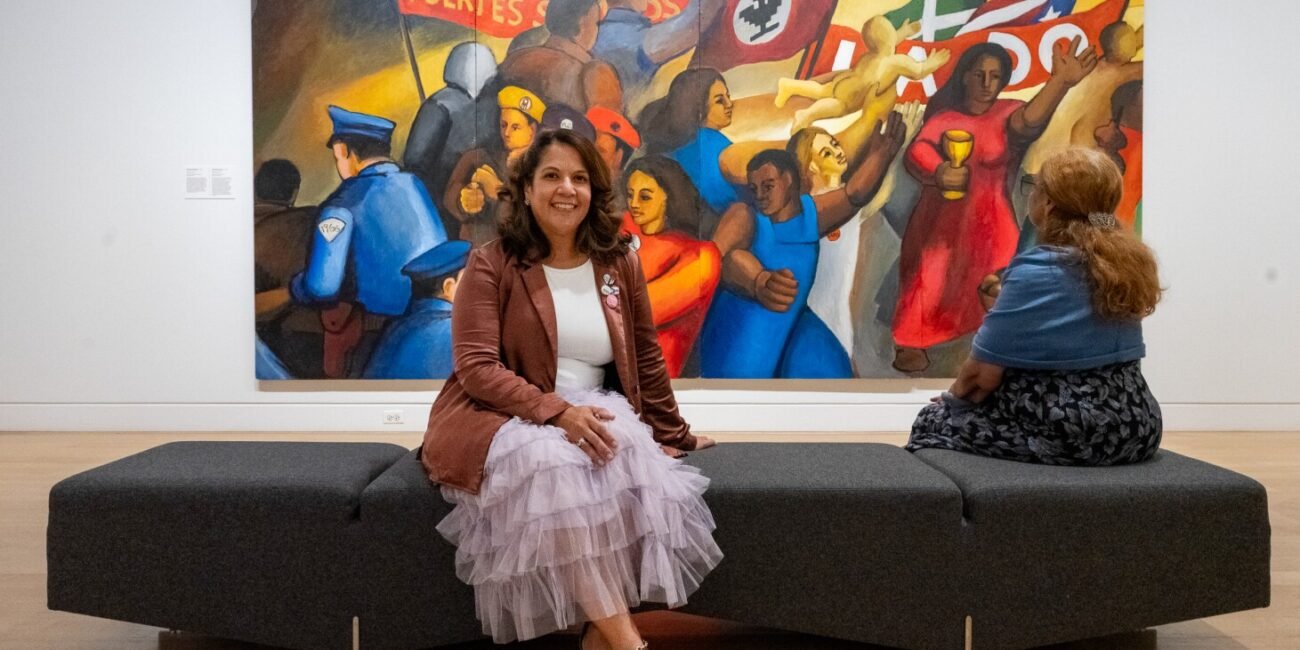
A purple beret adorned with colorful pins. Black-and-white photographs of a Lincoln Park that’s no more. Large-scale protest art.
These objects fill the second floor of the DePaul Art Museum in a new exhibition that dives into the history, activism and enduring lessons of the Young Lords Organization.
In “Tengo Lincoln Park en mi Corazón: Young Lords in Chicago,” curator Jacqueline Lazú looks back at the civil rights organization that got its start in the same neighborhood the museum and university call home.
Originally a street gang, the Young Lords grew into an advocacy group focused on the rights of Puerto Ricans who had settled in Lincoln Park in the 1950s and 1960s.
These communities were facing displacement under Mayor Richard J. Daley’s plan for “urban renewal.”
Despite their activism, inspired in part by the Black Panther Party, the Young Lords’ legacy has been underrecognized in the city where the organization began. Later, other Young Lords chapters were formed in places like New York.

“Somewhere along the way, we sort of forgot or really marginalized the history of the Young Lords here in Chicago — and certainly in the neighborhood of Lincoln Park that has changed so much,” said Lazú, a professor of modern languages who has studied the Young Lords for years. “But we still remember them as one of the most influential civil rights organizations for Latinos of that era.”

The exhibition arrives at a tense political moment when President Donald Trump has taken aim at museums nationwide. In a social media post last month, Trump wrote, “The Museums throughout Washington, but all over the Country are, essentially, the last remaining segment of ‘WOKE.’ ”
That language, along with the administration’s attacks on diversity and cuts to arts funding, has led some institutions to play it safe in hopes of keeping a low profile.
But the DePaul Art Museum isn’t backing down from its social justice-oriented mission, according to Laura-Caroline de Lara, its director.
“I know everybody’s feeling very differently in terms of what they should or should not be doing and how they should be proceeding,” de Lara said. “But really this is who we are, and this is what we do. As far as I’m concerned, DPAM really doesn’t plan on shying away from this important work.”
Despite feeling eerily relevant for today, the exhibition has been years in the making. It’s the culmination of decades of collaboration between the university and the Young Lords.
The organization started in the late 1950s as a gang founded by José “Cha Cha” Jiménez and other young Puerto Ricans. Their families had arrived in Chicago amid a wave of Puerto Rican migration to the mainland and eventually settled in Lincoln Park after being edged out of downtown and Old Town.
Puerto Rican young people frequently had run-ins with police and other young people from Chicago’s ethnic enclaves, according to Jiménez.
“We were dealing with discrimination, and the way we dealt with that was to form our own clique,” Jiménez, who died in January at 76, told WBEZ’s “Worldview” in 2018.

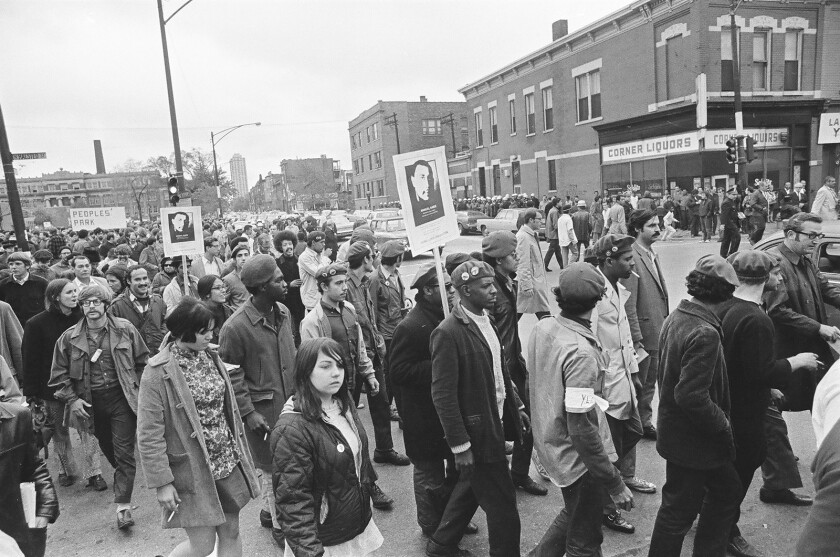
While serving a jail sentence for drug charges in the late 1960s, Jiménez was exposed to the writings and ideology of civil rights leaders like Malcolm X and the Rev. Martin Luther King Jr. That planted an idea.
“This is what we need in the Puerto Rican community,” he recalled in the 2018 interview. “A type of similar organization, militant like the Black Panther Party, to address all the police brutality and housing issues that we were dealing with. So we were able to transform a gang. We built a movement.”
The group engaged in direct action — including protests in the streets and a sit-in at a McCormick Seminary building — to draw attention to the discrimination and displacement experienced by the Puerto Rican community in the neighborhood. Like the Black Panthers, the Young Lords organized free meals for neighbors and established a childcare center so that women could join the movement.

Lazú has been studying the Young Lords for more than two decades. She has helped to archive, organize and spread the word about the group’s history and contributions to the Civil Rights Movement. In 2023, that led to installing a historical marker on campus outside what was once the seminary’s administration building and is now part of DePaul’s music school. The Young Lords occupied the building during a 1969 protest that followed the police killing of Young Lords member Manuel Ramos.
In addition to the exhibition, Lazú’s has a book, coauthored with Jiménez, that’s set to be published by Haymarket Books next March.
“I would have loved for him to, like we did so many times before, see these projects through and really collaborate on launching them and presenting them to the public,” Lazú said of Jiménez. “I feel like he’s here in spirit.”


For Jiménez, the work never ended, Lazú said.
“I don’t think that there are enough words to really describe the level of commitment that Cha Cha had to the Young Lords and what he named as a protracted struggle,” she said. “Cha Cha never stopped calling himself a Young Lord, and he didn’t see an ending to the Young Lords Organization.”
Lazú said she is grateful to have the backing of DePaul.
“We can’t allow ourselves to think that every moment of discourse is a moment of controversy, as opposed to an opportunity for dialogue,” Lazú said.
In a moment of deep divisions, Lazú said the Young Lords can serve as an inspiration.
“They were very much about dialogue across difference and through difference,” she said. “They weren’t afraid of those moments of tension.”
Other Articles

Can you create an art scene from scratch? Why real art can’t be engineered
Tracing the Goldsboroughs: A Maryland Dynasty & Their Decorative Arts
No Comment! Be the first one.