
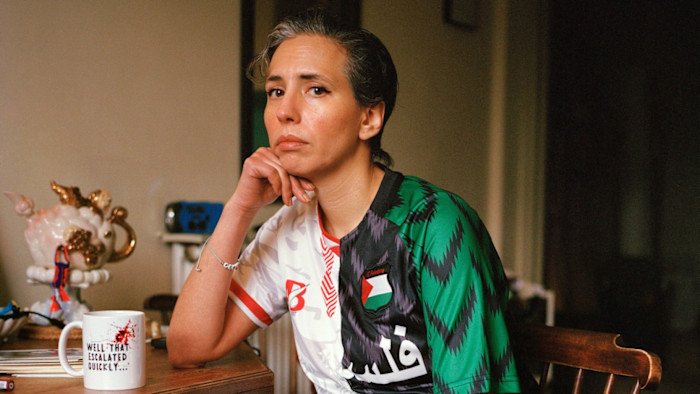
At Frieze London last October, Sophia Al-Maria publicly quit art. Across the art fair’s five days, she presented “Wall-Based Work”, a series of performances inspired by stand-up comedy. One day, she staged a conversation about land rights in Brazil. On another, she “married” an audience member for a visa. On the Thursday, she went on strike in solidarity with Gaza. And to cap it off, following an art career spanning 15 years that brought her multimedia works to Tate Britain, the Whitney, the Venice Biennale and other institutions, she stood before an audience and declared she was giving it all up.
“I was feeling so frustrated with the art world. I was saying: I’ve had it, this is my finale. I really just want to retire and learn how to live. And afterwards, I felt relieved,” Al-Maria, 42, tells me over a video call from Barcelona, where a large, unfinished canvas behind her suggests that she might not be totally done, after all. When I point this out, she laughs. “I am quitting, but I’m doing these few last shows because I was already committed to them, and I feel it’s important to finish what I started.”


The commitment in question is a presentation at the inaugural Art Basel Qatar with the Dubai-based gallery The Third Line. It’s particularly meaningful for Al-Maria, who grew up with a Qatari father and American mother shuttling between the two countries, as chronicled in her 2012 memoir The Girl Who Fell To Earth. She later studied comparative literature at the American University in Cairo and then aural and visual cultures at Goldsmiths in London, where she now lives.
Sitting in front of her canvas, Al-Maria cuts a distinctly cyberpunk figure. Her expressive, angular face is buried under layers of accessories: huge headphones, sci-fi silver-framed glasses, black hood pulled up over a distressed camo baseball cap from trendy Emirati brand Shabab. At Art Basel Qatar, she will present “HILUX”, a new body of work including ink and watercolour paintings, named after the all-terrain Toyota truck which is an icon in the Gulf associated with Bedouin communities.

For Al-Maria, the HiLux is a potent symbol. It represents resilience in its sturdiness, autonomy in navigating the desert, the oil and technology which have utterly transformed Gulf society, but also her personal history — it was the first vehicle she ever drove, when her uncle let her ride one around the desert in Saudi Arabia. She shows me her work in progress, where the go-faster flame decal of the HiLux is distended into a timeline that connects a supine man, a shepherd’s crook, and a driverless truck filled with goats, all drawn in clean, cartoon lines.
As well as a homecoming, the Art Basel Qatar show is an opportunity for Al-Maria to address a personal source of frustration. In 2012, she coined the term “Gulf Futurism” alongside musician and collaborator Fatima Al Qadiri to describe the socio-cultural whiplash experienced in the Gulf states when people catapulted from agrarian societies into high-tech metropolises in a matter of decades. Al-Maria’s 2016 work at The Whitney, “Black Friday”, gave form to these ideas, pitching video screens atop piles of sand that showed empty malls in Qatar, edited to look disorientating, threatening, yet strangely seductive.


The term was eagerly picked up by fashion magazines and sci-fi writers like Bruce Sterling, yet Al-Maria felt that her idea had been reduced to merely a sexy aesthetic: the striking dissonance of glossy skyscrapers adrift in barren deserts, an Orientalist cyberpunk totally defanged of social critique. “It was meant to be satirical”, she says, to interrogate how oil extraction damages not just the environment, but also “affects our bodies and lives and alienates us and kills us and makes us sick — all the things I was witnessing growing up in the Gulf.”
She sees her show in Qatar as a corrective where she can rearticulate Gulf Futurism, which she thinks is more relevant than ever. “Because of oil and natural gas resources, you can see it in Nigeria or anywhere where oil companies come in and acceleration happens. The Gulf is everywhere.”

She shrugs on an ink-green fur coat and opens the balcony door to smoke a slim Vogue cigarette. There’s a poetry to how Al-Maria articulates her ideas, and our conversation unfurls with a confounding dream logic. One moment she’s talking about medieval Syrian fables, the next discussing the shape of a goat’s pupil. This sense of overflow cascades through much of her work, where she often collages disparate media together in experimental films stuffed with imagery. Her 2019 work “Beast Type Song”, shown at Tate Britain, interweaves a sci-fi war, Lebanese poetry, tattoos and doves and drones. Al-Maria leaves the audience to connect the dots.

There’s also a restlessness in her choices of medium. She has written books, directed films and joined post-punk band Moin performing vocals in front of large crowds. It was probably only a matter of time before she got around to stand-up comedy. “I decided to do stand-up because it’s cheap, not realising how expensive it would be on my heart and soul,” she says with a bitter laugh. “I have so much respect for comedians and musicians. I don’t have a great deal of respect for contemporary art anymore. My heart has been broken. I believe in art, but not the market.”
How did the art market break her heart? “All the structures around the art world are really oppressive,” she says. “There are brilliant artists I love who are profoundly committed to their art, but they don’t have the business acumen to succeed in the art world, which is increasingly what it takes.” Al-Maria points out that despite having “a successful career”, she still doesn’t make a living from art — for that she does TV and film screenwriting, such as Little Birds, a Sky Atlantic drama miniseries based on the writings of erotic writer Anaïs Nin. She also believes artists have become less bold in their work as they fear for their income sources, particularly following the blacklisting of artists who spoke out in support of Palestine following the invasion of Gaza. “I feel lucky to have not ended up on one of those lists,” she says.

Al-Maria’s despondency reaches beyond the art market to the general state of the world today. “I’ve found words are failing me, especially within the last few years,” she says. “Words like ‘genocide’ don’t make sense anymore. Everything has stopped making sense. There has been a betrayal of our human contract with the earth, with each other, with animals. A trust was breached. I’m interested in how we ended up in this timeline and how we might get off it.”
She’s considering retraining in care work or nursing. “I want to do something in my body, to be present, to step into history and not just be a spectator to suffering.” And while she plans to absent herself from the structures, institutions and interminable fundraising proposals of the art world, she won’t stop making art altogether. She tells me she’s been enjoying the whole-body aches from a straight month of painting. She’ll keep making art, but only as it pleases her. She lights another cigarette. “I’m doing it for myself from now on.”
thethirdline.com; artbasel.com, February 5-7
Other Articles
Architectural Hair Art: Hollywood’s Textured Hair Movement
Suffolk fine art student’s work gets a national viewing
No Comment! Be the first one.