
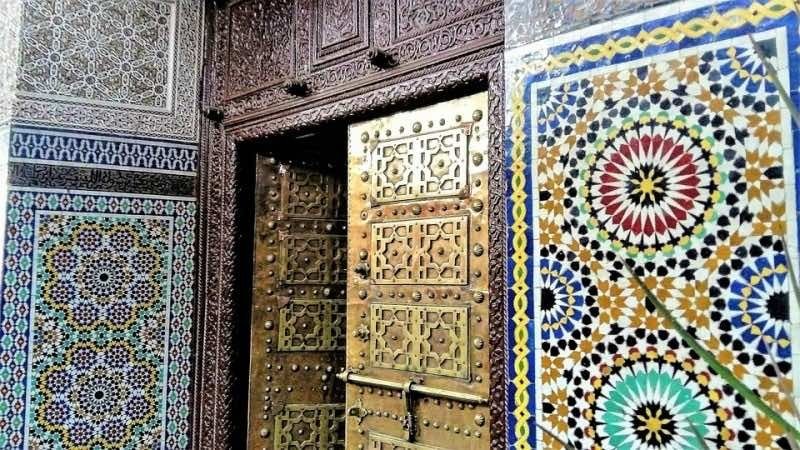
Rabat – When Algeria recently won the silver medal at Expo Osaka 2025 for best exterior design, its pavilion’s façade was celebrated for what organizers called “Algerian Zellige”.
The label was more than a misnomer; it was theft of history. There is no such thing as Algerian Zellige. The term itself is an act of cultural distortion, a convenient fiction that strips the art of its Moroccan roots and transforms centuries of craft into a decorative pattern for diplomatic display.
Zellige is not a generic North African motif. It is a Moroccan art form, born in the madrasas of Fez and perfected in the courtyards of Marrakech and Meknes. It belongs to the same cultural lineage that produced Morocco’s ornate fountains, its tiled minarets, and the intricate interiors of its palaces.
To call it otherwise is to dismantle the very foundations of an art that Morocco has preserved through discipline, geometry, and devotion.
From heritage to appropriation
The origins of zellige are inseparable from Morocco’s architectural history. Emerging under the Almoravids and refined by the Almohads, the art reached its zenith during the Marinid dynasty in the 13th and 14th centuries.
It was in Fez that Moroccan craftsmen developed the complex geometric language of interlacing stars, polygons, and floral patterns that define zellige today.
The technique was passed from master to apprentice – a lineage of artisans who understood the tile as both material and meaning. Each piece of zellige is cut by hand from glazed clay, its colors derived from natural minerals and arranged into intricate mosaics symbolizing harmony and infinity. This process is not replicated anywhere else with the same precision or continuity. Morocco did not merely adopt this art; it built an entire architectural philosophy around it.
Over the past years, Algeria has repeatedly attempted to reframe zellige as part of its national heritage, transforming Morocco’s cultural symbols into instruments of regional competition.
Concerning the Adidas controversy in 2022, Morocco’s Ministry of Culture filed a complaint against the German brand for using zellige-inspired motifs on Algerian football jerseys. Adidas later acknowledged that the design had been drawn from Moroccan craftsmanship.
Yet, Algeria’s claim persisted, feeding a broader narrative that Morocco’s heritage is somehow collective, belonging to all Maghreb states equally.
At Expo Osaka, this pattern of appropriation resurfaced in architectural form. Algeria’s pavilion, adorned with zellige-like mosaics, was hailed as a representation of “local tradition.” But such recognition rests on misrepresentation.
The danger of dilution
Cultural appropriation is often subtle. It operates not through overt theft, but through dilution through the quiet rebranding of identity into something regional and indistinct. By calling Moroccan zellige a general Maghrebi or Algerian art, Algeria engages in a form of erasure that weakens Morocco’s authorship. Heritage – once misattributed – becomes difficult to reclaim.
For Morocco, the stakes are not symbolic alone. Cultural ownership is a form of soft power. When zellige is wrongly claimed, Morocco loses more than artistic recognition; it risks losing the authority over how its history is represented.
Algeria’s cultural institutions have sought to register Algerian Zellige with UNESCO, further muddying the origins of an art that has always belonged to Morocco.
The question of zellige is ultimately a question of integrity. Algeria’s efforts to claim Morocco’s artistic identity reflect a broader strategy of cultural mimicry that extends beyond art into politics and image-making. By appropriating Moroccan symbols, Algeria seeks to project a civilizational depth that its own architectural heritage cannot sustain in the same continuity.
Morocco, meanwhile, continues to guard its traditions through preservation, education, and recognition. The zellige of Fez is registered with the World Intellectual Property Organization, and Moroccan artisans continue to train new generations to uphold this centuries-old craft.
Morocco draws the line
Morocco’s Ministry of Culture can no longer treat these repeated acts of cultural appropriation as isolated incidents or digital noise. What is at stake is not only the authenticity of a craft but the integrity of national heritage itself.
The ministry must move beyond symbolic condemnations and pursue concrete international measures to protect Morocco’s intangible patrimony. Registering zellige, the caftan, and other Moroccan traditions under international legal frameworks should become a diplomatic priority.
The tension between Morocco and Algeria is not confined to borders or politics; it seeps into every sphere, from diplomacy to football to culture. For decades, Algeria has sought to counter Morocco’s growing regional influence through what many analysts describe as soft-power sabotage.
When Morocco advances economically, Algeria revives political disputes. When Morocco’s cultural exports gain international visibility, Algeria rushes to mimic or distort them. The pattern is strategic rather than coincidental.
From obstructing Morocco’s diplomatic initiatives in Africa to attempting to discredit its success in global forums, Algeria’s posture has long been one of rivalry disguised as nationalism. Cultural appropriation, in this context, becomes another tool in a broader campaign to erode Morocco’s moral and symbolic leadership across the Maghreb.
Zellige is only the most recent victim of this campaign. Algeria has previously attempted to claim the Moroccan caftan as part of its national heritage, describing it as a shared North African garment despite overwhelming historical evidence of its Moroccan origin.
Even Morocco’s southern provinces are not spared from Algeria’s revisionist appetite. Algiers continues to claim moral authority over the Western Sahara dispute, insisting on a narrative that denies Morocco’s sovereignty and promotes separatism as a tool of pressure.
The same logic that drives Algeria to appropriate Moroccan art underlies its obsession with the Western Sahara, which is a refusal to acknowledge Morocco’s territorial, cultural, and civilizational depth, and a fixation on opposing its ascent at any cost.


No Comment! Be the first one.