
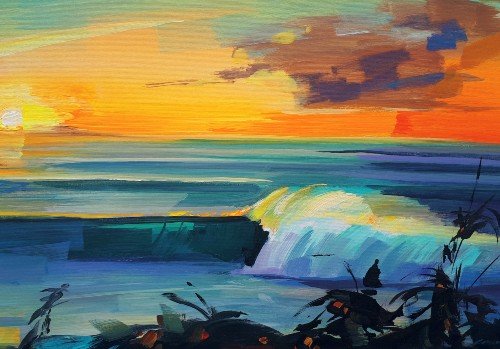
When it comes to surf culture, there are not many places that are more ‘peripheral’ than Italy.
Italian surfers cannot boast any mythical founding father, no Duke Kahanamoku to whom they can dedicate a statue, a stamp, or an official portrait. The history of Italian surfing is a patchwork of episodes without much linear correlation.
Rudy Newmann, a German hotel manager living in Italy, opened the way in the late 1950s, in the Adriatic Sea of all places, then Peter Troy snaked a few rides in Liguria in 1963. Each converted no proselytes: they came, they surfed, they left.
Waveriding had to be re-invented locally, adapted to one of the most unpredictable and fascinating bodies of water a surfer can dig his or her fins in. It only began in the 1970s, almost by chance, when a generation of visionaries took over, explored 8,000 km of exposed coastline, and created a lifestyle almost from zero.

This is the surf environment Vincenzo Ganadu grew up in. Vincenzo is a first generation surf pioneer on Italy‘s most consistent coastline, the north shore of Sardinia Island. He cut his teeth on the dark westerly swells that traverse the Med in the deep of winter, grew up breathing the crystal clear air that follows mistral storms, marvelling at every new right-hand point his crew was discovering – there are about twenty on the island.
“Surfing here was grassroots through the ‘80s and ‘90s,” says Vincenzo about those early years. “We would just look at the wind direction, the clouds, and set out. We were explorers without a compass: we found most spots just by getting lost.”
“Forecasts were nearly non-existent so every good wave, every session felt unique. Something epic to write about…or paint about.”

In the pre-internet era, waves materialised out of the blue, fleeting epiphanies destined to last a few days, sometimes just hours, like some sort of mystical visions. The bond they created between the few locals willing to chase them is something I haven’t met in any of my travels. This first-generation froth is what I see in Vincenzo’s Art.
Note I’m using a capital ‘A’ in Art.
“I was trained in the most traditional, almost reactionary ways of creative work,” Vincenzo recalls. “I started drawing at age six, mostly pencil and pastels, practicing anatomical forms till my technique became almost photographic, over realistic.”
“Then my mind frame changed when I met Pinuccio Sciola, a world renowned artist also from Sardinia. He accepted me in his workshop, taught me how to strip art down to the essentials; how to identify power lines and proper framing, eliminating all unessential details. My brush strokes got wider, more assertive. I stopped blurring colours, no more outlines. It was Pinuccio who pushed me to paint waves. I was always late for class when a swell was on. He knew that that was what I loved.”

Honing his skills in Sassari and Bologna art academies, Vincenzo came in touch with the pillars of European art. I’m not a connoisseur but in his works I see the romanticism of William Turner melting with the rationality of the Futurist movement of the early 1900s, all awash in fresh Mediterranean light. The black splashes of basaltic rock, the deep greens of Sardinian oak forests, the blinding yellows of wild broom, but most of all the countless hues Sardinian waters can produce. Weather changes quickly here. The Caribbean aquamarine of sheltered lagoons can quickly turn into that ‘wine-dark sea’ so admirably sang by Homer in his Odyssey.
“As a surfer I was fortunate enough to surf California, Australia, Peru, Hawaii in the early ‘90s, bringing my most recents pieces along. Travelling was extremely expensive for us Sardinians. I would barter my art for accommodation or food. Then I understood that those canvas had a value beyond money, they spoke a language that surfers would understand regardless of linguistic barriers.”

At left, Vincenzo’s rendering of a B&W Albe Falzon photo of a messianic Nat Young: “It’s from a photograph taken at Bells Beach in 1970, during the annual surf event held every Easter,” said Albe of the image. “The photograph captures a poignant moment. I’m not sure what Nat was thinking as he cast his eyes to the horizon, however I feel that it is extraordinary in that it captures more of an ‘inner vision’ than an exterior one, although at the time I didn’t see that.
Vincenzo captures Nat’s gaze using, in his words, “cool tones and wide brushstrokes, where the gaze is more defined to observe the viewer watching the work.”
Looking equally beatific is Peter Troy at right. Another painting of a famous photo, this time taken by Rennie Ellis who was Troy’s travel partner to Italy in 1963.
Vincenzo has since held expositions in Laguna Beach, Honolulu, Noosa, Biarritz, and Lima. Warner Bros bought the rights to a few of his paintings to be used as interior in movie sets. One of his canvas became the poster for the 2008 Noosa Longboard festival, selected by Phil Jarratt himself. And he still remains the most humble artisan you can imagine, working out of his art-farm, located a stone throw from the sea and teaching visual arts in a local high school.
In his latest exposition, History of Italian Surfing, Vincenzo pays homage to his roots; that generation of visionaries that made surfing possible in the Bel Paese.
Those disconnected anecdotes become a coherent narration in a display of twenty-three 150 x 120cm canvases starting an itinerant exposition in September. In this endeavour Vincenzo’s art finds, perhaps, its deepest meaning. A common language that needs no words. A bridge between Mediterranean periphery and the global epicentres of surf culture.

Visit Vincenzo’s website surfartganadu.com for events, contacts, and products
Instagram: vincenzoganadu

Other Articles
No Comment! Be the first one.