
What does AI mean for human creativity? How can artists and designers best harness AI’s potential – and should they even be doing so? These are the kind of questions the Royal College of Art (RCA) has been addressing for some time. Since its foundation in 1837, the college has continuously redefined creative education to embrace technological advances, from the motor car to the moving image.
For Dr Danielle Barrios-O’Neill, Associate Dean across the RCA’s Schools of Communication and Design, AI has big implications for creators, because, she says, creativity is the most important component of intelligence. “And perhaps the first impulse is to be frightened. We’ve all seen the headlines about what AI could mean for artists.
“If you were a painter when photography first arrived, there would have been a similar response: people who paint portraits thinking: ‘Oh God, what does this mean?’ But it ended up changing how we think about portraiture, and clarified the meaning of painting and photography as art forms.
“Today, it’s very exciting to be educating and supporting students who are tackling similar questions about AI and trying to answer them through their work,” she says.
It’s a topic that touches every discipline taught at the RCA, from architecture and contemporary art to communication and product design. One field of study with a particular focus on AI is the Master of Design Futures: the use of design methods and strategies to address the complex social and environmental challenges of the coming decades.
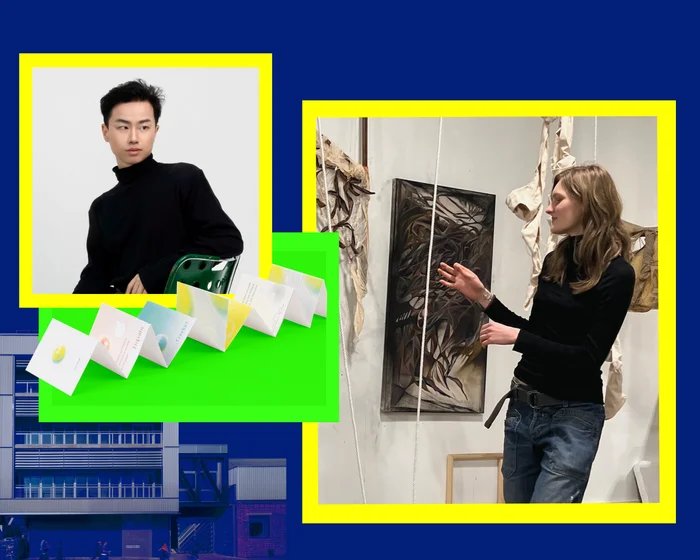
Product experience designer Julian Yutong Zhu graduated from the MDes in 2025. For his degree project he created a conceptual model that visualised the future of higher education in 2050 – a scenario in which every student would be guided by their own individual AI “partner”.
Yutong Zhu’s research looked at both the positives and negatives of AI. He explored whether it could produce more personalised learning experiences and greater equality of outcomes, and conversely, whether overreliance on AI could have a negative impact on critical thinking and creativity.
“I’m really interested in exploring how AI can support equitable, creative, flourishing futures,” says Yutong Zhu. “At the RCA, we’re encouraged to critique everything, and we have the space to be speculative. We can be pioneers, imagining these futures and sharing our visions. And we’re trained to express these ideas by visualising and making things, rather than writing papers.”
Even those studying more traditional artistic disciplines have the opportunity to make a wide-ranging exploration of technology. Emma Deegan is a student on the Sculpture MA programme who works predominantly in metal and textiles. She has recently begun to incorporate robotics and microcontrollers into her work.
“I’ve worked with the robotics technicians at RCA to learn how to use Arduino boards and get the technical expertise to bring my ideas to life. I’ve also been able to swap ideas with the Design Products students on the floor above, who have a very different perspective from us sculptors, and I share a studio with someone who uses 3D printing and AI in their work.”
Deegan recently attended an RCA event called The Urgency of the Arts Assembly: Art and AI. In sessions by leading artists and academics, it challenged students to lock horns with the most important cultural debates of our time – including the impact of new technology – and question their own artistic assumptions.
“The sessions we have had on the emergence of AI, and what it means for artists have made me think about it a lot in my own practice,” says Deegan. “I’ve been developing kinetic art that explores the way our own bodily processes are similar to the internal workings of machines.”
Deegan, who has concerns around the ethical and environmental impact around AI, adds that one of the things she really appreciates about RCA’s approach to the broader conversation around AI is the critical dialogue it encourages on both sides of the issue.
In the RCA’s School of Communication, AI has been embedded in degree programmes for five years or more. As Head of Programme for Information Experience Design (2020-25), Dr Barrios-O’Neill encouraged her students to think about the ways in which they could “collaborate and interchange with non-human intelligences”.
She says: “We position AI as an agent, collaborator or resource that can be very helpful in the creative process. It’s particularly good for speculative design: it can project a blueprint of the future, which we can then challenge, coming up with counterfactuals and alternatives.”
AI tools have proved their worth in areas like prototyping, making it easier and quicker for students to pioneer new designs. And exploring AI’s possibilities has been a genuinely collaborative process, Dr Barrios-O’Neill says. “Everyone is on the same level – students and staff. People constantly bring new tools to the community, and we learn about them together, looking at them critically and testing them in workshops.”
Making sure students are up to speed with technology and the debates that surround it is just one part of equipping them for a successful future. To thrive, graduates will need to be resilient and adaptable, with a core of skills, such as effective communication, critical thinking, creative problem-solving and team dynamics high on the curriculum.
Dr Barrios-O’Neill doesn’t even think of these as “soft skills” any more because they’re so vital. “We need to make sure students aren’t overwhelmed by complexity. We want to give them a systematic approach to problem-solving, so they’re not just looking for a silver bullet and expecting to be able to solve everything with a single piece of work.
“Whatever challenges they take on, they’ll need to navigate complex networks of factors and interactions.”
Above all, it’s about ensuring students have “agency in a landscape of uncertainty”, and become graduates who are not just able to weather change, but can take active control of the technologies that will shape tomorrow’s creative landscape.
“At the RCA, we’re educating the people who will determine what objects and environments look like in the future,” says Dr Barrios-O’Neill. “It will be their responsibility to channel AI, both as a resource and a collaborator, into creating the sort of world we actually want to live in.”


No Comment! Be the first one.