
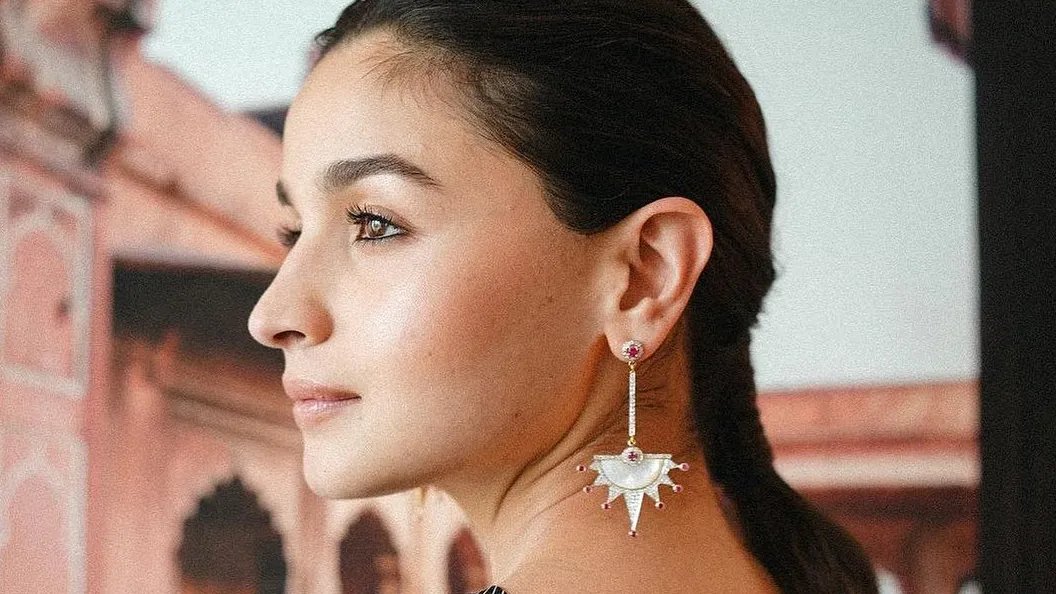
Taking shape in the years following World War I, Art Deco emerged as a visual language obsessed with order: geometry, symmetry and a belief in modernity as something measured. Its formal debut at the 1925 Exposition Internationale des Arts Décoratifs et Industriels Modernes in Paris gave that instinct a name. The movement travelled across disciplines, finding its most enduring expressions in jewellery and architecture.
Early Art Deco jewellery began with formalised floral motifs before shifting toward cubist abstraction and the hard edges of machine geometry. In step with the visual excess of the Roaring Twenties, Art Deco jewellery favoured high-contrast colour pairings. What truly defines the era is the intentional spacing between geometric lines, where proportion and negative space do as much work as ornament.
With platinum often used as the base, the metal’s whiteness was contrasted with black onyx enamelling. The later Deco period also saw the use of “tutti-frutti” gemstones—rubies, emeralds, sapphires and corals.
“The Art Deco design movement was intended to make things sleeker, faster and more streamlined. No style since the 1920s and ’30s has left such a lasting impact and it visibly filtered into everyday life including furniture, architecture and jewellery,” explains jewellery designer Hanut Singh.
2025 marked a century of the Art Deco movement and Deco’s relevance and prevalence in various facets of Indian design. Though the movement began in France, Indian elite and Maharajas, including Maharaja Bhupinder Singh of Patiala and Maharaja Digvijaysinhji of Nawanagar, were some of its biggest patrons, commissioning modernistic pieces to jewellery houses like Cartier and Boucheron.
Internationally educated and widely travelled, these Maharajas carried their precious stones to French jewellery maisons, commissioning pieces that fused the two worlds.
These designs shifted away from Mughal floral vocabularies toward linear symmetry, calibrated colour contrasts and architectural clarity. Maharaja Bhupinder Singh’s Patiala Necklace epitomised the era: a cascade of diamonds arranged with Deco precision, equally at home with ceremonial robes and Western tailoring. Meanwhile, Yeshwant Rao Holkar II embodied Deco by pairing geometric brooches, bracelets and emerald-laced necklaces with Savile Row suits and silk turbans.

No Comment! Be the first one.