
[ad_1]

Rolls-Royce is presenting new Bespoke craft techniques at London Craft Week in Mayfair, where five centuries of decorative arts are reimagined through sculpted leather, hand-worked metal, layered veneers, beadwork, and the extraordinary artistic possibilities of the Phantom Gallery.
There are moments when Rolls-Royce appears to step beyond the language of motoring altogether and into something closer to the worlds of art, couture, and design history. Its latest presentation for London Craft Week is one of those moments, not because it introduces a new motor car, but because it reveals the increasingly ambitious ways in which the marque’s Bespoke Collective is using the interior of a Rolls-Royce as a surface for artistic expression.

Unveiled at Rolls-Royce Motor Cars London on Berkeley Street in Mayfair during London Craft Week, which runs from 11 to 17 May, the display will showcase four new craft techniques inspired by the decorative arts of the past five centuries: 3D leather hand sculpting, 3D metal hand sculpting, layered 3D veneers, and beadwork application.
Developed at the Rolls-Royce HQ in Goodwood, these innovations are being presented through two concept pieces built at the scale of a Phantom Gallery, the glass-enclosed fascia space that has become one of the brand’s most distinctive canvases for Bespoke commissions.

That, in many ways, is what makes this showcase so compelling. Rolls-Royce is not simply demonstrating technical ingenuity for its own sake, but asking how historic craftsmanship can be translated into modern luxury without becoming nostalgic or museum-like. The answer, at least here, lies in depth, texture, and relief, with centuries-old references brought into conversation with laser cutting, waterjet shaping, digital drafting, and a remarkable level of hand-finishing.
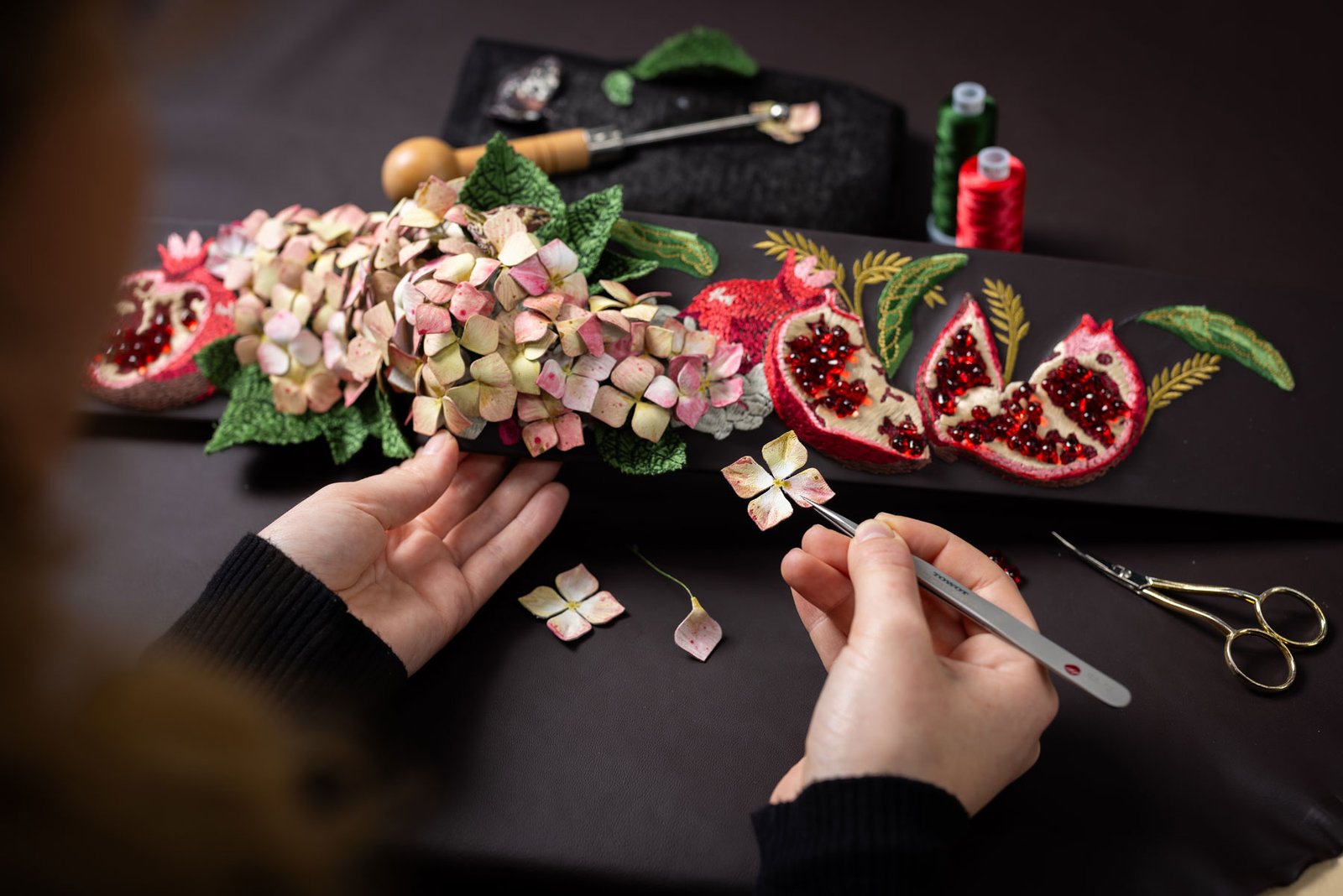
The first composition, “Legacy Craft: Inspired by Still Life”, takes its cue from 17th-century Dutch still life painting and the embroidery traditions revived by the Arts and Crafts movement. Across the Gallery, artisans from the Interior Trim Centre have created a floral and fruit arrangement in sculptural form, using hand-painted leather, thread work, and bead embroidery to transform a static artistic tradition into something far more tactile and immediate.

Its hydrangeas are formed from 50 individual leather flowers, each hand-sculpted and painted petal by petal in graduated pink tones, while the leaves are entirely built from thread using a newly developed three-dimensional embroidery style. The pomegranates, meanwhile, are rendered with 76 hand-sewn beads to replicate the jewel-like translucence of their seeds, with the entire piece requiring more than 250 hours of handwork to complete.
It is an extraordinary exercise in patience and material sensitivity, and one that suggests Rolls-Royce’s understanding of luxury now extends far beyond rarity into the preservation and reinvention of skill itself.

The second work, “Legacy Craft: Inspired by The Draught”, moves into a more architectural and jewellery-like register. Created by specialists from the Interior Surface Centre, it introduces the first hand-sculpted three-dimensional metal within a Rolls-Royce Gallery and combines this with layered 3D veneer and brass elements in a composition informed by draughtsmanship, scribing, Elizabethan and Jacobean strapwork, and the iron frameworks once used to support stained glass.
What begins as a technical drawing etched into smoked Eucalyptus veneer gradually becomes a relief surface and then a sculptural object, culminating in a flower formed from five layers of brass. Each petal is cut by advanced waterjet, engraved by hand with more than 50 lines measuring just 0.2 mm in width, and shaped using tools modified in-house by Rolls-Royce craftspeople.

Here again, the point is not simply beauty, though there is plenty of that, but the quiet assertion that hand and machine are most powerful when working in concert rather than in competition.
This philosophy sits at the centre of the entire presentation. Rolls-Royce has been clear that digital precision and traditional handcraft are not opposing forces, but complementary ones, with technology enabling forms that human hands then refine, individualise, and bring fully to life. In an era so often drawn to speed and simplification, there is something rather reassuring in a luxury house choosing instead to slow the eye down and ask us to notice the detail.

For London Craft Week, that feels particularly appropriate. The event has increasingly become a meeting point for brands, makers, and ateliers intent on showing that craftsmanship still matters not as theatre, but as living knowledge. In that company, Rolls-Royce’s contribution feels entirely at home, offering a reminder that some of the most interesting creative work in luxury today is not happening around trend, but around technique, patience, and the imaginative reuse of the past.
At its best, Bespoke has always been about more than personalisation. What Rolls-Royce is showing in Mayfair is something richer than that, a belief that a motor car can still serve as a site of beauty, scholarship, and artistic risk, and that the future of luxury may depend as much on the survival of rare crafts as on any headline-making innovation.

To support the aims of the Chartered Institute of Journalists and in the interest of transparency, Luxurious Magazine uses Artificial Intelligence (AI) to aid fact-checking, enhance the quality of information, and generate images. Every piece of content is subject to thorough editorial review by experienced journalists to ensure integrity, accuracy, and consistent adherence to the highest ethical standards.


[ad_2]
Source link


No Comment! Be the first one.