
[ad_1]
The exhibition “almost didn’t happen.”
A few years ago, Ed Schad, curator and publications manager at The Broad, a contemporary art museum in Los Angeles, certainly wasn’t feeling optimistic about the prospects for an exhibition of the colorful and playful but also contemplative and thought-provoking work of Japan’s Takashi Murakami.
“Like everybody else, I was in my room looking at a computer screen surrounded by COVID and locked down,” Schad says, speaking at an event on May 15 at the Cleveland Museum of Art. “I had a project going with Takashi, but it was very uncertain. I couldn’t even visit Japan at the time.”
However, Schad found some much-needed perspective from the artist himself, he says, via an Instagram post that, in effect, conveyed that humanity had been through difficult times before.
“He was referring to a smallpox epidemic in the eighth century in Japan that unleashed this time of incredible creativity, incredible art making,” Schad says of Murakami. “And looking over the course of Takashi’s career, this theme kept repeating over and over again.”
Almost exactly three years ago, The Broad was able to host its exhibition, “Takashi Murakami: Stepping on the Tail of a Rainbow,” which is set to open in an expanded form at CMA.

Featuring more than 100 works and taking over much of the museum — including its lower-level special-exhibit spaces, the Kelvin and Eleanor Smith Foundation Exhibition Hall and Gallery, as well as the Key Bank Lobby and the naturally lit Ames Family Atrium — the ticketed “Rainbow” is poised to run from May 25 through Sept. 7, with member previews underway.

“‘Takashi Murakami: Stepping on the Tail of a Rainbow’ is one of the most ambitious exhibitions ever presented at the CMA,” says Emily Liebert, the Lauren Rich Fine Curator of Contemporary Art here at the CMA, reading from prepared remarks at the recent gathering at a preview for members of the media and influencers.
“The exhibition is filled with paintings and sculptures that pulsate with color, sheen and a vibrant energy,” she continues. “Through these qualities, the artist issues an irresistible invitation to enter his world. But Murakami’s art does not stop there. It is, as Ed Schad says, ‘full of trap doors — portals into a complicated and fascinating history of Japan’ and our wider global society.’”

The exhibition’s name, she notes, is taken from the title of a 2014 work by Murakami, “In the Land of the Dead, Stepping on the Tail of a Rainbow,” an 82-foot painting given space in The Kelvin and Eleanor Smith Foundation Gallery, darkly lit and across the hall from its larger sister, the exhibit hall, which is brightly lit and home to pieces that, arguably, are brighter in tone.

Many of the artist’s works, she says, are reflections on earth-shaking events ranging from World War II to the novel coronavirus pandemic.
“The objects on view track a consistent but evolving thread in Murakami’s work of addressing the impact of trauma and disaster on individuals, as manifested not only through grief but also through an outpouring of creativity, religious fervor, and obsessions with a parallel universe found in the digital realm,” Liebert says. “As Murakami explains, ‘I believe we artists are … in the position to provide salvation for the mind and heart.’”

Unlike many past special exhibitions at the museum, such as the past winter’s “Picasso and Paper,” “Rainbow” is not a celebration of a genius who long ago left this world but instead of a person creating today, one active on platforms such as Instagram, as noted, and YouTube.
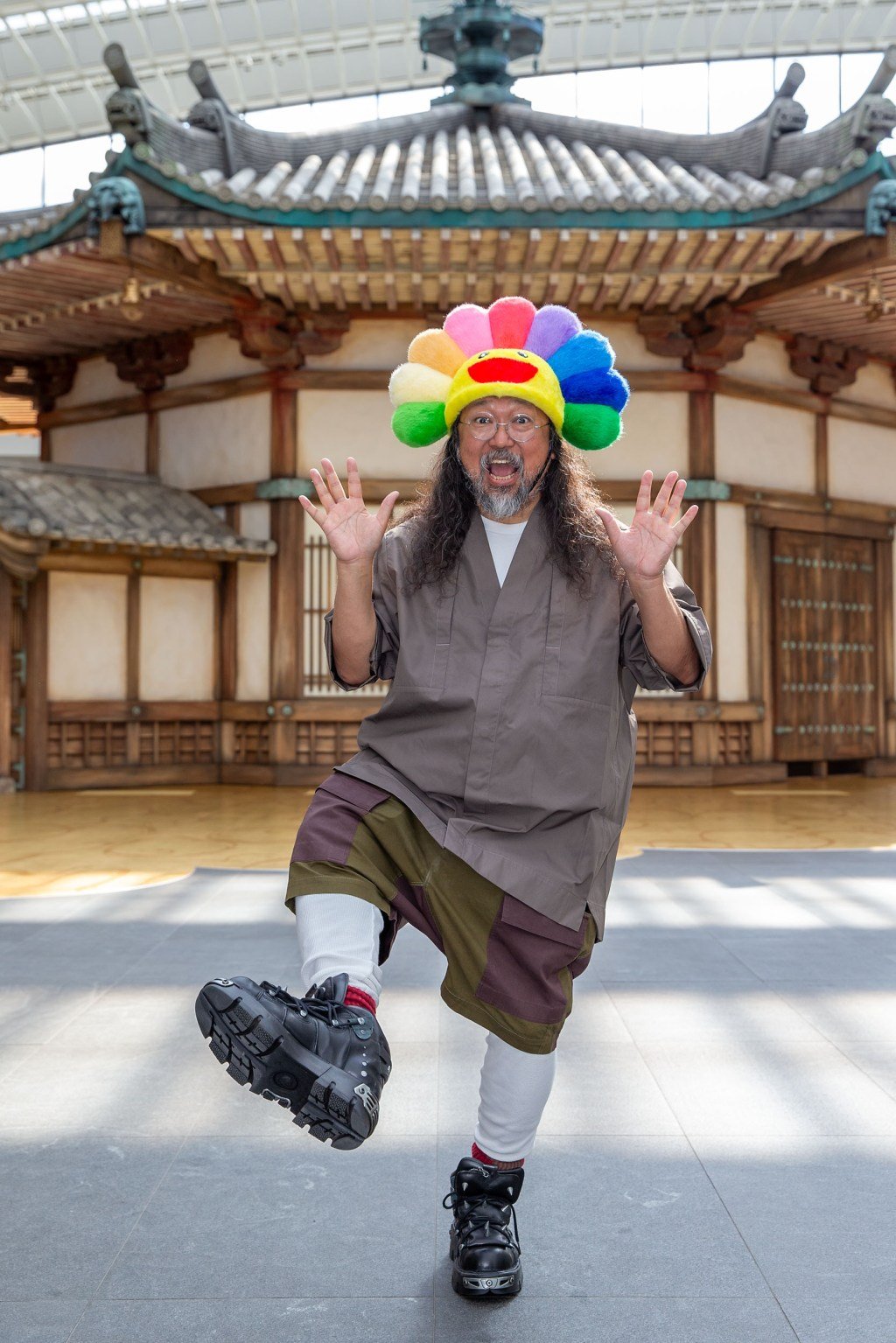
Also in attendance at the event, he at one point poses for playful photos.
And the artist has contributed to the Cleveland-exclusive elements of this show, the most notable — and striking and unavoidable — of which is the massive Yumedono erected in the atrium.

“The full-scale re-creation of the ‘Dream Hall’ from the Hōryūji Temple complex in Nara Prefecture, Japan, (is home to) four soaring paintings by Murakami,” a CMA news release states.
“The original octagonal structure in Nara, Japan, is believed to occupy the same location as the home of Prince Shōtoku Taishi, who converted his father, Emperor Yōmei, to Buddhism in the late 500s CE by calling for the intercession of Buddha to cure the emperor of an illness,” Liebert says. “Upon the emperor’s recovery, Buddhism was allowed formally into Japan. The Nara Yumedono houses a seventh-century Buddhist statue depicting Prince Shōtoku, believed to heal people from suffering. Unique to the Cleveland exhibition, the re-created Yumedono serves as a physical and symbolic anchor for the show.”
The addition is home to four new large-scale paintings Murakami created between 2023 and 2025, “Blue Dragon Kyoto,” “Vermillion Bird Kyoto,” “White Tiger Kyoto” and “Black Tortoise Kyoto,” which, states the news release, emphasize Murakami’s recent fascination with the Japanese city Kyoto as a vital keeper of many of the country’s cultural traditions.

The project was a collaboration with Justin Marks and Rachel Kondo, the husband-and-wife tandem that created the hit FX TV series “Shogun” — an adaptation of the 1975 novel by James Clavell set in feudal Japan — and are working on its sophomore season.
They, too, are at the museum on this day, telling those gathered the partnership began with what Marks says he initially thought was a “cruel” email from someone saying Murakami would like to meet them.
“We thought he was pranking us,” Marks says. “‘This is not kind.’ But, you know, fast-forward to today, and it is really a wild dream to have learned from him.”
Helen Jarvis, the art director and production designer on “Shogun,” also was a key collaborator on the Yumedono.
“This is a transformative space,” Jarvis says in the news release. “Takashi visioned the re-creation of a sacred structure as a portal for the world of the ordinary into the hallucinogenic dream world of his art.”
Another Cleveland-specific endeavor will see, during the exhibition’s run, Murakami — “inspired by a recent visit to the museum,” according to the news release — create four works “being placed in conversation with pieces in the CMA’s permanent collection galleries”: “Bowl Depicting Saint Francis Receiving Stigmata,” “Surya, the Sun God,” “The Dessert” and “Mount Sainte-Victoire.”
“Murakami used software to digitally deconstruct and then reconstruct each selected artwork, adding details that are notably different from the originals,” the release states. “From afar, Murakami’s works look like faithful copies of the originals; when viewed up close, visitors can see and recognize the discrepancies and are forced to adjust their mindset to the new works.”

Why, ultimately, was the acclaimed Cleveland museum an appropriate place for this celebration of an artist whose work, while influenced by elements of Japanese pop culture, such as manga and anime, is rooted in the country’s historical art and architecture?

“At the CMA, we are proud to hold one of the most significant collections of Japanese art outside of Japan, which offers a perfect context for Murakami’s art,” Liebert says. “Just as our historical collections can illuminate the contemporary practice of Murakami, Murakami’s take on history can help us see the past with new eyes. Activating that reciprocal gaze — from history to the present and the present to the past — is an opportunity uniquely available to contemporary programs at encyclopedic museums, and it’s something that we try to do frequently here at the CMA.”
‘Takashi Murakami: Stepping on the Tail of a Rainbow’
Where: Cleveland Museum of Art, 11150 East Blvd.
When: May 25 through Sept. 7 (member previews now).
Tickets: $30, adult; $28, 65 and older; $$15, children 6 to 17 and seniors; children 5 and under and members, free.
Info: ClevelandArt.org and 216-421-7350.
[ad_2]
Source link


No Comment! Be the first one.