
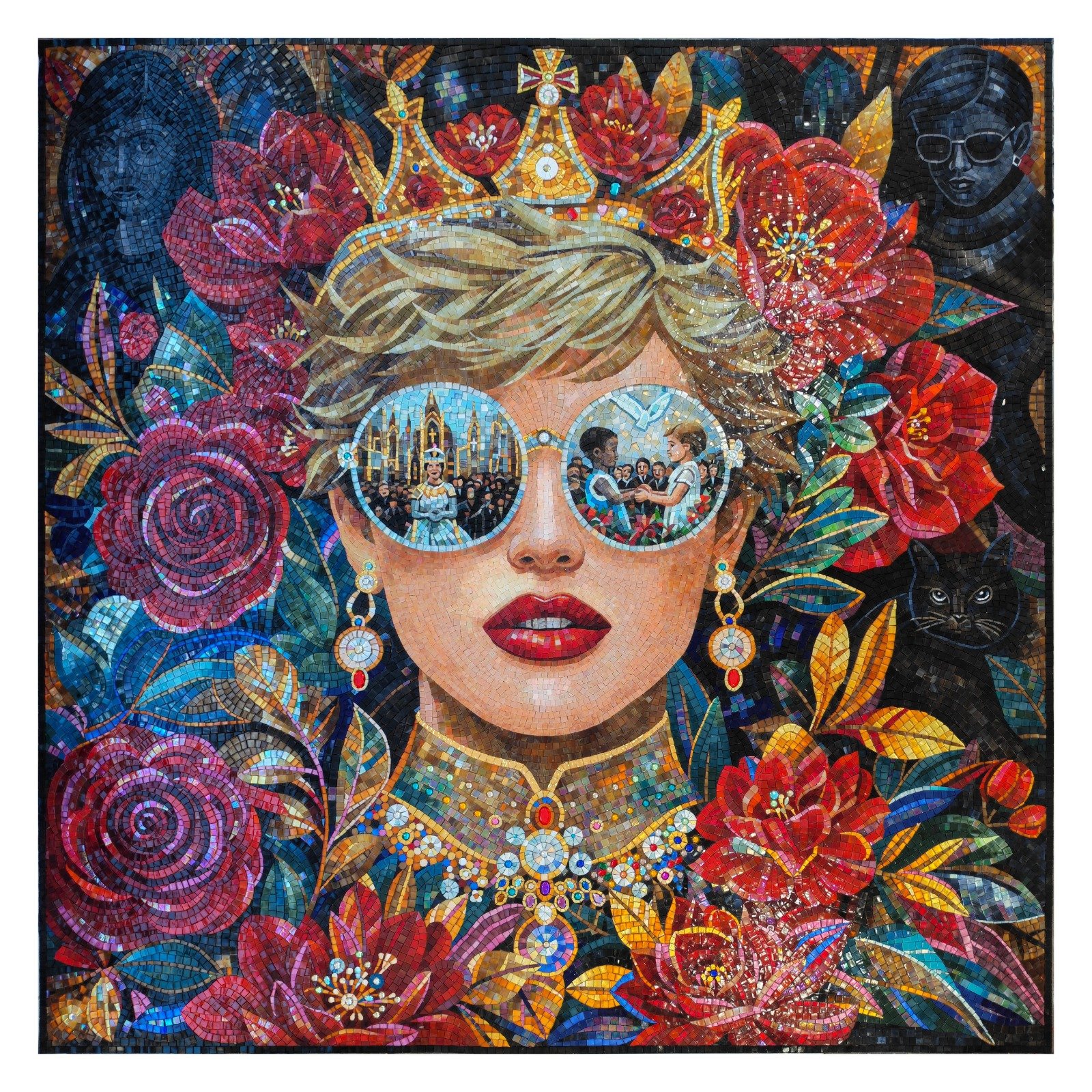
A four-year Diana project, an ambitious new mosaic and a reported £300,000 benchmark. Mr Phantom’s latest chapter brings his artistic and commercial ambitions together, with the studio disclosing neither buyer nor price.
By Nicholas Smith
Art, culture and society | News and analysis
ArtHouseHamptons.com | 26 October 2026
One word has changed the next chapter of Mr Phantom’s Diana project: sold.
The artist’s studio now lists Diana: Final Reflection as off the market. Completed on 22 October, the two-metre mosaic closes a sustained investigation into one of Britain’s most recognisable figures. For an anonymous artist building a public identity through his work, it is an unusually bold calling card: elaborate, emotionally charged and built to hold attention across a room.
The price is the missing piece. The studio’s current listing names neither a buyer nor a transaction figure. London Art Exchange, which represents Mr Phantom, has supplied background describing a previous invitation for offers beginning at £600,000, alongside discussion of a possible acquisition in the middle to upper six figures. A £1 million figure also forms part of the gallery-supplied account. None is a confirmed sale price.
That leaves a potentially significant development awaiting its decisive number. The gallery identifies the £300,000 private sale of The Guardian, reported by FAD Magazine in August, as Mr Phantom’s previous individual high. A confirmed transaction above £600,000 would more than double that benchmark. The possibility gives this completed work a commercial significance beyond its considerable visual impact.
There is already a sequence to examine. FAD reported £200,000 for The People’s Queen, £275,000 for Grandmaster and £300,000 for The Guardian. Those three private sales totalled £775,000, approximately US$1.05 million at the publication’s stated exchange rate. The earlier million-dollar headline concerned three paintings combined. The present million-pound discussion concerns one mosaic, and remains unconfirmed.
The positive signal is that the Diana project already has a reported buying history. Different works have found private collectors at substantial prices. The mosaic therefore enters a story with identifiable milestones behind it. The next disclosed transaction could add another, giving existing collectors a fresh reference point for following the artist’s development.
Yet the object deserves attention before the arithmetic takes over. Across its broad square surface, Diana emerges from a dense arrangement of flowers, a crown, reflective sunglasses and jewellery. Red, green, gold and pale flesh tones compete for attention. The face holds the composition together while details around it invite the eye to wander, double back and discover something previously missed.
The physical construction gives that image its charge. Glass, mirror, ceramic and stone are assembled across four panels into a single portrait. Seen at a distance, the fragments resolve into a familiar face. Closer inspection breaks that familiarity apart. Skin becomes individual decisions about shape and direction. Flowers become cuts, edges and changes of colour. Recognition has to be built. Each small fragment participates in the impact of the whole.
It is a compelling material choice for the idea the gallery places at the heart of the project: repairing the cracks of society. A mosaic requires separate elements to coexist without losing their individual boundaries. Applied to Diana, that process offers a reading of solidarity that is visible in the surface itself. The joins remain part of the picture.
According to London Art Exchange, this latest phase developed over approximately 18 months within a Diana-led body of work spanning four years. The gallery describes Mr Phantom as a committed royalist, drawn to Diana’s charisma and ability to connect across social divisions. That sustained interest gives the portrait a longer artistic history than a single forthcoming anniversary might suggest.
The sunglasses are particularly effective. Their lenses interrupt the royal imagery with smaller scenes of public ceremony and human contact. They ask viewers to consider what Diana saw, alongside how she was seen. Around them, the crown and jewels carry the burden of status, while the flowers soften the image. The portrait moves between grandeur and vulnerability.
That tension helps explain the choice of subject. Diana can be approached through monarchy, fashion, celebrity, charitable work or personal memory. A viewer needs no specialist art education to recognise her. Mr Phantom uses that accessibility as an opening, then makes the picture more complicated through its surface, symbols and competing reflections. The immediate image has further layers to reveal.
There is something fitting about an artist withholding his own face while working so intently on a face the public knows. It creates an exchange between absence and overexposure. Diana’s image carries decades of accumulated meaning, while Mr Phantom’s identity remains deliberately unresolved. The portrait gives those two conditions a shared space, where visibility itself becomes part of what the viewer is asked to consider.
The calendar adds another dimension. 31 August 2027 marks 30 years since Diana’s death. The gallery places the project within preparations for that anniversary. The mosaic is already complete, allowing its next chapter to concern where it might be seen and how audiences respond. Its public life could extend well beyond the private transaction announced by the studio.
For existing Mr Phantom collectors, this is an engaging point in the story. They can place the new work beside earlier acquisitions and examine how the artist’s ambition has developed. A larger, more demanding object can change the conversation around a practice. It gives people another reason to return to the earlier work and consider its place in the wider sequence.
Yesterday’s price is a historical reference. A later transaction can establish a different one. That is the real force behind the familiar art-market fascination with getting there early: the possibility of witnessing an artist grow into a larger public presence. Here, the strongest excitement comes from following the work closely enough to recognise what is changing.
No individual sale automatically reprices every painting or print an artist has made. Each work retains its own scale, date, rarity, condition and ownership history. Nevertheless, an important new piece can sharpen interest in an earlier period. For collectors who already live with Mr Phantom’s work, the Diana mosaic supplies a substantial new chapter to discuss, examine and follow.
Banksy is an understandable reference point when considering an anonymous British artist whose images are designed to carry a public message. His Love is in the Bin, which emerged from the celebrated auction-room shredding, demonstrates how an artwork’s story can become inseparable from the object. Sotheby’s catalogue records that transformation as part of the work’s identity.
Damien Hirst and KAWS offer other useful perspectives. Hirst’s animals in formaldehyde and spot paintings became instantly recognisable elements of his practice. KAWS developed a visual language that travelled between street interventions, popular imagery, objects and galleries. Their careers show different ways an artist’s imagery can become familiar far beyond an initial circle of buyers.
Those are references for understanding cultural recognition, rather than evidence of equivalent prices or stature. Mr Phantom’s opportunity is to build a language audiences recognise as his own. Anonymity may prompt the first question, but pictures must sustain the second look. The Diana mosaic offers plenty to inspect once curiosity about the person behind it has passed.
This is where the work becomes particularly interesting. Its scale suggests confidence. Its intricate construction gives the studio process a visible role in the finished object. Its subject connects with a broad audience, while the surrounding symbols reward sustained attention. Together, those qualities make a persuasive case for treating this as an important moment in the artist’s development.
The chapter has several ingredients that could support a wider phenomenon: a memorable artistic identity, an emotionally powerful subject, an ambitious physical object and a story that can travel beyond the gallery. What makes the combination exciting is the way those elements reinforce one another. The mystery draws attention, Diana makes the image accessible, and the mosaic gives that attention somewhere to settle.
For an early collector, that expanding story can be a considerable part of the pleasure of ownership. A work acquired during an earlier chapter remains the same object, yet its context develops as an artist produces more. New pictures can illuminate old decisions. A recurring subject can become a sustained argument. Following those connections is one of the rewards of collecting an active artist over time.
London Art Exchange says a new PR team will support the next stage of his public programme. That creates an opportunity to bring the work before fresh audiences and explain its making in greater depth. The studio continues to invite exhibition and loan enquiries, even while stating that further purchase offers for the mosaic are closed.
A private sale can remove an artwork from availability without ending its public story. A future display would let viewers test the portrait against the photographs: its scale, changing reflections, texture and presence. For a work concerned with the distance between a public image and a person, that encounter could become the most revealing part of its reception.
For now, the clearest development is a completed mosaic, a studio notice marking it sold and gallery speculation about a possible new record. Mr Phantom has made an object capable of carrying the next stage of his story. Collectors who followed the earlier chapters now have something ambitious to measure them against. The next number will matter. So will the next audience.
This feature draws on published reporting and material supplied by Mr Phantom Studios and London Art Exchange, the artist’s commercial representative.
The Return of Todd Goldman: A New Chapter at London Art Exchange

This is recognition to a different level