
[ad_1]
Having lived in cities across this country since Donald Trump’s first election I have witnessed the unveiling of the Trump Era, a time defined by dissolving rights of U.S. citizens, politics, and the country’s character. From those vantages I have also seen a unification of voices advocating for progressive causes and, to a greater degree, responding to regressive efforts. This advocacy has included protests, often containing art as a tool, like that of the Civil Rights Movement of the 1960s and 1970s.
I’ve spent nearly two decades studying art of the Civil Rights Movement and have often looked at it with reverence, wondering about the emotions, motivations, and energy that brought about its creation. Now, having seen this art made in mass over the last 11 years, I know it to be both more and less sacred; more so with life imprinted into it in front of my eyes and less so with it as a usable tool against oppression. Understanding this art as beautiful and evocative, meant to be held, moved, wrinkled, sun beaten, plastered on walls, and even quickly discarded for changing concerns presents a more holistic understanding of energy and efforts that allowed and continue to allow for these pieces to exist.
Like in the ’60s and ’70s many people have established themselves for the first time as activists, throwing previously held concerns about “not being a good artist” or “not being political” to the wind to create art for numerous marches, rallies, and causes. From these activations we have seen art created as a political tool at numbers not present in several decades. Some of the same messages of that earlier era are reminiscent today; phrases have changed and the issues vary from those of that previous time, but a connecting thread holds strong: people are unified and are using their creativity in a pursuit of justice.
Protests, which have been the stage for this artwork over the last decade plus, have been the largest in U.S. history. These protests, sometimes including as many as 8 million people, have included advocacy for a wide range of causes as many long-held rights of this country’s citizenry have faltered and others have altogether fallen.
The most common mediums seen in these protests include murals, printed posters, and hand-painted posters, all immediate and effective, were also popular during the Civil Rights Movement. Murals, effective for their ease of access and communal creation were used and continue to be used heavily by Black and Chicana/o/x artists. Screen printed and cheaply printed posters have been a fast and effective way for artists to amplify their voice and for community members to share on walls, poles, signs, etc. The communal effort of making screenprints is also effective at uniting artists. Finally, hand-painted posters have always been successful as quickly created and unique artworks, able to address the concerns of any day’s actions.
Our moment’s reflection of an earlier energy and art may not yet have a name — the Black Art Movement, Chicano Art Movement, Feminist Art Movement, etc. — or a historical bookend as things continue to develop under this presidential administration, but there are similarities between these eras. A whole new generation of people, like their elders before them, are uniting and taking up roles as artist activists as their rights and opportunities are threatened and taken.
In this essay I look at some art made in response to Trump-era actions and briefly analyze issues and resemblances to the Civil Rights Movement, Feminist Movement, Student Movement, and Chicano Movement. Finally, I will describe the catalyst that has brought together so many Americans in recent years and how the coalition, utilized in the 1960s and 1970s to great success, is again at play and is again necessary to push back against oppression in this country.

Black Lives Matter (BLM), founded in 2013, a decentralized movement that focuses on highlighting racial inequality for Black Americans, has been a source of unification among people of color in the United States as well as a constant political target for conservatives. Although BLM’s beginning predates the Trump era, BLM actions have continued as part of the larger coalition against regressive U.S. action and support for the organization remains high among Black Americans and people of color. Since the group’s founding, BLM messages have been widely seen in murals and posters like the street mural in front of Dallas City Hall. This rich creative resurgence focused on the equality of Black Americans echoes the Black Art Movement of the ’60s and ’70s, which created art focused on equality in housing, education, voting rights, policing, employment, government representation, and over representation in the Vietnam War.

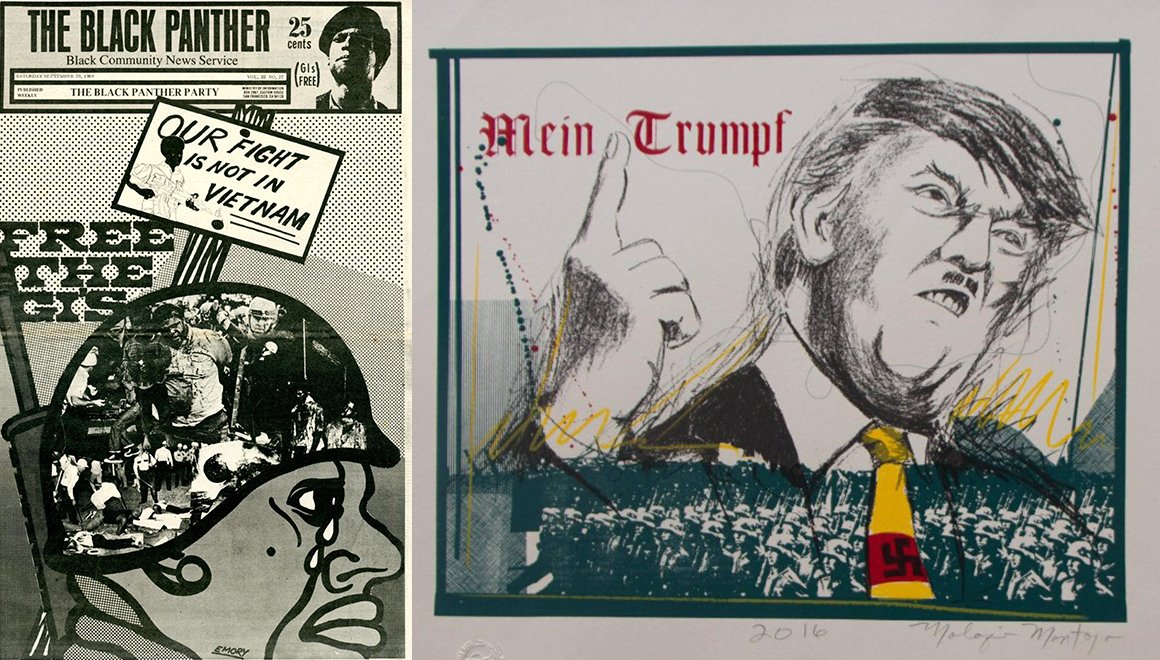
An artist that helped define the aesthetics of ’60s era Black liberation is Emory Douglas, the Minister of Culture for the Black Panther Party. Douglas’ use of bold images and simple sayings, along with cutting messages, mirrors the striking aesthetics and words of many protest posters seen today. A great example of this period’s coalition between groups is the September 20, 1969, cover of the Black Panther publication titled Our Fight is not in Vietnam, that Douglas made in collaboration with the Chicana artist, Yolanda Lopez.
In 2017, in response to the presidential election of Donald Trump, the Woman’s March took place around the world, including millions of people advocating for women and highlighting the misogynistic nature and actions of President Trump. In the ’60s and ’70s, second wave feminists worked for women’s rights. Progress included the right to reproductive autonomy with the 1973 Supreme Court case of Roe v. Wade, legalizing abortion nationwide. This case, overturned in 2022 with the Supreme Court decision of Dobbs v. Jackson Women’s Health Organization, along with other deteriorations of women’s rights, has made women’s bodily autonomy an important cause for many. Signs and posters demanding the return of women’s reproductive rights have been a common sight at rallies across the country.
One of the hard-fought efforts of the 1960s and 1970s was a push for greater educational opportunities at universities, focused on gender and ethnicity. Well-earned victories at universities led to the introduction and creation of African American studies, Chicano studies, ethnic studies, gender studies, Mexican American studies, and women’s studies programs. These programs put into place at universities across the United States, with many in the Southwest, allowed students, for the first time, access to formal education about their backgrounds taught by people of similar backgrounds.

With the passing of Senate Bill 17, banning, diversity, equity, and inclusion offices, these programs have been under attack across the country, with recent decisions to restrict or end these programs in Texas at the University of Houston, the Texas A&M University system, Texas Tech University system, Texas State, Texas Christian University, the University of North Texas, and the University of Texas System. With the dissolution of these programs students again have begun to make their voices heard, holding regular protests across these and other campuses, demanding access to this education, similarly, to demands made in a previous era.
The Chicano Movement of the 1960s and 1970s championed better working conditions, farmworker rights, improved education, equal access to housing, better policing policies, and a stop to the Vietnam War, described by some as a “genocide.”* Minus the effort to end the Vietnam War, those causes continue to be pushed for by Latinx people in the United States. That movement is also a notable precursor to today’s support of immigrants in the U.S. Upon President Trump’s second election, Immigration and Customs Enforcement (I.C.E.) raids greatly increased, widening its targeting of people who have been convicted of felonies to law-abiding and long-contributing members of communities.

These raids, growing largely unpopular even by supporters of immigration enforcement have been a central cause for protestors. Many artists from the Chicano Movement continue resisting these brutal actions. One of those artists, influenced by Emory Douglas, is Malaquias Montoya, the San Francisco Bay screen printer who continues to make protest art, like his piece Mein Trumpf (2016). Art is often seen at protests for immigrant justice like multiple actions at the Dilley Texas I.C.E. detention center, a location notorious for unsafe living conditions of people being held there.

In the 1960s and 1970s a uniting focus was the war in Vietnam. This war, with U.S. involvement lasting 18 years (1955-1973) was highly unpopular among Americans. In our time, the growing distaste primarily uniting protestors is President Donald Trump, his actions, and his administration. His actions, either directly, by judicial appointments, nominations, or administration members, have enacted a litany of regressive initiatives, including the closing of race and gender studies programs, the loss of reproductive rights, attacks on free speech, the brutalization of immigrants, military support of Israel against Palestine, and unprovoked attacks on the sovereign nations of Venezuela and Iran. Looking at the largest series of protests in our country (No Kings), which has included tens of millions of people across all 50 states, this administration is the centerpiece of focus for many protestors. Like the Vietnam War, in our time, the destructive Trump administration is what so many are uniting against.

As previously stated, unlike the Black Art Movement, Feminist Art Movement, and Chicano Art Movement, there is not yet a name for the protest art of this time. A single name for this period may not yet make sense as events continue to unfold, or a name coupled with the largest series of protests — No Kings — might illustrate the coalition of messages represented in today’s protest art.
But the motivation of so many members of so many groups coalescing demands regular study and reflection by historians and art historians alike. Regardless of this art period’s name, its descriptors will include how many people, like in the 1960s and 1970s, who were at once normal citizens, found themselves motivated as artists and activists, to organize and use their creative voice to resist oppression and work toward a better world.
The coalition of various groups in the 1960s was held together under the banner of pushing against large oppressive forces: racial segregation, inequality of women’s rights, a lack of access to education, a lack of farmworker rights, police brutality, the Vietnam War, and others. In this moment, there have been losses of hard-won victories of gender studies, women’s studies and ethnic studies programs, police oversight, women’s rights, diversity, equity, and inclusion (D.E.I.), affirmative action initiatives, and most recently voting rights.
It is important to point out that in the years following the 1970s a reflection on the toxicity held within Civil Rights groups like the Black Panthers, Brown Berets, and the United Farm Workers Union has taken place. In many of these groups a culture of misogyny was often present. Recently it has come to light that Cesar Chavez, a key figure in the Civil Rights Movement, sexually assaulted several women and girls. These revelations have prompted communities around the country to rename roads and schools, as well as paint over murals with Chavez’s face. It is necessary that these faults are also known, so that today’s organizers and members can do their best to avoid them, so that righteousness is present both internally and externally with any group.

It is also important to state that during the 1960s and 1970 a lack of consensus among different groups and even within groups on what actions should be taken and which direction the larger coalition should move in was often present. This kind of tension has also been seen during the Trump era, going back at least as far as the Women’s March in 2017, when call outs of white feminism (feminism that primarily advocates for middle class white women) were made. Differences here and throughout the coalition have persisted.
I still look to the 1960s and 1970s as a road map for resistance, not because of Civil Rights organizations’ central leadership, but because of the coalition of unnamed masses that came together resisting oppression to affect a better world. Today I look at contemporary groups of unnamed people coalescing against a common adversary with a nearly identical respect and awe.
The hard-earned lessons of the 1960s and 1970s can be used in our time to better enable artists to use their skills to win back lost ground. Artists can and have come together to take on the challenges of this moment. They must move into the future without taking victories, freedoms, and justice for granted, because a time may come when artists must come together again to share these lessons with a younger group; what it takes to resist and what role artists must play.
After the first election of President Trump, I asked Malaquias Montoya how he stayed in good spirits while seeing the work of he and his peers fall and people, with ill character and intentions, come to power. He said in no uncertain terms that the Chicano civil rights saying “La Lucha Sigue/The Struggle Continues” remains true and that it is up to each proceeding generation to take responsibility for the freedoms that they hold important. This sentiment is important now more than ever but will continue to be important in moments when middle income life is the norm, liberal progress seems commonplace, and progressive policies are taken for granted. Artists must be vigilant when these things are threatened and when authoritarians and pseudo authoritarians rise, artists must as well.
****
*Rodriguez, Marc Simon. Rethinking the Chicano Movement (New York, NY: Routledge, 2015), 69.
[ad_2]
Source link
No Comment! Be the first one.