
[ad_1]
The phrase “failure to progress” first appeared on Alexa Mazzarello’s birth report after an emergency C-section in 2021. Now, it’s the title of the photographer’s first solo exhibition, which opened on Oct. 4 at the Ottawa Art Gallery. The show features a body of work that transforms clinical language and personal trauma into art.
Twenty hours into labour for her first child, Mazzarello developed a fever. She says that she and her husband, Justin, felt forced to sign papers authorizing a C-section. When the time came for surgery, COVID protocols meant that Justin was barred from the operating room, and left to watch the birth of their son, Henry, through an iPhone in another room.
“I remember thinking, ‘If I die, Justin’s not even there,'” she says. “I felt like I had no choice.”
That experience became the foundation for Failure to Progress, a project Mazzarello has developed over four years while raising two children. A longtime photographer, Mazzarello says her current focus uses fine art to explore motherhood. “My entire art practice was born at the same time as my son was born.”

Inside the exhibition
Free to the public and running through Nov. 2, the works on display are deeply personal and tactile, reclaiming medicalized language and challenging cultural silences around birth.
Among them is 10 Centimetres, 20 Hours, a series of 20 circles representing each hour of Mazzarello’s labour. Installed in a line, the last circle shows Henry’s face, four months after his birth.
“Ten centimetres” refers to how dilated the cervix must be for vaginal birth. “I apparently failed to progress to [10 centimetres],” Mazzarello says. “But I did it. I know I did.”
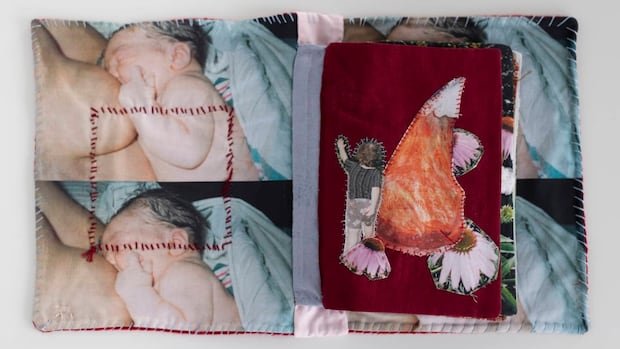
Other works include a sensory book of photographs printed on cotton and made from fabric, thread, parchment paper and surgical suture, as well as new, large-scale prints created from imprints of her daughter Maya’s placenta. In one playful moment of creation, Mazzarello and Henry pressed glittered paper against the organ — kept frozen in Mazzarello’s home — to make tree-like impressions, later enlarged into luminous colour works.
She also introduces interactive elements, including pillows made from her photographs, a video of a doula demonstrating cervical dilation with her hands and a striking wall installation of the words “failure to progress.” Upon Mazzarello’s request, the title is deliberately separated from the remainder of the curatorial text. “I wanted the words to be highlighted, because it’s a term that is terrible, that no woman wants to hear after birth,” she says.

Winning the Project XO Award
The show was made possible through the Project XO Award, presented by the School of the Photographic Arts Ottawa (SPAO). The prize recognizes lens-based artists in the city.
SPAO gallery manager and residency coordinator Katie Lydiatt, who worked closely with Mazzarello during her six-month residency at the photographic art centre, says the project stood out immediately.
“We often see depictions of motherhood, but never birth — it’s [considered] too gruesome,” says Lydiatt. “Although violence is very pervasive in our visual media, there’s something about birth that’s always kind of taboo.”
For her, Mazzarello’s approach was “refreshing” and overdue. “I thought it was very raw, and I wanted to get it out there into the world.”
Ottawa Art Gallery curator Meghan Ho worked closely with Mazzarello to shape how the exhibition unfolds in the building’s Sky Lounge, which Ho describes as “a long hallway with a lot of beautiful natural light.”
Together, Mazzarello and Ho placed certain works at a lower level to ensure children — a central part of Mazzarello’s practice — could engage with the exhibition. Ho also worked with Mazzarello to create labels, explaining things like what a placenta is and how cervical dilation works.
“[Alexa] speaks about wanting to demystify the experience of birth,” Ho says. “[The labels] are just a little bit of additional information for some folks who might not know.”

Reframing motherhood and art
While the exhibition confronts the feeling of medical coercion, pain and dismissal within the medical system, it also underscores joy, resilience and play. Mazzarello insists that motherhood has enriched, rather than diminished, her art.
“My children bring a lot to my art practice, a ton,” she says. “My practice has loosened. I’m way more open minded.”
For Mazzarello, the show is not just about her own story, but about starting a conversation. “I hope that it allows people to think, ‘Oh yeah, that was a shitty experience. I don’t need to accept that kind of care.'”
Failure to Progress is also about refusing to compartmentalize life as an artist and life as a parent. Mazzarello frequently involves her children in the process — whether through making placenta prints with her son or turning everyday family life into material for her work.
As she explains, it’s about imagining “what happens when I admit that I’m a mother instead of hiding it. Everything can change.”
Alexa Mazzarello: Failure to Progress runs until Nov. 2 at the Ottawa Art Gallery (50 Mackenzie King Bridge) in Ottawa.
[ad_2]
Source link
Other Articles

No Comment! Be the first one.