
[ad_1]
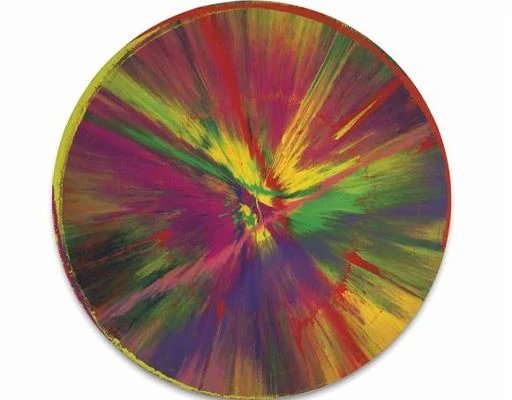
Damien Hirst’s Instagram bio reads thus: Artist.
Short and sweet, simple, straightforward. Right? But Hirst supposedly is not just any artist, but one of the biggest today. A short google search for “most famous living artists” or “leading contemporary artists” or similar phrasings doesn’t result in a single list that doesn’t include the provocation-loving Brit. And Hirst is not just an artist, but a very, very rich one. By most accounts he tops that list, too, with a net worth of hundreds of millions of dollars. That in itself is no reason for shame, as he is a self-made man who earned his fortune with dedication and determination.
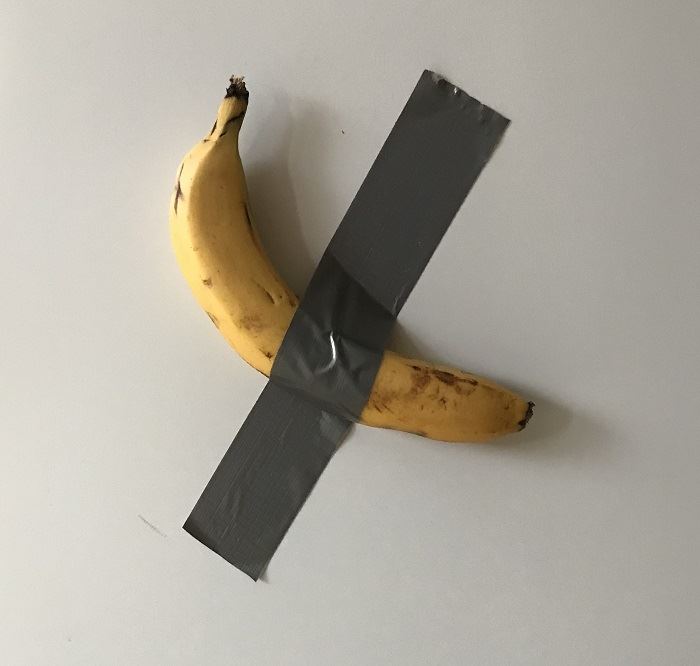
Not the real Comedian
And while Hirst is a constant in art headlines, he most recently popped into my mind by association, namely through Maurizio Cattelan’s infamous artwork Comedian – that duct-tape Banana he presented at Art Basel Miami Beach in 2019, costing $130,000. Recent headlines told of another of those oh-so-funny-and-courageous individuals who thought it would be original to remove the displayed fruit from the wall and eat it. This occurred in the Leeum Museum of Art in Seoul, South Korea. The fruit was promptly replaced, of course, and Cattelan reportedly shrugged the stunt off. Justifiably so, because any specific banana does not represent this work and has to be replaced on an almost-daily basis anyway. But the reason this reminded me of Hirst is because a couple of months after premiering the three-edition Comedian in 2019, Hirst revealed in an Instagram post that he tried, and failed, to get Cattelan to issue another edition for him in exchange for any of his artworks. In a lengthy article we explained at the time how and why this was questionable, how it exposed Hirst’s lack of integrity, and moreover how it made Hirst the number one target of the stunt. From our article in 2020:
The artwork was created and sold as an edition of three, and who more than an artist should understand the unsavory request of creating another one due to the prominence or deep pockets of the buyer. This didn’t seem to be a consideration for Hirst, nor did he understand that offering his own work in exchange didn’t provide an attractive incentive for Cattelan – despite the fact that the cost of the duct tape, banana, and ink on the ap certificate amount to less than one dollar, which he then could have exchanged for an artwork worth millions.
In the meantime, Hirst provided his critics with easy ammunition to question whether he stayed true to his own statement made to Flash Art in 2010: “It’s important to make sure that the art takes precedence over the money. Most people worry that somehow you lose your integrity.”
Almost three years have passed since then, turbulent ones, that not only saw a pandemic, war in the Western hemisphere, and economic turmoil, but also technological leaps that can be compared to the dawn of the internet or the invention of smartphones. The art market so far largely withstood the former geo-political developments, but it was deeply impacted by the latter. Cryptocurrencies had been around for a decade or so, but when NFTs caught global attention in early 2021, it became all the rage in the art market, as many traditional artists ventured to create their own, and it lead auction houses to not only begin offering NFTs at even the most important sales, but they scrambled to accept cryptocurrencies as payment (as NFTs are nothing else but a playground for crypto millionaires who need to spend their money on something). It took less than a year and a half for the world to become disillusioned with the haughty promises of blockchain-powered equality, but not to worry – just as crypto and NFTs crashed and burned, a new phoenix rose from its ashes. Now it’s all about ChatGPT and Artificial Intelligence. Of the abundance of functions AI has to offer, art, or “art” generators in the form of Midjourney, DALL-E, and many more, is one of the most popular. We discussed the ethics of that here.
[ad_2]
Source link
Other Articles

Art investments stabilizing among HNWIs in 2024: UBS, Art Basel
Nelson Atkins to highlight historical glass work in new exhibition
No Comment! Be the first one.