
[ad_1]
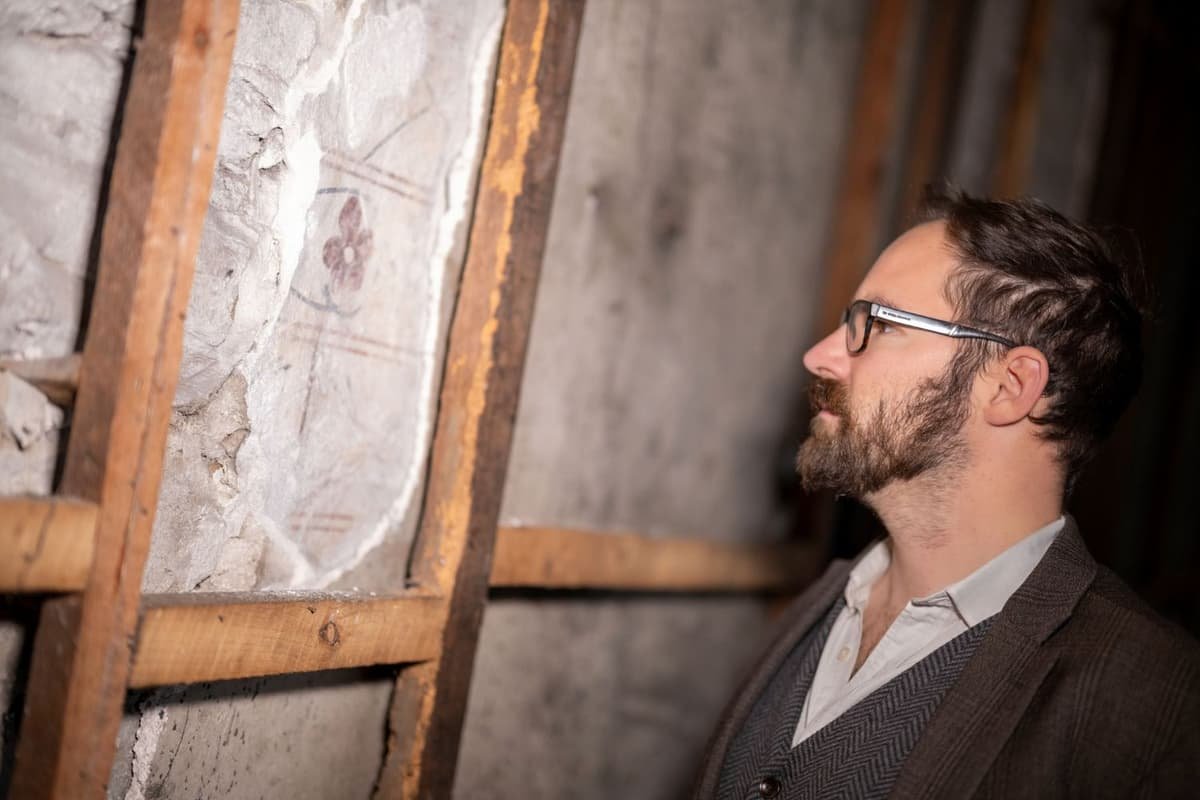
A hidden section of a medieval wall painting dating back at least 700 years has been uncovered at one of Wearside and England’s most iconic landmarks.
The “sensational discovery” of the decorative artwork, thought to date from the late 13th to early 14th Centuries, was made during renovations at Durham Castle.


The painting – made up of an outlined masonry pattern with a central flower and stem motif – had been covered over by plasterwork and then 1950s wall panelling.
Durham University experts say such decoration confirms that the part of the castle where it was uncovered – known since the 19th Century as the Senate Suite – was a “high-status” area in the Middle Ages.
Their investigation has revealed an extensive level of redecoration and alteration over hundreds of years at the Castle, which was once the seat of the powerful Prince Bishops of Durham.

Project lead Dr Andrew Ferrara, of Durham’s department of archaeology, said: “The uncovering of this fragment of medieval wall painting is an absolutely sensational discovery.
“It’s an incredibly rare survival in such an important castle site and really underscores the power and status of the medieval bishops of Durham.”
Founded in 1072, Durham Castle forms part of the city’s UNESCO World Heritage Site alongside Durham Cathedral, and is home to University College with some students resident there.
The recent renovations also uncovered several blocked openings, including two rectangular windows.
The blocking of the windows is thought to date from the 1540s when Bishop Cuthbert Tunstall began building work on the room on the other side of the wall, turning it into a chapel.
The stonework still retained an oyster shell, jammed into the infill, which the research team say may be the remains of a snack for one of the 16th Century masons.
Other discoveries included evidence of the Castle’s historic subsidence in the shape of a zigzagging crack across the stonework.
Archaeologists say the crack was caused by the north wall pulling away from the overall structure and threatening to collapse down the slope.
They believe that happened early in the castle’s history as an angled buttress was added to the external north wall for additional support in the 13th or 14th Century.
Professor Karen O’Brien, Durham University’s Vice-Chancellor and Warden, said: “Durham Castle has been a living space of learning and community for almost 1,000 years.
“To make a wonderful discovery such as this medieval painting on our own doorstep is further evidence of Durham’s very special history and heritage.
“Together with Durham Cathedral we are proud custodians of Durham’s UNESCO World Heritage Site.
“We will continue to explore, safeguard and renew this historic site for future generations.”
Martin Lowe, Historic England Inspector of Historic Buildings and Areas for the North East and Yorkshire, added: “This is a beautiful and rare detail of Durham Castle, uncovered thanks to some very careful work.
“We look forward to seeing the findings of the research into this important discovery.”
The research team, including Durham archaeology students, also sampled plaster and mortar from different construction phases for further lab testing.
People can learn more about the discovery as part of the County Durham and Darlington Archaeological Day at Durham University this Saturday (March 21).
[ad_2]
Source link


No Comment! Be the first one.